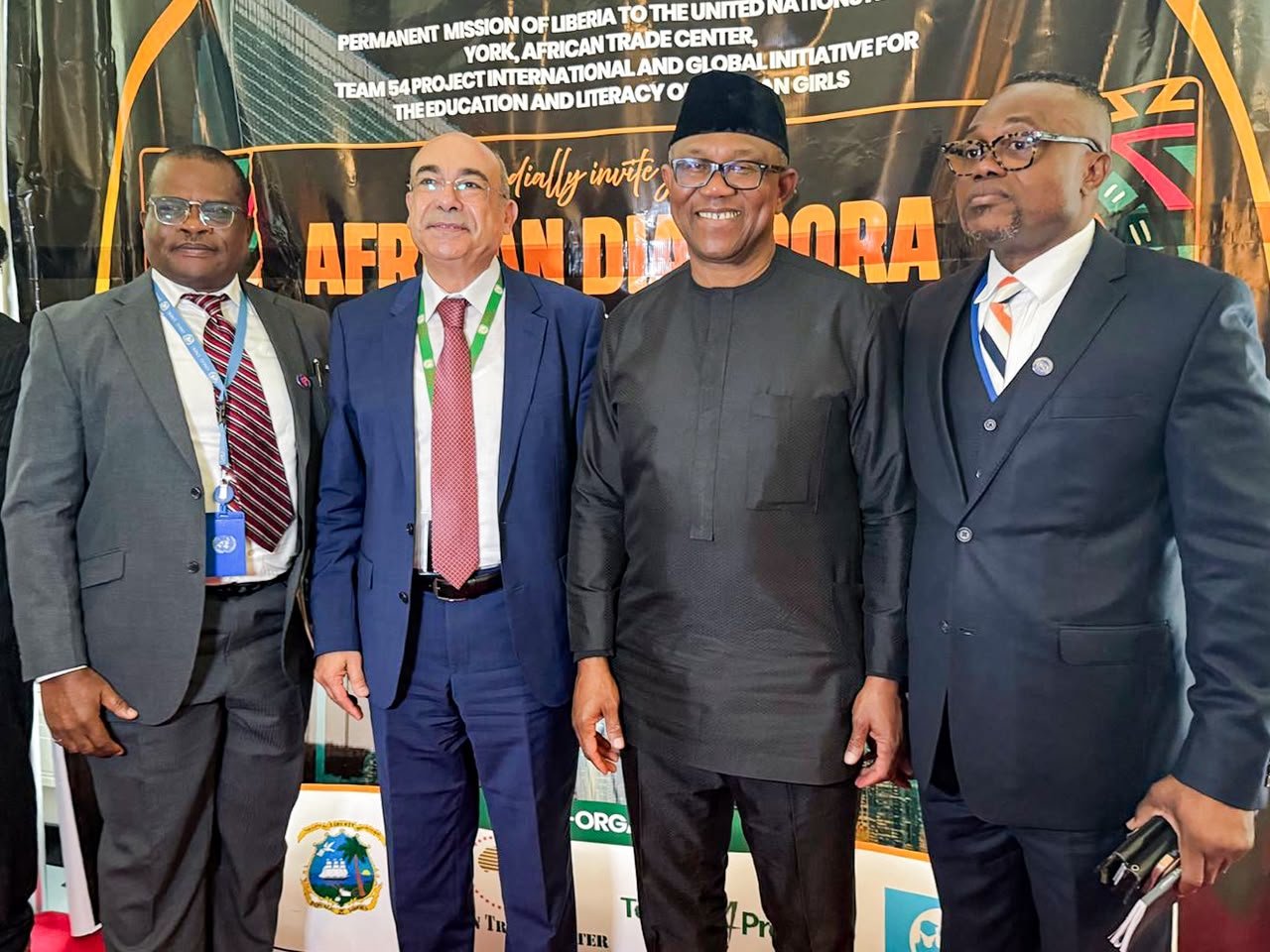
Peter Obi, the presidential candidate of the Nigeria Democratic Congress (NDC), has called on Africans in the diaspora to become active partners in the continent’s development by championing good governance, institutional reforms and sustainable economic growth.
Obi made the call while delivering the keynote address at Mandela Hall, the African Union Permanent Observer Mission to the United Nations in New York, on Friday, July 10, 2026. Speaking on the theme, “The Role of the Diaspora African in Sustainable Development across Africa,” he argued that Africa possesses enormous natural and human resources but continues to lag behind because of poor leadership and weak governance.
According to Obi, Africa remains the richest continent in terms of natural endowments and human capital, yet millions of its citizens continue to live in poverty. He described the paradox as one of the greatest challenges confronting the continent, stressing that the solution lies not in the absence of resources but in the quality of leadership.
He noted that Africa is the world’s second-largest continent by landmass, spanning more than 30 million square kilometres, and is also the second most populous continent with a population exceeding 1.5 billion people. More importantly, he said, the continent is blessed with the world’s largest youthful population, with over one billion people in their productive years.
Obi explained that this youthful demographic represents one of Africa’s greatest competitive advantages, particularly when combined with the continent’s vast agricultural potential. According to him, Africa possesses nearly one billion hectares of arable land, with approximately 60 per cent still uncultivated, giving it the capacity not only to achieve food security but also to become the world’s leading food-producing region.
Despite these immense advantages, he lamented that Africa continues to account for the largest concentration of people living in extreme poverty.
Citing global poverty statistics, Obi noted that of the estimated 800 million people living in extreme poverty worldwide, almost 60 per cent reside in Africa. This translates to about 480 million people, with countries such as Nigeria and the Democratic Republic of the Congo among the worst affected.
He observed that nearly one in every three Africans lives in extreme poverty, while the continent also bears the highest burden of multidimensional poverty, a situation he described as unacceptable considering Africa’s abundant resources.
According to him, the obvious question is why a continent so richly endowed continues to struggle with underdevelopment and widespread deprivation.
Obi argued that the answer lies in what he described as the “missing link”—competent leadership.
He maintained that Africa’s greatest challenge is not a shortage of natural resources or opportunities but the absence of leaders with the capacity, integrity and commitment to transform those resources into prosperity for the people.
“The missing link is competent leadership with capacity, compassion, character and commitment to good governance,” he said.
The former Anambra State governor stressed that sustainable development cannot be achieved without leaders who are genuinely committed to transparency, accountability and responsible governance.
According to him, once Africa gets leadership right, many of its current challenges—including poverty, unemployment, insecurity and underdevelopment—will begin to diminish as governments focus on investing in people and productive sectors of the economy.
Obi then turned his attention to Africans living abroad, describing them as indispensable partners in the continent’s transformation.
He said the African diaspora occupies a unique position because many of them live and work in countries where institutions function effectively, democratic accountability is respected and governance systems operate more efficiently.
For that reason, he urged them not to remain passive observers but to actively contribute to shaping Africa’s future.
According to Obi, members of the diaspora should use their experiences and global exposure to advocate for good governance across the continent.
He encouraged them to speak openly whenever governments fail to uphold democratic principles, insisting that their voices carry significant influence both internationally and back home.
“Even where you cannot vote, your voices matter,” he said.
“They should be heard both at home and abroad whenever things are going wrong on our continent.”
He urged Africans abroad to challenge public officials constructively whenever they visit foreign countries, encouraging them to demand accountability and remind political leaders of their responsibilities to citizens.
“Stand firmly for what is right. Speak truth to the leaders who visit you. Let them know where they are getting it wrong. That is what some of us have continued to do,” Obi stated.
Beyond advocacy, he said, the African diaspora has an equally critical role to play in driving economic development through investments, technology transfer, skills acquisition, education and innovation.
To support his argument, Obi cited examples from countries whose remarkable economic transformations were significantly influenced by their diaspora communities.
He pointed to Japan’s rapid industrialisation following the Meiji Restoration of 1868, noting that the country’s decision to invest heavily in education and global knowledge exchange enabled Japanese professionals who had studied abroad, particularly in Germany, to return home and spearhead technological advancement and industrial growth.
According to him, Japan’s experience demonstrates how nations can harness the knowledge and expertise of their citizens abroad to accelerate national development.
He also highlighted China’s extraordinary economic transformation as another example of the positive impact of diaspora engagement.
Obi recalled that China’s reforms under former leader Deng Xiaoping, beginning in 1978, placed strong emphasis on education, innovation, industrialisation and global economic integration.
Those reforms, he explained, created an enabling environment that encouraged millions of Chinese professionals and entrepreneurs abroad to contribute their expertise, investments and technology to the country’s development.
He noted that China’s remarkable progress stands in sharp contrast to Africa’s continued struggle with poverty.
“In 1980, China had more people living in poverty than Africa. Today, China has drastically reduced extreme poverty, while Africa continues to battle the challenge,” Obi observed.
He said the comparison illustrates what visionary leadership, strategic planning and effective utilisation of human capital can achieve.
Obi concluded by urging Africans across the world to see themselves not merely as observers but as active stakeholders in the continent’s future. He stressed that Africa possesses every ingredient necessary for prosperity—from abundant natural resources and fertile land to a vibrant youthful population—but must now cultivate the leadership and institutional capacity required to unlock that potential.
He expressed confidence that with accountable leadership, stronger institutions and meaningful contributions from Africans in the diaspora, the continent can reverse decades of underdevelopment and build a future defined by inclusive growth, innovation and sustainable prosperity for all.