The Vatican has formally declared members of the Society of Saint Pius X (SSPX), a breakaway traditionalist Catholic group, to be in schism and excommunicated after the society proceeded with the ordination of four bishops without the approval of Pope Leo XIV.
The decision, announced on Thursday, July 2, marks one of the strongest disciplinary actions taken by the Holy See against the group in decades and underscores Pope Leo XIV’s determination to preserve unity within the Roman Catholic Church.
The Vatican’s Dicastery for the Doctrine of the Faith issued a decree stating that the four newly ordained bishops, together with the two bishops who participated in the episcopal consecration, have automatically incurred the penalty of excommunication after carrying out the ordinations in direct defiance of papal authority.
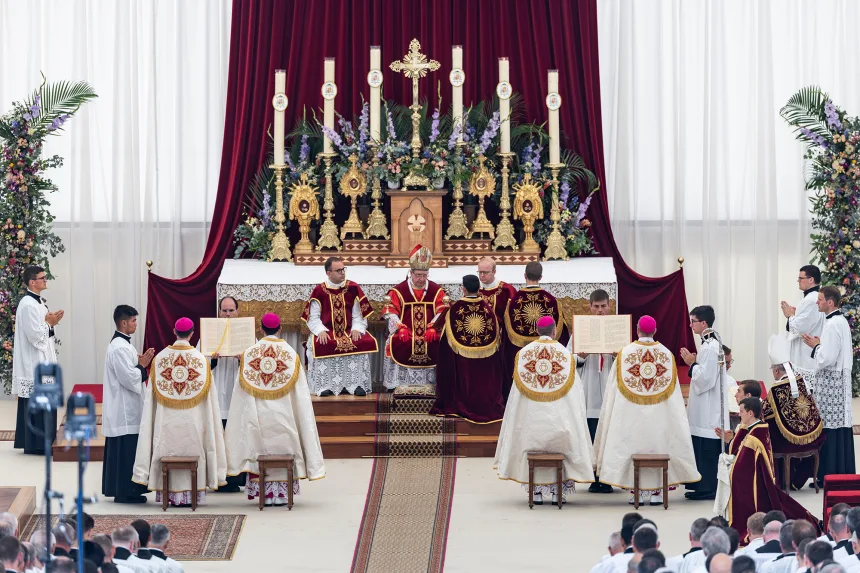
The ordinations took place on Wednesday despite repeated warnings from Pope Leo XIV urging the society to cancel the ceremony and avoid actions that would further deepen divisions within the Church.
According to the Vatican, the unauthorized ordinations constitute a schismatic act because they reject the authority of the Pope and undermine the hierarchical unity upon which the Catholic Church is founded.
Excommunication is the Church’s most severe ecclesiastical penalty and bars those affected from receiving the sacraments or exercising legitimate ministry within the Catholic Church until reconciliation is achieved.
In an explanatory note accompanying the decree, the Vatican clarified that the sanctions extend beyond the six bishops directly involved in the ceremony.
The Holy See declared that priests belonging to the Society of Saint Pius X, as well as lay faithful who formally adhere to the group’s schismatic position, are likewise considered to be in schism and are subject to excommunication.
The decree also warned Catholic clergy and lay faithful worldwide against formally associating with or supporting the society, stating that anyone who knowingly joins or publicly adheres to the group’s schismatic position risks incurring automatic excommunication under canon law.
The Vatican’s latest action followed a final appeal issued by Pope Leo XIV on Tuesday, during which he described the planned episcopal ordinations as an act of “extreme gravity” that would constitute a grave sin against the unity of the Church.
Despite the Pope’s warning, the society proceeded with the consecration ceremony, prompting the Vatican to impose sweeping canonical sanctions.
Later on Thursday, the Vatican’s doctrinal office outlined the conditions under which priests affiliated with the SSPX could eventually be restored to full communion with the Catholic Church.
According to Vatican News, any priest seeking reconciliation must personally write to Pope Leo XIV requesting that the penalty of excommunication be lifted.
Applicants must also make a formal profession of the Catholic faith, pledge obedience to the Pope, and undertake not to publicly oppose the Pontiff or the official teachings of the Church.
Other canonical requirements may also apply before reconciliation can be granted.
As of Thursday evening, Pope Leo XIV had not issued any additional public statement following the ordinations or the publication of the decree.
However, Vatican Secretary of State Cardinal Pietro Parolin expressed profound sadness over the developments, describing the unauthorized consecrations as a serious rupture of ecclesiastical unity.
He said the ordinations represented a direct violation of the Church’s hierarchical structure and inevitably attracted the canonical sanction of excommunication.
The Society of Saint Pius X has maintained a complicated relationship with the Vatican for more than five decades.
The organization was founded in 1970 in Switzerland by French Archbishop Marcel Lefebvre, who strongly opposed several reforms introduced by the Second Vatican Council during the 1960s.
Five years after its establishment, the society was officially suppressed by the Bishop of Fribourg following disagreements over its teachings and activities.
The conflict reached a major turning point in 1988 when Archbishop Lefebvre ordained four bishops without the approval of Pope John Paul II.
Those ordinations resulted in the excommunication of the bishops involved, although the sanctions at that time were limited primarily to those who participated directly in the episcopal consecrations.
The latest Vatican decree goes considerably further by extending the sanctions to priests and lay members who formally align themselves with the group’s schismatic position.
During the pontificate of Pope Francis, the Vatican had sought to maintain dialogue with the SSPX despite ongoing theological disagreements.
Francis granted priests of the society faculties to validly hear confessions and authorized them to witness marriages under certain conditions in an effort to promote reconciliation.
However, the new decree issued under Pope Leo XIV reverses much of that accommodation.
According to the Vatican, marriages celebrated by SSPX clergy and confessions heard by the society will no longer be regarded as valid because the group now stands outside full communion with the Catholic Church.
Despite the severity of the sanctions, the Vatican emphasized that the Church continues to hope for reconciliation.
The explanatory note stressed that the Church, “as a caring mother,” remains ready to welcome back with sincere affection all those who genuinely desire to return to full communion with the Holy See.
At the heart of the dispute lies the Society of Saint Pius X’s rejection of several teachings of the Second Vatican Council.
The group opposes the Council’s teaching on religious freedom, ecumenism, interfaith dialogue and many liturgical reforms introduced after the Council.
Among its principal objections is the celebration of Mass in local languages instead of exclusively in Latin, a change that became one of the most visible reforms of modern Catholic worship.
The society has also rejected aspects of the Council’s approach to relations with other Christian denominations and non-Christian religions.
One of the Council’s landmark achievements was its explicit condemnation of antisemitism and its encouragement of dialogue with the Jewish community, positions that the SSPX has long criticized.
Since assuming the papacy, Pope Leo XIV has consistently identified the preservation of ecclesiastical unity as one of the central priorities of his pontificate.
Addressing journalists on June 16, the Pope noted that the Lefebvrist movement continued to reject fundamental elements of Catholic teaching, particularly those flowing from the Second Vatican Council.
Commenting on the planned episcopal ordinations, he acknowledged that the society had made its own choice but insisted that the Catholic Church must continue moving forward in fidelity to its teachings and institutional unity.
The Society of Saint Pius X maintains an active presence in several countries, including the United States.
Its American headquarters is located in Missouri, while its principal seminary for priestly formation operates in Dillwyn, Virginia.
One of the bishops consecrated during Wednesday’s ceremony was Father Michael Goldade, the rector of that seminary.
Speaking after the ordinations, Goldade sharply criticized the contemporary Catholic Church, describing what he called the “modernist church” as “a desert that kills everything that it touches.”
His remarks further highlighted the deep theological divide separating the society from the Vatican.
With the latest decree now in force, the Vatican has signalled that it intends to defend the unity and authority of the Catholic Church while leaving open the possibility of reconciliation for those willing to return to full communion under the authority of Pope Leo XIV.