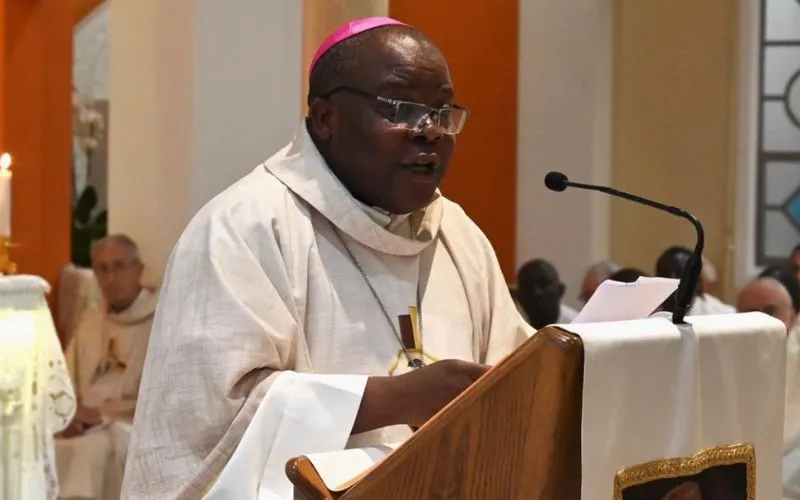
Mozambique has been thrown into mourning following the tragic death of Bishop Citora Afonso, a respected Catholic cleric whose lifeless body was discovered on Saturday at his residence in the city of Quelimane, located in the country’s central Zambezia Province.
The shocking incident has sent waves of grief through the Catholic Church and the wider Mozambican society, with church leaders, government officials, and citizens demanding a thorough and transparent investigation into the circumstances surrounding his death.
Bishop Afonso, 54, was found dead under what church authorities have described as mysterious circumstances. The nature of the incident has raised serious concerns among religious leaders and members of the public, who are seeking answers about what happened to the cleric known for his dedication to pastoral service and community development.
Officials from Mozambique’s Criminal Investigation Service have confirmed that preliminary investigations indicate the bishop died from a gunshot wound to the chest.
Speaking to journalists outside the residence where the tragedy occurred, police spokesperson Maximino Amilcar disclosed that early findings suggest the bishop was struck by a single bullet.
According to Amilcar, investigators have classified the case as a homicide involving the use of a firearm, although authorities have not yet established a motive for the killing or identified any suspects.
“This is a case of murder by gunshot,” Amilcar said while briefing members of the media.
He explained that investigators were carefully examining all available evidence and interviewing potential witnesses in an effort to reconstruct the events that led to the bishop’s death.
The police spokesman stressed that it would be premature to draw conclusions at this stage, assuring the public that additional information would be released as the investigation progresses.
The killing has sparked widespread concern throughout Mozambique, where Bishop Afonso was regarded as a dedicated servant of the Church and an influential moral voice within society.
The Episcopal Conference of Mozambique expressed profound sorrow over the tragedy and called for an urgent investigation to establish the truth behind the bishop’s death.
In a statement issued shortly after news of the incident became public, the church body described the circumstances surrounding the killing as deeply troubling and emphasized the need for justice.
Church leaders noted that Bishop Afonso was discovered lifeless under conditions that remain unclear and require immediate clarification from law enforcement authorities.
The conference urged investigators to leave no stone unturned in uncovering the facts surrounding the incident and identifying those responsible.
The statement also highlighted the bishop’s commitment to pastoral ministry and his devotion to serving both the Church and society.
For many members of the Catholic faithful, the tragedy is particularly painful because Bishop Afonso had only recently assumed leadership of the Diocese of Quelimane.
His appointment was welcomed with enthusiasm by parishioners and clergy who viewed him as a compassionate leader capable of strengthening the Church’s mission in the region.
Many had high hopes for his tenure and believed he would play a vital role in advancing pastoral outreach, youth development, and social justice initiatives within the diocese.
His sudden and violent death has therefore left the Catholic community in shock and disbelief.
Messages of condolence have continued to pour in from across the country and beyond as church members struggle to come to terms with the loss.
Mozambique’s President, Daniel Chapo, also paid tribute to the slain bishop, describing his death as a significant loss not only to the Catholic Church but to the entire nation.
In a statement issued after the incident, the president expressed deep sadness and extended his condolences to the bishop’s family, the Catholic community, and all Mozambicans affected by the tragedy.
President Chapo described Bishop Afonso’s passing as “an irreparable loss for Mozambican society,” noting that the cleric’s contributions extended far beyond religious ministry.
According to the president, Bishop Afonso dedicated his life to promoting peace, unity, compassion, and service to humanity.
He noted that the bishop’s influence touched the lives of countless people, regardless of their religious affiliation, making his death a matter of national concern.
Born in Mozambique, Bishop Afonso devoted decades of his life to religious service and missionary work.
Throughout his ecclesiastical career, he served in various capacities both within Mozambique and abroad, earning a reputation for humility, commitment, and pastoral excellence.
Before becoming a bishop, he undertook several assignments in different countries, including the Democratic Republic of Congo and Italy, where he gained valuable experience in ministry and missionary outreach.
His international exposure helped shape his vision of the Church as a force for social transformation and human development.
In 2023, he was appointed Auxiliary Bishop of Maputo, one of the most significant positions in the Catholic hierarchy in Mozambique.
The appointment marked a major milestone in his religious career and reflected the confidence that church authorities had in his leadership abilities.
His tenure as Auxiliary Bishop further enhanced his profile within the Church, leading to greater responsibilities and recognition.
In July 2025, Pope Leo XIV appointed him Bishop of Quelimane, entrusting him with the pastoral leadership of one of Mozambique’s important dioceses.
The appointment was seen as an acknowledgment of his dedication and service to the Church.
Unfortunately, his time in the diocese would prove tragically brief.
Less than a year after assuming office, his life was cut short in circumstances that continue to puzzle investigators and devastate the faithful.
The killing has also reignited broader conversations about security, violence, and the protection of religious leaders in Mozambique.
Human rights advocates and civil society organizations have joined church leaders in demanding accountability and urging authorities to ensure that those responsible are brought to justice.
Many observers have warned that attacks on religious figures can have far-reaching consequences, not only for faith communities but also for social cohesion and public confidence in the rule of law.
As investigations continue, the nation remains united in grief and anticipation of answers.
For now, Bishop Afonso is being remembered as a devoted shepherd, a committed missionary, and a compassionate servant of God whose life was dedicated to uplifting others.
His untimely death has left a void in the Church and in Mozambican society, while the unanswered questions surrounding his killing continue to fuel calls for truth, justice, and accountability.
As family members, parishioners, fellow clergy, and government officials mourn his passing, many hope that the ongoing investigation will provide clarity and ensure that those responsible for the crime are held accountable.