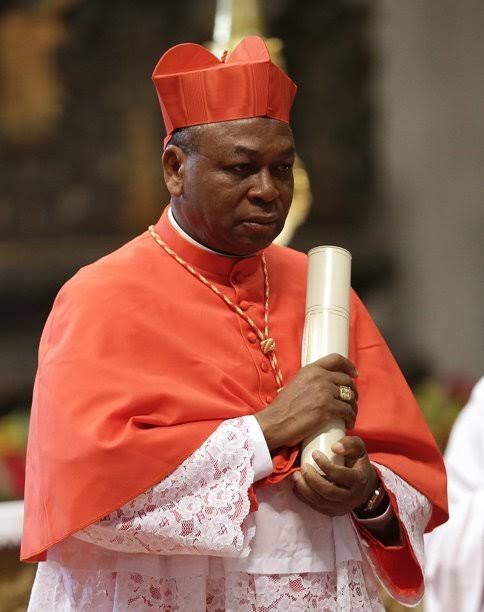
The Minister of the Federal Capital Territory (FCT), Nyesom Wike, has questioned the neutrality of the Archbishop Emeritus of the Catholic Archdiocese of Abuja, Cardinal John Onaiyekan, insisting that the senior cleric was not impartial during the 2023 general election.
Wike made the remarks during a media parley in Abuja on Tuesday while reacting to the controversy that followed comments made by Cardinal Onaiyekan after a recent meeting between President Bola Ahmed Tinubu and members of the Catholic Bishops’ Conference of Nigeria (CBCN).
The controversy began after the cardinal granted a television interview in which he said individuals around President Tinubu were presenting an overly optimistic picture of Nigeria to him. Onaiyekan also suggested that the President appeared more focused on securing victory in the 2027 presidential election than on addressing the country’s pressing challenges.
His comments attracted reactions from the Presidency, with presidential aides criticising him for discussing aspects of what they described as a private engagement with the President.
Responding to the matter, Wike argued that public interventions by religious leaders should reflect balance and fairness. According to him, criticism of government is legitimate, but it should be accompanied by acknowledgment of areas where progress has been made.
“If a religious leader is perceived or seen to be taking a side, which is very clear, it becomes difficult for people to regard such comments as objective and helpful,” Wike said.
The FCT minister maintained that Cardinal Onaiyekan’s political preferences were well known and should not be ignored when assessing his public comments.
“I am aware of the position of Cardinal Onaiyekan,” Wike said. “All of us know it; it is not hidden whom he supports. Everybody knows that.”
According to the minister, the problem is not that the cardinal criticised government policies, but that his interventions were often one-sided.
Wike said leaders who regularly comment on national affairs should be willing to commend government when it performs well, while also pointing out areas requiring improvement.
“It is not every time that one says everything is bad,” he stated. “Nobody has heard him say government has done this well.”
“The point I am making is simple: as a leader, you should be able to say government has done well in certain areas and then say government should improve in other areas.”
He argued that constructive criticism is more credible when it acknowledges both successes and shortcomings.
According to Wike, if a respected public figure consistently presents only negative assessments, government officials are likely to conclude that the criticism is driven by political opposition rather than objective concern for national development.
“If every intervention is negative, government will naturally think that the person is acting from a political position,” he said.
When journalists suggested that the position of the Catholic bishops was not partisan, Wike disagreed and insisted that religious leaders openly aligned with political candidates during the 2023 presidential election.
“Don’t tell me they are not partisan,” he said. “You know what happened in the 2023 election. People took sides; religious leaders took sides, and it was very open.”
The minister said it would be unrealistic for anyone to expect him to accept claims that all religious leaders were politically neutral.
“I would be deceiving myself if I sat here and allowed anybody to tell me that this person is impartial,” Wike added. “No. We know ourselves in this country; we know who belongs where. Who did they support in 2023? It was obvious.”
Wike’s comments have added a new dimension to the ongoing debate over the role of religious leaders in politics and public discourse.
The Catholic bishops, during their recent meeting with President Tinubu, reportedly raised concerns about insecurity, economic hardship, governance and the need to strengthen democratic institutions ahead of future elections.
Supporters of the bishops argue that their intervention was motivated by concern for the welfare of Nigerians and should not be interpreted as partisan opposition.
Critics, however, contend that some religious leaders crossed the line from moral advocacy into political activism during the last election cycle.
Political observers say Wike’s remarks reflect a broader national debate about whether influential clerics can maintain public credibility when they are perceived to have supported particular candidates during elections.
The controversy has also reopened discussion about the relationship between religion and politics in Nigeria, where religious leaders often command significant public influence and are frequently consulted on national issues.
Wike did not call for restrictions on religious commentary, but he emphasised that public interventions from influential figures should be balanced, responsible and constructive.
According to him, criticism aimed at improving governance is welcome, but it should avoid creating the impression that the speaker is acting as a political opponent.
The FCT minister concluded by reiterating that government remains open to constructive engagement from religious leaders and other stakeholders, provided such engagement is guided by fairness, objectivity and a genuine desire to advance the national interest.