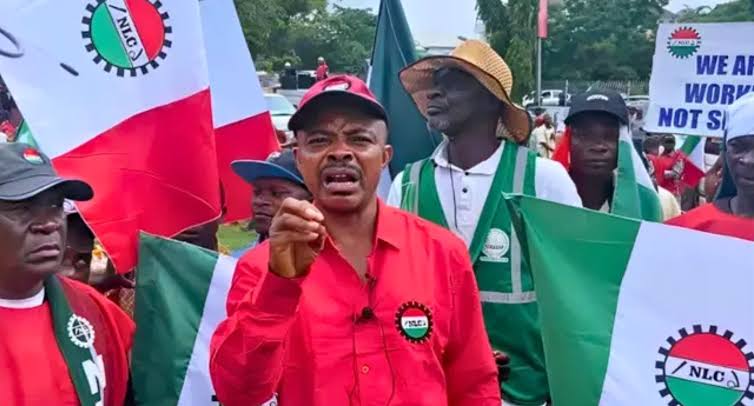
The Nigeria Labour Congress (NLC) has said it is preparing to open fresh negotiations with the Federal Government on a new national minimum wage, arguing that the current N70,000 monthly wage can no longer meet the basic needs of Nigerian workers amid rising inflation and worsening economic conditions.
The union disclosed this on Thursday during the Rights of Workers Summit held in Birnin Kebbi, Kebbi State, where labour leaders expressed concern over the growing erosion of workers’ purchasing power and the increasing cost of living across the country.
Speaking at the summit, NLC President Joe Ajaero, who was represented by the Deputy President of the Congress, Audu Titus Amba, said organised labour was already considering a review of the wage structure and would soon begin discussions with the government.
According to him, the current minimum wage has become inadequate in the face of soaring prices of food, transportation, housing, healthcare, and other essential commodities.
“Workers should begin to prepare for another round of negotiations because the present wage can no longer sustain the average Nigerian worker,” Amba said.
He maintained that a substantial upward review was necessary to restore the dignity of labour and protect workers from deepening economic hardship.
“Anything less than N500,000 cannot cater for workers. The current minimum wage is due for review, and we will soon begin negotiations with the government,” he added.
The NLC leadership argued that the sharp rise in inflation since the implementation of the N70,000 wage had significantly reduced its real value, leaving many workers unable to cope with everyday expenses.
Amba said labour unions would continue to push for a wage structure that reflects prevailing economic realities and enables workers to maintain a reasonable standard of living.
The summit brought together labour leaders, trade union officials, civil society groups, and workers from different sectors, many of whom lamented the growing pressure on household incomes.
Also speaking at the event, President of the Trade Union Congress (TUC), Festus Osifo, represented by the TUC Secretary-General, Nuhu Toro, said the current economic situation had made it increasingly difficult for workers to survive on the existing wage.
Toro noted that the prices of basic food items, transport fares, school fees, rent, and medical services had risen sharply in recent months, while workers’ incomes had remained largely stagnant.
He said the continued increase in inflation had further weakened the purchasing power of workers and widened the gap between wages and the actual cost of living.
According to him, many workers now spend a significant portion of their salaries on transportation and feeding alone, leaving little or nothing for other essential needs.
The TUC official urged the Federal Government to approach the forthcoming wage negotiations with sincerity and a willingness to address the genuine concerns of workers.
He warned that failure to improve workers’ welfare could have adverse consequences for productivity, industrial harmony, and social stability.
Labour leaders at the summit stressed that the demand for a new wage was not merely a political issue but a matter of economic survival for millions of workers and their families.
President Bola Tinubu signed the current national minimum wage bill into law on July 29, 2024, increasing the minimum wage from N30,000 to N70,000 per month following negotiations with organised labour.
The legislation also introduced a provision requiring a review of the national minimum wage every three years.
Although the new wage was welcomed by labour unions at the time, organised labour now says rapid inflation and rising living costs have eroded much of its value within a short period.
The NLC and TUC insisted that the three-year review clause should not prevent discussions on workers’ welfare where economic conditions have changed significantly.
Labour leaders further called on governments at all levels to prioritise policies that would reduce inflation, improve food supply, stabilise transportation costs, and create an economic environment in which wages can retain their value.
They argued that wage increases alone would not be sufficient unless accompanied by broader economic reforms aimed at improving living conditions for ordinary Nigerians.
The unions said they would continue consultations with their affiliates nationwide ahead of the formal commencement of negotiations with the Federal Government on a revised national minimum wage.