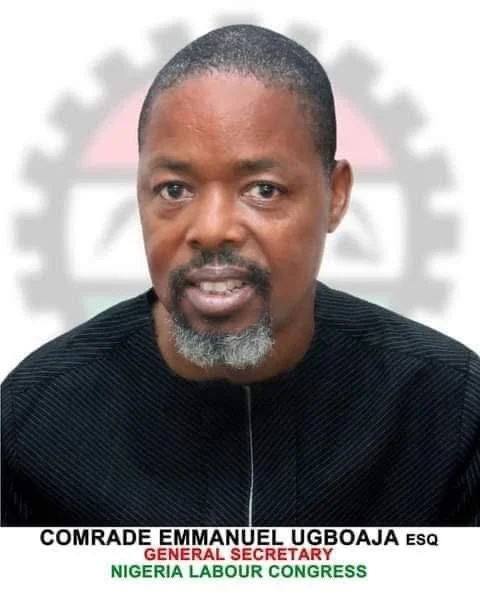
The General Secretary of the Nigeria Labour Congress, NLC, Emmanuel Ugboaja, has died at the age of 60 following a protracted illness.
Ugboaja’s death was announced by NLC President, Joe Ajaero, during the ongoing meeting of the Congress National Executive Council in Enugu, Enugu State.
According to reports, Ajaero informed members of the council about the development after reading a letter from Ugboaja’s family notifying the labour leadership of his passing.
As of the time of filing this report, details surrounding the nature of the illness and circumstances of his death had not been made public.
The death of the senior labour leader is expected to reverberate across Nigeria’s organised labour movement, particularly at a time when the NLC remains deeply involved in negotiations and engagements with the Federal Government over wages, workers’ welfare, economic reforms and the implementation of the new national minimum wage.
Ugboaja served as the General Secretary of the NLC from August 2019, after the Congress’s National Executive Council ratified his appointment at a meeting in Kano. He succeeded Peter Ozo-Eson, who retired from the position.
As the administrative head of Nigeria’s largest labour centre, Ugboaja played a central role in coordinating the activities of the Congress and its affiliate unions.
His responsibilities included managing relations between the NLC and its affiliated unions, coordinating industrial relations, participating in negotiations with governments and employers, implementing decisions of the Congress and helping to mobilise workers across the country.
His tenure coincided with a particularly challenging period for Nigerian workers, characterised by rising inflation, declining purchasing power, disputes over wages and repeated disagreements between organised labour and successive administrations.
Born on May 15, 1966, Ugboaja was a lawyer by training. He studied Law at the University of Calabar and graduated in 1987.
Following his graduation, he spent approximately four years in private legal practice before making a major career transition into the labour movement in 1993.
According to biographical information associated with the NLC, his entry into trade unionism marked a significant milestone, as he became the first Nigerian lawyer to work full-time for a trade union.
Ugboaja began his trade union career with the National Union of Chemical, Footwear, Rubber, Leather and Non-Metallic Products Employees, an affiliate of the NLC.
He rose through the ranks of the union and eventually became its General Secretary, a position he held between 2000 and 2005.
His experience at the union provided him with extensive exposure to industrial relations, collective bargaining, workers’ rights and labour administration.
After leaving the union’s leadership, Ugboaja served as Coordinator, Advocacy and Mobilisation, at the Alliance for Credible Elections between 2006 and 2009.
He subsequently joined the NLC Secretariat in 2009, where he continued to build his profile within the national labour movement.
His combination of legal training and trade union experience made him an important figure in the Congress, particularly during negotiations involving government policies with direct implications for workers.
One of the major issues that dominated Ugboaja’s years in the NLC leadership was the national minimum wage.
His tenure as General Secretary began shortly after the Federal Government approved the N30,000 national minimum wage in 2019.
However, implementation of the new wage became a major source of disagreement between organised labour and governments at different levels.
The NLC and other labour organisations repeatedly demanded compliance with the approved wage, while negotiations and disagreements over implementation threatened to trigger industrial action on several occasions.
Ugboaja was involved in the labour centre’s negotiations and mobilisation efforts during these periods, helping to coordinate the Congress’s position on workers’ remuneration and welfare.
The economic situation became even more difficult for Nigerian workers following the removal of fuel subsidy and the subsequent increase in transportation, food, housing and other living costs.
The NLC under its leadership repeatedly raised concerns about the impact of economic reforms on workers and low-income Nigerians.
Ugboaja remained an active participant in the labour movement’s campaigns for improved wages and better living conditions.
In April 2026, he signed an NLC directive calling on workers in states that had not fully implemented the 2024 National Minimum Wage Act to participate in street rallies scheduled for May Day.
The directive underscored his role in translating decisions reached by the Congress into nationwide mobilisation.
Ugboaja’s death comes at a crucial period for Nigeria’s organised labour movement.
The NLC has continued to engage the Federal Government and state governments over the implementation of the new minimum wage, workers’ purchasing power and the broader consequences of economic reforms.
Inflation and rising living costs have remained major concerns for workers, with organised labour consistently demanding policies capable of improving household welfare.
The Congress has also maintained its advocacy for stronger protection of workers’ rights and improved conditions of service across the public and private sectors.
Against this backdrop, Ugboaja’s death represents the loss of one of the key officials who participated in the labour movement’s recent negotiations and policy engagements.
As General Secretary, he occupied a pivotal position between the Congress leadership, its numerous affiliate unions and the wider workforce.
His responsibilities required him to coordinate complex industrial relations matters while ensuring that decisions taken by the Congress were communicated and implemented across its structures.
News of Ugboaja’s death is likely to attract reactions from labour unions, civil society organisations, political leaders, government officials and members of the Nigerian workforce.
The NLC is expected to provide further information regarding his funeral arrangements and other official activities to honour the late labour leader.
For decades, Ugboaja devoted his professional life to the labour movement, moving from private legal practice into trade union administration and eventually becoming one of the most senior officials of the NLC.
His career spanned more than three decades and covered some of the most consequential periods in Nigeria’s industrial relations history.
From his early years representing workers in the industrial sector to his later responsibilities at the national labour centre, he remained involved in issues concerning collective bargaining, workers’ rights, wages and social protection.
His death at 60 therefore marks the end of a significant chapter in the career of a lawyer who chose to dedicate much of his professional life to organised labour.
The NLC leadership and Ugboaja’s family are expected to announce further details concerning his burial and other arrangements as they become available.