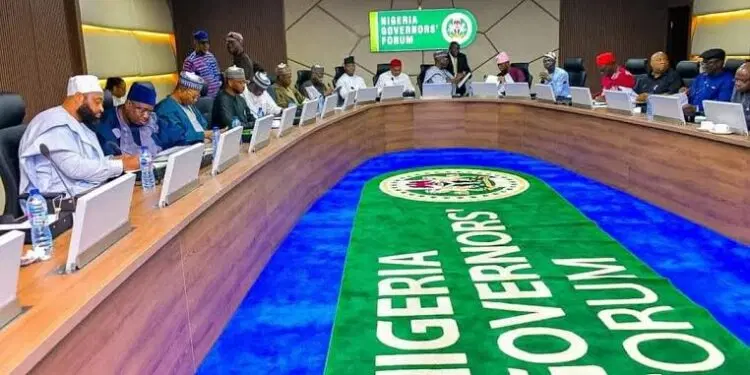
The 36 state governors under the platform of the Nigeria Governors’ Forum (NGF) have rejected allegations that sub-national governments have failed to properly account for funds accruing to them following the removal of petrol subsidy.
The governors maintained that claims suggesting states had mismanaged or failed to account for proceeds associated with the subsidy reform were unfounded, stressing that the issue should not be used to accuse sub-national governments of financial impropriety.
The position was made known after the governors held their third meeting at the NGF Secretariat in Abuja, which extended from Wednesday night into the early hours of Thursday.
Bayelsa State Governor, Douye Diri, who read the communique on behalf of the NGF Chairman and Kwara State Governor, AbdulRahman AbdulRazaq, said the Forum had also expressed support for the proposed National Affordable CNG Transit Programme (NACTP), describing it as a potentially important intervention for reducing transportation costs.
The NACTP is designed as a state-led initiative aimed at translating the lower operating cost of compressed natural gas (CNG) vehicles into cheaper fares for commuters.
Under the proposal, state governments would support the conversion of vehicles to CNG, provide or facilitate CNG-powered fleets and develop other necessary infrastructure. Participating transport operators would, in turn, commit to reducing passenger fares.
The governors, according to the communique, acknowledged the potential of the initiative but said further discussions were necessary regarding its financing and implementation framework.
Diri, while responding to questions from journalists about whether the governors would accept responsibility for alleged poor accountability over subsidy-removal funds, dismissed the claim.
“That cannot be true. That cannot be true. But we’ll leave that debate for another day,” he said.
The governor explained that the Forum was interested in exploring practical ways of reducing the economic burden created by higher transportation costs, particularly through collaboration with the private sector.
He said CNG offered an opportunity to lower the cost of operating commercial vehicles because gas is generally cheaper than petrol.
“Gas is cheaper than petrol, which will actually reduce the costs of transportation,” Diri said.
According to him, reducing transportation costs would have implications beyond the transport sector because the cost of moving people and goods significantly influences the prices of food, manufactured products and other essential commodities.
The governors therefore justified the proposed focus on transportation as part of efforts to cushion the effects of the petrol subsidy removal.
“Transportation is key. Transportation is key to several other factors,” Diri said.
He explained that when food items such as yam and garri are transported from one location to another, the cost incurred by the trader or farmer is ultimately reflected in the final price paid by consumers.
“So for that reason, the cost of my yam, the cost of my garri… And so by the time you reduce the cost of transport, as I said earlier, it will have a multiplier effect on several others,” he stated.
The NGF said the proposed CNG programme was among the measures that could help address the economic consequences of subsidy removal by lowering the cost of mobility for Nigerians.
The Forum said details concerning the implementation timeline and financing structure would be developed in further engagements between the governors and proponents of the programme.
When asked when Nigerians should expect the NACTP to commence, Diri said the specific details were still being worked out.
“Those details will be worked out between the Forum and those who have come to present to the Forum,” he said.
The governors’ support for the CNG initiative comes amid continued concerns over the impact of high transportation costs on household incomes and the prices of goods and services across the country.
Since the removal of petrol subsidy, transport operators have faced higher operating costs, prompting increases in fares on several routes. The resulting rise in transportation costs has also contributed to higher prices for goods transported across long distances.
The NGF believes that reducing transport costs could therefore generate a wider economic benefit.
Diri linked the rising cost of food and other commodities to transportation expenses, noting that businesses generally pass logistics costs to consumers.
The governors argued that an intervention capable of reducing the cost of transporting people and goods could consequently moderate prices across other sectors.
Beyond transportation, the NGF meeting also considered opportunities for states to participate in major trade and investment initiatives.
The Minister of Industry, Trade and Investment, Dr Jumoke Oduwole, briefed the governors on opportunities for state participation in CANEX Weekend 2026 and the Intra-African Trade Fair (IATF) 2027, both scheduled to take place in Lagos.
According to the Forum, the platforms would provide states with opportunities to showcase investment-ready projects, promote local exports and tourism, and connect state-based micro, small and medium enterprises with investors and buyers from Africa and other parts of the world.
The governors expressed their collective willingness to participate in the initiatives and assured the minister of their support.
The communique stated that the platforms had the potential to strengthen economic opportunities for states by promoting local businesses and connecting them to wider markets.
The governors’ position reflects their broader argument that state governments should be actively involved in efforts to stimulate production, trade and investment while addressing the effects of economic reforms.
On the subsidy debate, Diri said measures such as the proposed CNG transportation programme were intended to mitigate the hardship associated with the removal of petrol subsidy.
He noted that the impact of the reform had extended beyond the price of petrol itself, affecting transportation and, consequently, the prices of goods and services.
“These are part of the issues that have been addressed, particularly with the number two that I just talked about today about transportation fares,” he said.
Diri maintained that the focus should be on interventions capable of directly improving the welfare of ordinary Nigerians.
He said collaboration between state governments and private-sector operators could accelerate the adoption of CNG vehicles and help deliver cheaper transportation.
The governor stressed that the ultimate beneficiaries of such measures should be ordinary citizens who have borne the brunt of rising living costs.
“And it will have a multiplier effect on every other sector,” he said, adding that the expected impact was on “our people—the very common man that we all talk about.”
The NGF’s latest position underscores the governors’ push for interventions that can translate economic reforms into tangible benefits for citizens. While defending their handling of funds associated with subsidy removal, the governors have also indicated a willingness to explore alternative measures, particularly in transportation, to reduce the pressure on households.
With the proposed NACTP still requiring further consideration of its financing and implementation arrangements, the success of the initiative will ultimately depend on effective coordination among the Federal Government, state governments, private-sector operators and other stakeholders.
For the governors, however, reducing transportation costs remains a critical component of efforts to moderate inflation and ease the financial burden on Nigerians.