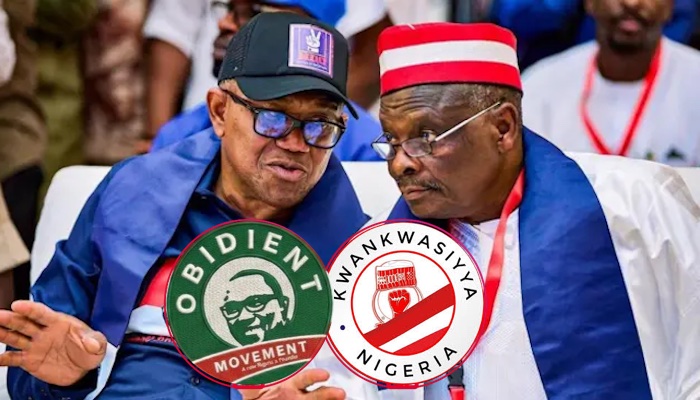
The presidential candidate of the Nigeria Democratic Congress (NDC), Mr. Peter Obi, has challenged Nigerians and members of the international community to scrutinise his personal, educational and professional background and publicly identify any wrongdoing associated with him.
Obi, a former governor of Anambra State, also called on Nigerians to subject the background and record of his running mate, former Kano State governor Senator Rabiu Musa Kwankwaso, to the same level of public scrutiny ahead of the 2027 presidential election.
The former governor made the remarks in Port Harcourt, Rivers State, during a town hall meeting with voters tagged “Obi Talks Nigeria,” where he responded to questions concerning his political ambition, his record and preparations for the 2027 general election.
Obi said he and Kwankwaso had deliberately made information about their backgrounds available to the public, arguing that Nigerians should have the opportunity to independently verify the credentials and history of anyone seeking to occupy the highest political office in the country.
“I want to give every Nigerian the opportunity to know who I am,” Obi said.
He explained that relevant details about both himself and his running mate, including their dates of birth, educational histories and institutions attended, had been presented publicly for verification.
“Both of us have presented our backgrounds, from our dates of birth to our schools, education and all, to the people. You can go and verify our backgrounds worldwide, anywhere,” he said.
The challenge comes at a time when the backgrounds, qualifications, professional histories and previous political records of presidential aspirants are increasingly becoming subjects of public debate as political parties position themselves for the 2027 elections.
Obi also made what appeared to be a veiled reference to his legal dispute with his former spokesperson, Kenneth Okonkwo, over comments relating to their dealings during the 2023 presidential campaign.
According to Obi, the legal action followed claims by Okonkwo that he possessed information about the former governor’s past which, if made public, would shock Nigerians.
“We have sued somebody in court. He said he knows something he can say that will shock people. I said I want you to say what people will be shocked about,” Obi said.
He used the development to challenge anyone with information about alleged wrongdoing on his part to make such information public.
“And I’m challenging every Nigerian. If there is anything that you know I have done that is wrong, say it out now,” he declared.
Obi extended the same challenge to anyone with allegations against his running mate.
“I’m challenging the world over: if you know anything that Rabiu Musa Kwankwaso has done that is wrong, say it out now,” he added.
The NDC presidential candidate further argued that political leaders should be subjected to credible and transparent processes before being entrusted with public office.
He questioned the value of political titles if the process through which an individual obtained political power was not credible.
“You cannot continue to answer His Excellency when the process that got you there is not excellent,” Obi said.
Kwankwaso Warns APC Against Overreliance on Governors
Meanwhile, Obi’s running mate, Senator Rabiu Musa Kwankwaso, has warned the ruling All Progressives Congress (APC) against assuming that its control of more than 30 state governors would automatically translate into victory in the 2027 presidential election.
Kwankwaso, a former governor of Kano State, said relying heavily on the strength of incumbent governors and political structures could prove to be a serious strategic mistake.
Speaking at the Port Harcourt event, he argued that the number of governors controlled by a political party does not guarantee electoral success.
According to him, previous elections have demonstrated that political parties can suffer defeat despite controlling significant political structures across the country.
“The sitting president lost the election. I’m giving you an example, especially for those who think because they have over 30 governors, they cannot lose the election. That is a very big mistake,” Kwankwaso said.
He maintained that voters ultimately determine electoral outcomes and that political parties should not mistake control of government structures for guaranteed support at the grassroots.
The former Kano governor also expressed concern about the performance of some governors, particularly in Northern Nigeria, suggesting that dissatisfaction among residents could make it difficult for some incumbent governors and their political parties to campaign effectively ahead of the 2027 elections.
“By the grace of God, all of them, especially the ones in the North, because I studied the trend. The trend is that those governors and their party have performed woefully to the extent that it is very difficult for them even to come out and campaign,” he said.
Kwankwaso further questioned the manner in which governments have utilised the increased revenue available to them, arguing that higher allocations have not translated into corresponding improvements in the living conditions of ordinary Nigerians.
He recalled that when he became governor in 1999, state and local governments operated with significantly smaller financial resources.
According to him, the substantial increase in government revenue in recent years should have resulted in visible improvements in infrastructure, social services and the general welfare of citizens.
“Now, in one year, we have seen it on social media that our government collected over N1.11 trillion in just less than one year. You go around, what have you done with that money? Close to nothing,” he said.
Kwankwaso argued that the apparent disconnect between rising government revenue and the conditions experienced by ordinary citizens was contributing to growing frustration across the country.
He said the situation was particularly troubling in Northern Nigeria, where insecurity continues to affect communities and undermine economic and social development.
According to him, persistent insecurity, combined with economic hardship and inadequate public services, could significantly influence voters’ attitudes ahead of the 2027 elections.
The statements by Obi and Kwankwaso underline the NDC’s emerging campaign message ahead of the 2027 presidential contest, with emphasis on transparency, accountability, leadership records and the performance of incumbent governments.
While Obi challenged Nigerians to investigate his record and that of his running mate, Kwankwaso sought to caution the APC against relying solely on political structures and the number of governors under its control.
With the 2027 election approaching, both sides are expected to intensify their engagement with voters and present competing arguments over leadership, governance, accountability and the country’s economic and security challenges.