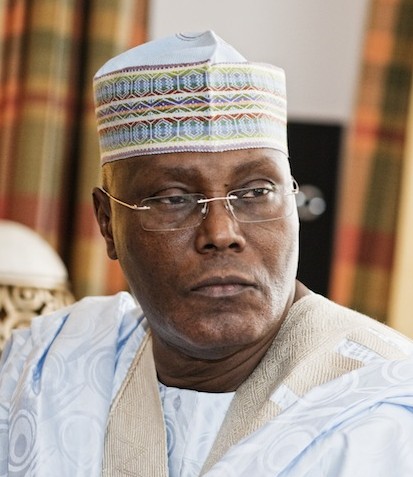
Former Vice President and presidential candidate of the African Democratic Congress (ADC), Atiku Abubakar, has called on President Bola Tinubu to initiate an immediate review of Nigeria’s N70,000 national minimum wage, arguing that rising costs of fuel, food, transportation and housing have significantly reduced workers’ purchasing power.
Atiku made the call in a statement issued on Sunday by the Director of Strategic Communications of the ADC Presidential Campaign Council, Phrank Shaibu.
The former vice president said the increase in the statutory minimum wage had not kept pace with the rise in the cost of living, leaving many workers struggling to meet basic household expenses.
He urged the Federal Government to negotiate what he described as a substantial upward adjustment that would better reflect prevailing economic conditions.
The Federal Government increased the national minimum wage from N30,000 to N70,000 in July 2024 following negotiations involving the government, organised labour and other stakeholders. President Tinubu, while announcing the new wage, said it would be reviewed after three years.
Atiku, however, argued that the purchasing power of the N70,000 wage had already been substantially weakened by increases in the prices of essential goods and services.
He used petrol prices as one measure of the erosion in workers’ purchasing power, comparing the amount of fuel that could be purchased with the old minimum wage and what the current wage could buy at the prices cited in his statement.
“At N1,400 a litre, the entire N70,000 monthly minimum wage buys just 50 litres of petrol. What does the worker take home to feed the children? What pays the rent? What gets that worker back to work on Monday?” Atiku asked.
According to his comparison, N30,000 at the April 2023 national average petrol price of N254.06 per litre could purchase approximately 118 litres of petrol. At N1,400 per litre, N70,000 would purchase about 50 litres.
Atiku said the comparison illustrated what he regarded as a gap between nominal wage increases and actual purchasing power.
“The payslip has grown, but the fuel it can buy has more than halved,” he said, arguing that the increase in the statutory wage had not translated into a comparable improvement in workers’ ability to meet their daily needs.
The former vice president also linked the cost-of-living pressures to the removal of the petrol subsidy, a policy introduced by the Tinubu administration after it assumed office in 2023.
Atiku criticised the manner in which the subsidy removal was implemented, arguing that measures designed to protect low-income households and workers from its effects had not sufficiently addressed the resulting increases in transportation and other living costs.
He said the impact of petrol prices went beyond motorists because fuel costs influence transportation, agricultural production, manufacturing, food distribution and other sectors of the economy.
According to him, higher transportation and energy costs ultimately affect the prices paid by households for food and other essential commodities.
The issue of wages has remained closely linked to broader economic reforms since the Tinubu administration began implementing changes to fuel pricing and the foreign exchange market.
The Presidency had acknowledged the economic difficulties confronting Nigerians during the minimum-wage negotiations in 2024. Tinubu said workers deserved improved welfare and better wages but also argued that the government had to consider the overall structure and affordability of wage adjustments.
After further negotiations, Tinubu increased the Federal Government’s minimum-wage offer to N70,000 and agreed that the wage should be reviewed after three years rather than five years.
Atiku is now calling for that review to take place before the scheduled three-year period, arguing that economic conditions have changed significantly since the 2024 agreement.
He challenged the Federal Government to make its position on a fresh wage adjustment clear and engage organised labour on the issue.
“If he has no intention of raising workers’ pay, he should say so plainly and stop stringing the Nigeria Labour Congress and other labour leaders along,” Atiku said.
He argued that workers should not have to depend on repeated negotiations without a clear response from government.
The ADC presidential candidate also referenced wage levels in other African oil-producing countries, arguing that Nigeria’s minimum wage should be considered in the context of the country’s economic resources and the cost of living.
He acknowledged that wage structures, currencies and living costs differ from country to country but maintained that the comparison raised questions about the adequacy of the current Nigerian wage.
Atiku also outlined some of the measures he said he would pursue if elected president in 2027.
According to him, his administration would begin work on raising the wage floor from its first day in office. He also proposed measures aimed at reducing living costs through increased domestic production, targeted social protection and interventions in the petroleum sector.
He said a targeted production subsidy could be introduced for petroleum products refined in Nigeria and sold to Nigerian consumers.
Atiku said any such intervention should be subject to spending limits, public accounting and independent auditing to ensure that government support produced measurable benefits.
“Government support must produce measurable relief at the pump,” he said.
The former vice president further argued that wage increases alone would not resolve the difficulties facing Nigerian households unless accompanied by measures to reduce the prices of essential goods and services.
He therefore called for policies that would address the cost of energy, transportation, food and other basic necessities alongside any adjustment to workers’ salaries.
His latest comments come amid renewed calls from some labour groups and civil servants for an upward review of the minimum wage.
For example, the Federal Workers Forum wrote to the President and National Assembly earlier in September 2026 seeking an increase in the minimum wage from N70,000 to N300,000, arguing that the current wage structure no longer reflected prevailing economic conditions.
Atiku’s intervention therefore adds a political dimension to an issue that has also featured in labour and public-sector discussions.
The former vice president said the central issue was not simply the figure written on workers’ payslips but what that income could purchase after meeting basic expenses.
He argued that workers faced difficult choices involving food, rent, transportation, education and healthcare as prices continued to rise.
“Nigerians do not eat FAAC figures. A full treasury is no answer to an empty kitchen,” Atiku said, framing workers’ purchasing power as a key measure of economic policy outcomes.
He maintained that a minimum wage should provide workers with sufficient income to meet basic needs and called for renewed negotiations between the Federal Government and organised labour.
The Tinubu administration’s 2024 position was that the N70,000 minimum wage represented the outcome of negotiations with labour and other stakeholders and that a three-year review period had been agreed.
Atiku’s latest intervention seeks an earlier reconsideration of the wage, based on what he described as changes in the economic environment since the agreement.
The debate over the minimum wage is consequently tied to wider questions about inflation, fuel prices, household purchasing power, government revenue, business costs and the sustainability of public-sector wage commitments.
As the 2027 election approaches, Atiku’s proposal places workers’ income and the broader cost of living among the economic issues he is highlighting as part of his campaign platform.
For now, the N70,000 statutory minimum wage remains the benchmark established by the 2024 legislation, while Atiku is calling for the Federal Government to review the figure before the previously agreed three-year review period.
The outcome of any fresh wage negotiation would depend on discussions among the Federal Government, organised labour, employers and other relevant stakeholders, as well as consideration of the fiscal implications for governments and employers across the country.