Former Imo State Governor and Senator Rochas Okorocha has built a new world headquarters for Ohanaeze Ndigbo Worldwide in Enugu, with the multimillion-naira facility expected to be formally handed over to the apex Igbo socio-cultural organisation in October.
The new headquarters, located on Park Avenue in the Enugu Government Reserved Area, is designed to serve as a permanent institutional home for Ohanaeze Ndigbo and a centre for preserving Igbo history, culture and identity.
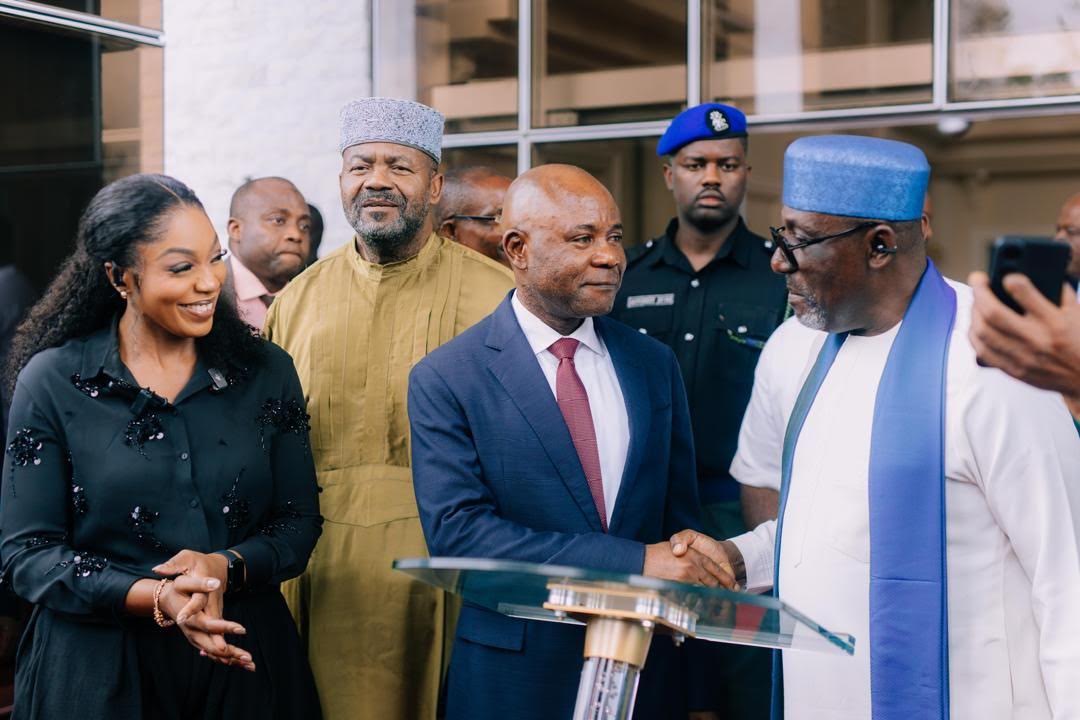
Enugu State Governor, Dr Peter Mbah, inspected the facility alongside Okorocha and other officials as construction and finishing works entered the final stage.
The facility, which occupies more than 3,000 square metres, comprises twin auditoriums, about 11 offices, conference rooms, a library, an interactive audiovisual space and a memorabilia section dedicated to preserving the history and heritage of the Igbo people.
Speaking during the inspection, Okorocha explained that his decision to undertake the project was driven by his desire to provide Ohanaeze Ndigbo with a befitting and permanent headquarters capable of reflecting the organisation’s importance to Ndigbo in Nigeria and across the world.
According to him, the project was not motivated by personal wealth or a desire for publicity, but by what he described as his love for his people.
“I am not doing this because I am wealthy. I am not doing it to dramatise wealth. It is simply my heart speaking, the heart of love for my people,” Okorocha said.
The former governor said his decision to build the facility was influenced by an earlier visit to the old Ohanaeze secretariat, which he considered inadequate for an organisation representing millions of Igbo people at home and in the diaspora.
He said the new headquarters was conceived as a permanent institutional base that would strengthen Ohanaeze’s capacity to coordinate its activities, preserve Igbo heritage and respond to issues affecting Ndigbo around the world.
Okorocha said the facility was also intended to encourage younger generations of Igbo people to understand and appreciate their roots.
“I want them to identify with their roots. And I want the pride of being Igbo to be restored,” he said.
He further explained that the headquarters should function as more than an administrative building, stressing that it ought to provide Ohanaeze with the institutional capacity to intervene whenever Igbo people encounter serious challenges in different parts of the world.
According to him, the organisation should be able to respond quickly whenever an Igbo person faces difficulties abroad, particularly in circumstances involving allegations of offences that the individual may not have committed.
“Wherever in the world, whether in China, America, Singapore, or anywhere else any Igbo child is in trouble for any reason, particularly where they are accused of an offence they did not commit, this secretariat should intervene as quickly as possible,” Okorocha said.
He disclosed that the building was approximately three to four weeks away from completion, with landscaping and other finishing works still ongoing.
Okorocha said the formal commissioning would be organised by the leadership of Ohanaeze Ndigbo in collaboration with the Enugu State Government, while his role would be to complete and hand over the property to the organisation.
“This building is for Ohanaeze, and, forever, it will be for Ohanaeze. It is a property for the organisation,” he said.
Governor Mbah, who toured the facility, commended Okorocha and the Rochas Foundation for undertaking the project.
The governor described the building as a befitting headquarters for Ohanaeze Ndigbo and said its location in Enugu added significance to the project because of the city’s longstanding importance to Igbo identity and collective life.
Mbah said the facility should also remind Ndigbo of their common heritage and the importance of unity.
“This reminds us that, at a time like this, the Igbo must come together,” the governor said.
The governor’s comments reflected the broader significance attached to the project as a permanent home for an organisation established to represent and promote the interests of Ndigbo.
The President-General of Ohanaeze Ndigbo Worldwide, Senator John Azuta-Mbata, also expressed appreciation to Okorocha for the project.
Azuta-Mbata described the headquarters as a lasting symbol for the organisation and said it would serve as a legacy for successive administrations of Ohanaeze Ndigbo.
He said the facility would strengthen the organisation’s institutional capacity and provide an appropriate environment for its leadership to pursue issues relating to the protection and advancement of the interests of Ndigbo.
Beyond its administrative functions, the architectural design of the headquarters incorporates several elements intended to communicate Igbo history, culture and identity.
The building was designed by Walsh Blanc, an integrated spatial design and experiential architecture practice led by its Managing Director, Mrs Uloma Rochas Nwosu.
Nwosu explained that the design was developed around the idea of creating a space capable of bringing Ndigbo together while telling the story of their historical development, culture and identity.
She disclosed that the building was about 85 per cent complete at the time of the inspection.
Among the features incorporated into the design are a lion motif, red and white colours and seven pillars representing the seven Igbo-speaking states.
The headquarters also includes a memorabilia section in the basement, where audiovisual installations, artworks, documentaries and other historical materials will be displayed.
The space is intended to provide visitors with an opportunity to engage with aspects of Igbo history and cultural heritage through photographs, video materials, artworks and other exhibits.
Nwosu also disclosed that part of the old Ohanaeze secretariat would be preserved as a historical reference point.
According to her, old furniture, flooring and other materials from the former secretariat would be retained, alongside photographs and videos documenting the history of the previous building.
She added that a significant portion of the furniture and artworks incorporated into the new headquarters was locally produced, reflecting an effort to combine modern architectural design with local creativity and craftsmanship.
The headquarters is therefore expected to function simultaneously as an administrative centre, meeting venue, cultural repository and historical reference point for Ohanaeze Ndigbo.
Its twin auditoriums and conference facilities are expected to provide space for major meetings, conferences and other programmes, while the offices will accommodate the organisation’s administrative activities.
The library and interactive audiovisual facilities are also expected to support research, documentation and educational activities relating to Igbo history and culture.
With construction now approaching completion, the new headquarters is expected to be formally handed over to Ohanaeze Ndigbo Worldwide in the first week of October.
The project places a permanent institutional facility at the disposal of the organisation and introduces a new physical space designed to combine administration, cultural preservation and historical documentation.
For Ohanaeze Ndigbo, the completion and handover of the headquarters will mark a significant development in the organisation’s institutional infrastructure and provide its successive leaderships with a permanent facility from which to conduct its activities in Enugu and engage with Ndigbo in Nigeria and the diaspora.