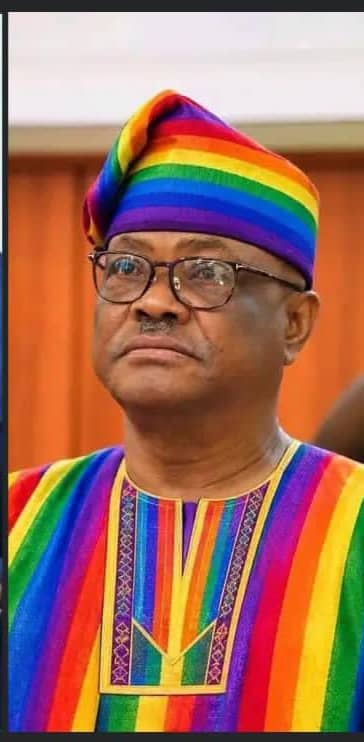
Several state chapters of the All Progressives Congress have rejected the Rainbow Coalition being promoted by Minister of the Federal Capital Territory, Nyesom Wike, with party leaders urging the former Rivers State governor to formally join the APC if he intends to support President Bola Tinubu’s re-election in 2027.
The disagreement has brought renewed attention to the political structure being developed by Wike and the question of whether support for Tinubu’s presidential bid can be separated from support for APC candidates contesting governorship and legislative elections.
Wike remains a member of the Peoples Democratic Party but serves as a minister in the APC-led Federal Government. President Tinubu appointed him FCT minister after the 2023 presidential election, despite Wike’s previous role as a prominent PDP politician and his participation in the party’s presidential contest.
Wike has said his political priority is the re-election of Tinubu in 2027, while maintaining that the Rainbow Coalition is not an APC structure. According to him, politicians from different parties can support Tinubu for president while retaining their respective party identities and supporting candidates of their choice in other elections.
The position has, however, drawn objections from APC governors and party officials who argue that the arrangement could create competing political structures and complicate the party’s electoral organisation.
Zamfara governor challenges Wike
The latest confrontation followed comments by Zamfara State Governor Dauda Lawal, who asked Wike to either join the APC or abandon the Rainbow Coalition.
Lawal made the remarks in an interview with Channels Television’s Inside Sources on the sidelines of the 81st United Nations General Assembly in New York.
He said APC governors wanted Wike to make his political allegiance clear, arguing that supporting Tinubu while simultaneously backing candidates from other parties was inconsistent with the interests of the ruling party.
Lawal also said he intended to discuss Wike’s political position with President Tinubu, stressing that there should be clarity about where the minister stood ahead of the 2027 elections.
The position reflects an earlier stance by the Progressive Governors Forum, which has distanced itself from any formal alliance with Wike’s coalition. APC governors have maintained that they remain committed to the party’s structures and have not entered into a formal agreement with any individual or opposition party through the Rainbow Coalition.
Imo, Gombe chapters oppose coalition
In Imo State, APC Publicity Secretary Jones Onwuasoanya urged Wike to formally identify with the ruling party if he was committed to Tinubu’s re-election.
Onwuasoanya argued that supporting the President should extend to the APC platform rather than being limited to the presidential contest. He also said the Imo APC did not recognise the Rainbow Coalition as a political structure in the state.
Similarly, Gombe State APC Publicity Secretary Murtala Usman said Wike should complete what he described as his political transition by joining the APC.
Usman expressed concern that a separate coalition could create difficulties for APC stakeholders, particularly in states where different political interests are already competing for control of party structures.
He therefore urged Wike to become a full member of the APC rather than continue operating across party lines.
Ondo wants support for all APC candidates
The Ondo State APC also rejected a political arrangement in which Tinubu would receive support for the presidency while candidates from other parties were supported in other elections.
State party Secretary Alex Kalejaiye said the chapter’s objective was to mobilise votes for all APC candidates, including those contesting the Senate, House of Representatives and State House of Assembly seats.
He called on Wike to bring his political structures into the APC if he wanted to support Tinubu, arguing that different voting choices on the same election day could create confusion for voters.
The Ondo position illustrates one of the central disagreements surrounding the Rainbow Coalition: whether presidential support can be organised separately from the broader party structure.
Different positions within APC
The reactions have not been uniform across the APC.
In Jigawa State, APC Publicity Secretary Bashir Kundu welcomed Wike’s support for Tinubu and said the state chapter would receive him if he decided to join the ruling party.
Kundu also noted that the APC itself was formed through a coalition of political interests and said the party had established structures that could accommodate politicians from different backgrounds.
In Benue State, reactions were similarly divided. One APC faction welcomed Wike’s support for Tinubu but expressed a preference for him to formally join the party. Another faction took a different position, arguing that Wike should remain in the PDP.
The divergent views demonstrate that the controversy is not limited to a simple division between supporters and opponents of Wike. It also reflects differences within APC structures over how cross-party support should be managed.
Rivers and other chapters raise concerns
In Rivers State, where Wike served as governor, the APC faction led by Emeka Beke backed the position of the Progressive Governors Forum.
Its publicity secretary, Darlington Nwauju, argued that voters could become confused if political actors asked them to support different parties for different offices on the same ballot.
He said Wike should either join the APC or refrain from using relationships with APC figures to influence the ruling party’s internal political arrangements.
The Anambra APC also criticised the Rainbow Coalition. State Chairman Senator Emmanuel Anosike argued that Wike, as a PDP member, should not intervene in the internal affairs of the APC.
The Kwara APC chairman, Sunday Fagbemi, similarly questioned how the coalition’s strategy would operate during elections in which presidential and legislative contests take place on the same day.
Plateau State APC Chairman Rufus Bature said his chapter was unaware of any Rainbow Coalition structure in the state. He nevertheless said Wike was free to join the APC if he wished.
Nasarawa APC also called for Wike to join the party, while some other state chapters, including Osun and Delta, said the matter should be handled by the national leadership rather than individual state organisations.
Wike defends his position
Wike has rejected the argument that supporting Tinubu requires him to join the APC.
In a statement issued through his Senior Special Assistant on Public Communications and Social Media, Lere Olayinka, Wike said his support was specifically for Tinubu’s presidential re-election and did not prevent the PDP or other political parties from fielding candidates for governorship and legislative positions.
Wike has also argued that the Rainbow Coalition should not be regarded as an APC structure. He has said the coalition brings together politicians from different platforms who support Tinubu based on their assessment of his administration.
He has further maintained that his position is consistent with the political arrangement involving the G5 governors before the 2023 election, when he and other PDP governors supported Tinubu without formally joining the APC.
Wike has described criticism of the coalition as misplaced and said his immediate political concern is Tinubu’s return to office in 2027.
Ebonyi rejects coalition
Minister of Works David Umahi, a former Ebonyi governor who moved from the PDP to the APC, has also said there is no Rainbow Coalition structure in Ebonyi State.
Umahi stated that the state remained aligned with the APC and its candidates and said he was unaware of any Wike-backed candidates operating under such an arrangement in the state.
His position reinforces the argument from several APC chapters that political support for Tinubu should operate through established party structures.
The dispute has also widened beyond the question of Wike’s party membership. Wike recently accused some APC governors of pursuing political interests connected with the future leadership of the National Assembly, particularly the offices of Senate President and Speaker. The governors have not accepted that characterization of their opposition to the coalition.
As the 2027 elections approach, the disagreement therefore centres on two competing approaches to political organisation: Wike’s model of a cross-party coalition focused on the presidential election, and the position of several APC chapters that electoral mobilisation should remain tied to the party’s candidates and structures.
For now, Wike remains a PDP member serving in an APC-led government, while publicly supporting Tinubu’s re-election. The APC chapters that have spoken on the matter are divided in their degree of acceptance, but several have called for him to formalise his relationship with the ruling party if he intends to participate in its wider electoral campaign.
The controversy is likely to remain part of the broader political debate over the organisation of the 2027 elections, particularly as political parties and alliances determine how presidential, governorship and legislative campaigns will be coordinated.