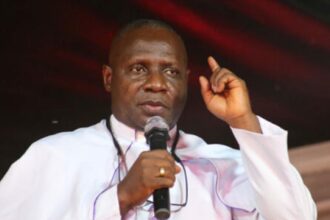
The General Overseer of the Redeemed Christian Church of God (RCCG), Pastor Enoch Adeboye, has defended President Bola Ahmed Tinubu against growing criticism over Nigeria’s worsening insecurity, insisting that the president has fulfilled his constitutional responsibilities as Commander-in-Chief of the Armed Forces by issuing directives to the military and should not be expected to personally lead combat operations.
Speaking at the US-Nigeria Faith Heroes Award Gala organised by the Save Nigeria Group in Washington, D.C., on June 23, Adeboye argued that much of the criticism directed at President Tinubu over the country’s security challenges misunderstands the role of a commander-in-chief.
According to the respected cleric, once a president gives clear operational directives to the armed forces, the responsibility for executing those orders rests with military commanders and personnel, not with the president himself.
“I need to make this one clear: I don’t support those who are accusing the president of not doing enough,” Adeboye declared.
“When the commander-in-chief has given instructions to his subordinates, he has done his bit. You don’t expect him to go and put on khaki and fight.”
His remarks come at a time when the Tinubu administration continues to face mounting public criticism over persistent attacks by terrorists, bandits, kidnappers and other criminal groups across various parts of the country.
Despite repeated military operations, insecurity has remained one of Nigeria’s most pressing national challenges, with incidents of terrorism, mass abductions and violent attacks continuing to claim lives and displace communities.
To illustrate his point, Pastor Adeboye drew a comparison between President Tinubu’s role and that of United States President Donald Trump, arguing that heads of state across the world exercise military authority through directives rather than direct participation in combat.
“When my friend Trump gives instructions to go and bomb anywhere, he doesn’t leave the White House,” Adeboye said.
“He has done his bit. ‘I hereby command, bomb Iran,’ and then he goes to his bedroom and sleeps. The rest is left to the supporters.”
The cleric’s analogy underscored his belief that political leaders should be judged by the quality of their decisions and directives rather than by expectations that they personally participate in military operations.
While defending the president’s constitutional role, Adeboye acknowledged that Nigeria’s security situation has deteriorated significantly in recent years.
He lamented that terrorism, kidnapping and other violent crimes, once largely concentrated in the northern part of the country, have now spread to southern states, affecting communities that previously considered themselves relatively safe.
“Things have gone far, far worse than before the bomb came,” he said, referring to the United States’ bombing of Islamist terrorist targets last December.
“Far, far worse… so bad that they are asking: ‘Where is your God?’ That is how bad it is.”
According to the RCCG General Overseer, the growing insecurity has become deeply personal, with criminal activities now occurring close to areas associated with his ministry.
“The terrorism, kidnapping, and so on that were in the north are now even at my doorstep. They have come all the way down to the south.”
His comments reflect growing concerns among Nigerians over the geographical spread of insecurity, with kidnappings, armed attacks and killings increasingly reported across southern states.
Adeboye maintained that the individuals financing and supporting terrorist groups are not unknown to authorities.
According to him, the real solution to Nigeria’s security crisis lies in dismantling the networks of influential sponsors who provide funding, logistics, weapons and other forms of support to criminal organisations.
“And, of course, the sponsors, they are all known, and they are still moving about freely,” he said.
The cleric argued that until security agencies confront those behind the financing of terrorism, military operations alone may not permanently resolve the problem.
Pastor Adeboye disclosed that he had personally discussed Nigeria’s security challenges with President Tinubu and the First Lady, Senator Oluremi Tinubu, who is also a pastor in the Redeemed Christian Church of God.
During those discussions, he said he advised the president to issue a firm ultimatum to the leadership of Nigeria’s armed forces.
According to Adeboye, military commanders should be given a strict 90-day deadline to eliminate terrorism or vacate their positions.
“I told him to tell all the military boys, all the army, navy and air force: ‘You have 90 days. Wipe out this rubbish or resign.'”
He suggested that setting measurable targets for military leadership would strengthen accountability and accelerate efforts to restore security across the country.
Beyond military operations, the respected preacher stressed the importance of targeting those who finance terrorism.
He described many of the alleged sponsors as wealthy and influential individuals, including politicians and businesspeople, who continue to operate freely despite allegedly enabling violent groups.
“You know them,” he said.
“Some of them are businessmen. Some of them are politicians. Go after them.”
According to Adeboye, disrupting the financial and logistical support networks sustaining terrorist organisations would significantly weaken their operational capacity.
He observed that many terrorist groups rely on sophisticated supply chains for arms, ammunition and transportation, arguing that those who provide such support should be treated as major contributors to the country’s insecurity.
“Because if you do not deal with those who are supplying these people with arms and ammunition, and most of the time, when they go about, they go about on motorcycles, if we don’t go after the sponsors, the problem will continue,” he warned.
His remarks echo the views of several security analysts who have repeatedly argued that intelligence-led operations targeting financiers and collaborators are essential to defeating terrorism.
Adeboye also called for stronger international collaboration in addressing Nigeria’s security challenges.
He urged the United States and other countries to support Nigeria’s counter-terrorism efforts through intelligence sharing, security cooperation and other forms of strategic partnership.
According to him, terrorism has become a global challenge requiring coordinated international action rather than isolated national responses.
The cleric expressed hope that stronger cooperation between Nigeria and its international partners would improve the country’s ability to combat insurgency, kidnapping and organised criminal violence.
Although Pastor Adeboye defended President Tinubu against claims that he had failed in his responsibilities as commander-in-chief, he made it clear that his comments should not be interpreted as a dismissal of the seriousness of Nigeria’s security crisis.
Instead, he argued that responsibility for defeating terrorism must extend beyond the presidency to military commanders, intelligence agencies and those responsible for financing criminal networks.
His remarks have added another dimension to the national conversation on insecurity, highlighting the distinction between political leadership, military execution and the broader institutional reforms needed to address one of Nigeria’s most persistent security challenges.
As the country continues to grapple with terrorism, banditry and kidnapping, Adeboye’s intervention underscores growing calls for greater accountability within the security architecture, tougher action against sponsors of violence and enhanced cooperation between Nigeria and its international allies in the fight against terrorism.