Babcock University has threatened to institute both civil and criminal legal proceedings against popular Nigerian content creator and comedian, Carter Efe, after dismissing as fraudulent a certificate he displayed on social media claiming he graduated from the institution with a first-class degree in Biochemistry.
The university, in a public notice issued on Monday, categorically denied issuing the document attributed to the comedian, whose real name is Oderhohwo Joseph Efe. It described the certificate as false, unauthorized and fraudulent, insisting that it did not originate from the university or any of its official academic processes.
The controversy erupted after Carter Efe appeared in an interview with fellow content creator Egungun of Lagos, during which he claimed to have graduated from Babcock University with first-class honours in Biochemistry.
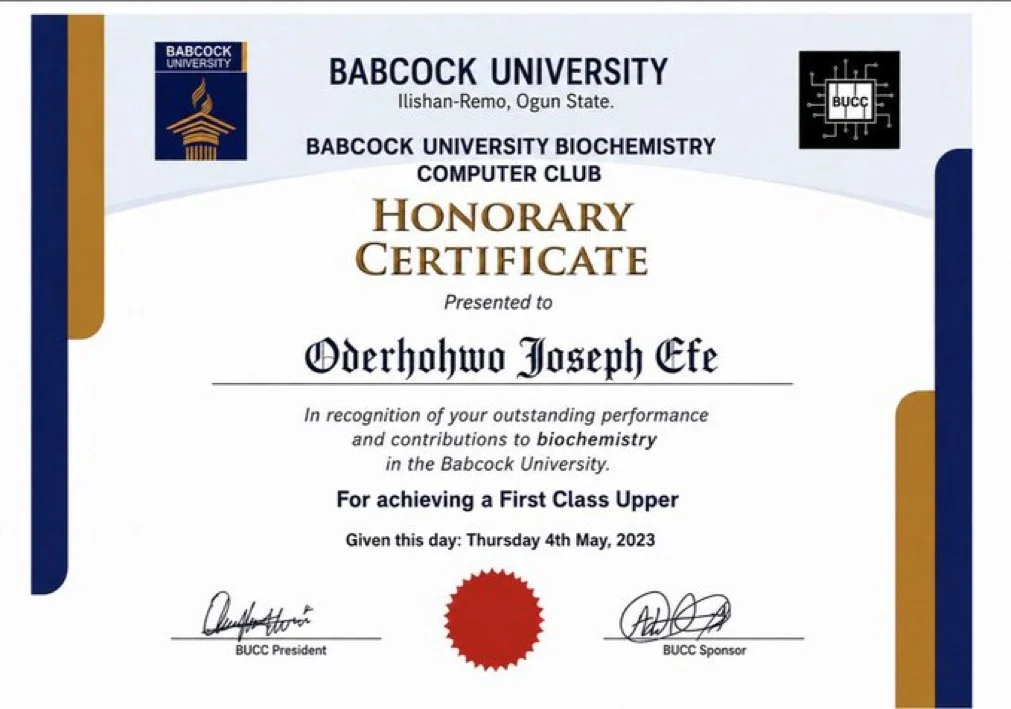
Seeking to reinforce his claim, the comedian later shared what he described as his graduation certificate on his X (formerly Twitter) account. The document suggested that he completed his studies at the university in 2023 and had earned what it described as a “First Class Upper” qualification in Biochemistry.
The certificate quickly attracted widespread attention online, with social media users questioning its authenticity. While some congratulated the entertainer, others pointed out unusual features on the document that appeared inconsistent with standard university certificates.
Responding to the growing controversy, Babcock University released a strongly worded statement distancing itself completely from the certificate.
According to the university, the document was fabricated and bore several glaring inconsistencies that immediately exposed it as fake.
“The attention of Babcock University has been drawn to the circulation of fraudulent documents by certain individuals falsely claiming to have affiliations with, and possessing honorary certificates and academic distinctions purportedly issued by the University,” the statement read.
The institution specifically referenced the certificate circulating in Carter Efe’s name, noting that it was allegedly issued by an organisation identified as the “Babcock University Biochemistry Computer Club.”
University authorities maintained that no such document was issued through its official academic channels.
“Babcock University unequivocally states that this document is false, unauthorized, and does not emanate from the University,” the institution declared.
One of the major discrepancies identified by the university was the academic classification printed on the certificate.
According to Babcock University, the phrase “First Class Upper” does not exist within its academic grading system.
Management explained that the institution only awards “First Class Honours” as its highest undergraduate degree classification, adding that there is no category known as “First Class Upper.”
“There is no academic classification or degree known to Babcock University as ‘First Class Upper’. The recognized classification is First Class Honours,” the university stated.
The institution also rejected any suggestion that it issues honorary certificates to recognise undergraduate academic performance.
It clarified that academic excellence is formally acknowledged only through official degree certificates and academic transcripts processed and issued by the Office of the Registrar after students have successfully completed all graduation requirements.
The university stressed that any document claiming to confer academic honours outside these official procedures should be treated as fraudulent.
The management warned employers, educational institutions, government agencies, professional bodies and members of the public not to rely on the disputed certificate or any other similar document purportedly issued outside its recognised academic system.
According to the university, accepting or relying on forged academic credentials could have serious legal and professional consequences.
Babcock further warned that anyone involved in producing, presenting, circulating or using fake academic certificates to obtain employment, admission into educational institutions, promotion, professional recognition, immigration benefits or any other advantage could be investigated and prosecuted under Nigeria’s laws relating to forgery, fraud and the falsification of academic records.
The institution disclosed that it had already begun taking steps to protect its reputation and preserve the integrity of its academic qualifications.
It revealed that both civil and criminal proceedings are being initiated against individuals or organisations found unlawfully producing or circulating forged documents bearing the university’s name, logo, seal or academic credentials.
“The University has commenced appropriate legal steps to pursue both civil and criminal proceedings against any individual or organisation engaged in the unlawful production, circulation or use of forged documents or misrepresentation of Babcock University’s name, seal, logo or academic credentials,” the statement noted.
In addition to the formal public notice, the university reinforced its position through its verified X account, where it issued what it described as a fraud alert.
The institution warned members of the public to beware of forged certificates currently in circulation, including fake honorary documents bearing the non-existent academic classification of “First Class Upper.”
“Fraud Alert. Babcock University warns the public of forged certificates in circulation, including fake ‘Honorary’ ones with a non-existent ‘First Class Upper’ classification. We do not issue such documents. ‘First Class Upper’ doesn’t exist here. Legal action underway,” the university posted.
The statement has generated significant discussion across social media platforms, with many users debating whether Carter Efe intended the certificate as part of a comedy skit or whether the claim was made seriously during the interview.
As of the time of filing this report, Carter Efe had not publicly responded to Babcock University’s latest statement or addressed the institution’s threat of legal action.
The comedian, who rose to national prominence through his comedy skits and viral online content before expanding into music, has built a large following across social media platforms. His activities frequently generate public attention, and he has often blended humour with exaggerated claims as part of his entertainment style.
Nevertheless, legal experts note that the production or circulation of forged academic credentials, even in the context of entertainment, could attract legal scrutiny if it is deemed capable of misleading members of the public or damaging the reputation of an institution.
Beyond the immediate controversy, Babcock University said the incident underscores the growing challenge posed by forged academic credentials and identity fraud in Nigeria.
The university reiterated its commitment to safeguarding the integrity of its qualifications and preserving public confidence in its academic standards.
It therefore urged employers, educational institutions, government agencies, scholarship bodies, professional associations and all other stakeholders to verify the authenticity of any academic credential purportedly issued by Babcock University before relying on it for official purposes.
According to the institution, all verification requests should be directed to the Office of the Registrar, which remains the only authorised channel for confirming the validity of certificates, transcripts and other academic records.
The university concluded by assuring the public that it would continue taking decisive measures against certificate forgery and any unauthorised use of its academic identity, warning that offenders would face the full weight of the law.