By Dr. Uzor Ngoladi
The abduction of school children and teachers has become one of the gravest threats to education, national security, and human development in Nigeria. What began as isolated incidents over a decade ago has evolved into a disturbing pattern of attacks on educational institutions, leaving thousands of students traumatized, hundreds of teachers endangered, and entire communities living in fear.
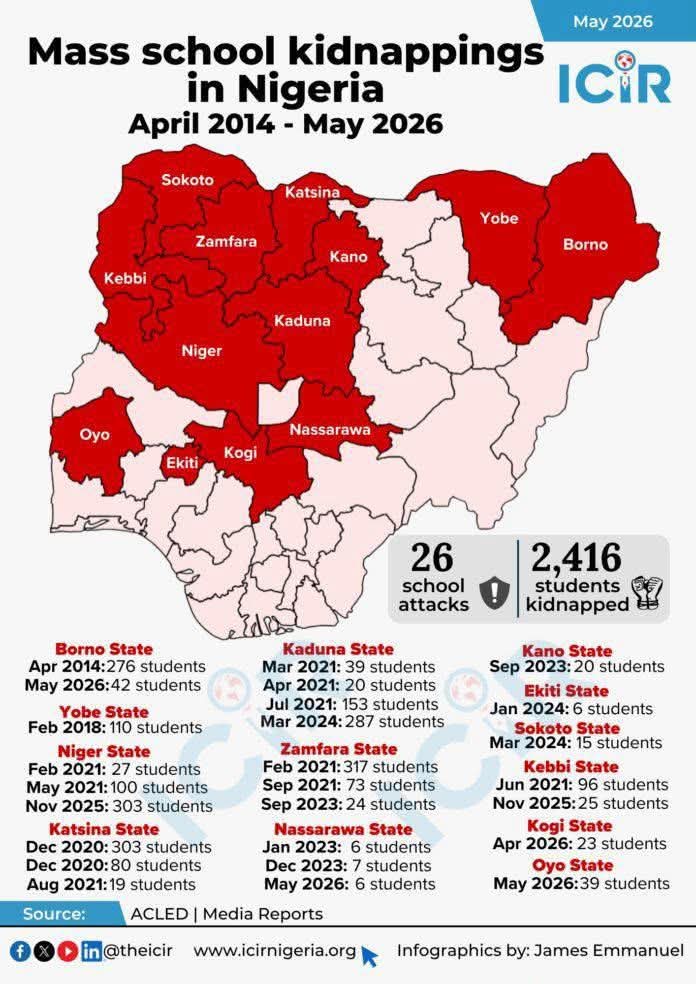
Recent data compiled by the International Centre for Investigative Reporting (ICIR) reveals the alarming scale of the crisis. Between April 2014 and May 2026, Nigeria recorded 26 major school attacks, resulting in the abduction of approximately 2,416 students across several states. Behind these statistics are shattered dreams, disrupted education, devastated families, and a nation struggling to protect its most vulnerable citizens.
The crisis gained international attention in April 2014 when 276 schoolgirls were abducted from Government Girls Secondary School in Chibok, Borno State, by Boko Haram insurgents. The incident sparked the global #BringBackOurGirls campaign and highlighted the vulnerability of schools in conflict-prone areas.
Unfortunately, the Chibok tragedy was not the end. Instead, it marked the beginning of a dangerous trend that has continued to plague the nation. In May 2026, another 42 students were reportedly abducted in Borno State, demonstrating that more than a decade after Chibok, schoolchildren remain targets of criminal and terrorist groups.
The ICIR data shows that school kidnappings have spread across northern and central Nigeria and have recently expanded into parts of the South-West.
Katsina State
Katsina has recorded some of the largest school abductions in the country. In December 2020, 303 students were kidnapped in Kankara. During the same month, another 80 students were abducted, while 19 students were kidnapped in August 2021.
Niger State
Niger State has suffered repeated attacks. In February 2021, 27 students were abducted. In May 2021, another 100 students were kidnapped, while 303 students were taken in November 2025.
Kaduna State
Kaduna has remained one of the epicentres of school kidnappings. The state witnessed the abduction of 39 students in March 2021, 20 students in April 2021, 153 students in July 2021, and 287 students in March 2024.
Zamfara State
The state recorded the kidnapping of 317 students in February 2021, 73 students in September 2021, and 24 students in September 2023.
Other Affected States
School kidnappings have also been reported in Nasarawa, Kano, Yobe, Sokoto, Kebbi, Kogi, Ekiti, and Oyo states. The geographical spread of these attacks demonstrates that no region can afford to consider itself immune.
Perhaps the most disturbing development in recent months is the expansion of school kidnappings into the South-West.
On May 15, 2026, armed terrorists attacked three schools in Esiele and Yawota communities in Oriire Local Government Area of Oyo State. The affected schools were:
- Community Grammar School
- Baptist Nursery and Primary School
- L.A. Primary School
The attackers abducted 39 pupils and students alongside seven teachers, bringing the total number of victims to approximately 46.
The attack was particularly horrifying because it claimed lives. A mathematics teacher, Michael Oyedokun, was brutally beheaded by the attackers. A motorcyclist was also killed, while a security operative lost his life after encountering improvised explosive devices during rescue operations.
Weeks after the abduction, many of the victims remained in captivity, prompting nationwide protests by teachers and education stakeholders.
While much attention has focused on abducted students, teachers have increasingly become targets as well. The killing of Michael Oyedokun in Oyo State illustrates the growing dangers facing educators.
Teachers now operate under constant fear, especially in rural communities where schools often lack perimeter fencing, security personnel, surveillance systems, and rapid emergency response mechanisms.
The situation has become so alarming that the Nigeria Union of Teachers (NUT) declared industrial actions and organized nationwide protests to demand greater protection for teachers and learners.
The teaching profession, already struggling with inadequate remuneration and poor working conditions, now faces an additional threat to life and safety. The consequences of school kidnappings extend far beyond the immediate victims. Many schools have been shut down following attacks. Parents increasingly withdraw their children from school due to security concerns. Nigeria already has one of the world’s highest numbers of out-of-school children. Frequent attacks on schools further discourage enrolment and attendance. Students who survive abductions often suffer long-term emotional and psychological trauma. Teachers and parents also experience anxiety, depression, and fear. Repeated disruptions reduce instructional time and negatively affect academic performanceLoss of Public Confidence Perhaps most damaging is the growing perception that schools are no longer safe spaces for learning.
Several factors contribute to the persistence of school kidnappings.
First, schools are often soft targets with limited security presence. Second, criminal groups view students as valuable hostages capable of generating large ransom payments. Third, weak intelligence gathering and inadequate rural security infrastructure make it easier for attackers to operate.
The convergence of terrorism, banditry, organized crime, and poor governance has created conditions that allow such attacks to flourish.
Call to action
Nigeria must adopt a comprehensive strategy to address this crisis.
Every school should have basic security infrastructure, including perimeter fencing, alarm systems, trained guards, and emergency response plans.
Security agencies must enhance intelligence collection and community-based surveillance to identify threats before attacks occur.
Many vulnerable communities lack roads, communication networks, and security facilities. Improved infrastructure would enhance rapid response capabilities.
Teachers working in high-risk areas should receive hazard allowances, insurance coverage, and additional security support.
Those responsible for attacks must be identified, arrested, prosecuted, and punished to deter future crimes.
Nigeria should collaborate with international partners, educational organizations, and security experts to develop sustainable solutions.
The kidnapping of school children and teachers represents an assault on the future of Nigeria. Every child denied access to education because of fear is a loss to the nation. Every teacher killed or abducted weakens the foundation upon which national development depends.
The statistics are sobering: 26 major school attacks and 2,416 students abducted between 2014 and 2026. Yet behind every number is a human story—a child whose dreams have been interrupted, a teacher whose dedication has been met with violence, and a family living in anguish.
Nigeria cannot build a prosperous future while its classrooms remain under siege. Protecting schools must become a national emergency. The safety of learners and teachers is not merely an educational issue; it is a fundamental requirement for peace, development, and nation-building.
Only through decisive leadership, sustained security reforms, and collective national commitment can Nigeria end the tragic cycle of school kidnappings and restore confidence in education as the pathway to a better future.
Dr. Uzor Ngoladi
Secretary General, Forum of South-East Academic Doctors (FOSAD)
Publisher www.dailyblastng.com & www.uzorngoladi.com