A United States District Court has sentenced a 32-year-old Nigerian national, Atuchukwu Markrufus Onyeanusi, after he was convicted on charges involving visa fraud, the misuse of official documents, and identity-related offences in Rapid City, South Dakota.
The sentencing was announced by United States Attorney Ron Parsons in a statement released by the U.S. Department of Justice on Tuesday, June 9, 2026.
According to the statement, Onyeanusi was sentenced on May 20, 2026, by U.S. District Judge Camela C. Theeler. The court ordered that he serve time already spent in custody, amounting to just under six months, followed by one year of supervised release. In addition, he was directed to pay a fine of $1,000 and a mandatory special assessment of $100 to the Federal Crime Victims Fund.
The case stemmed from an investigation that uncovered the use of fraudulent identification documents and false claims relating to citizenship and employment eligibility in the United States.
Federal authorities revealed that Onyeanusi was initially indicted by a federal grand jury in December 2025 on multiple charges, including fraud and misuse of visas, permits and other official documents, possession and use of false or fraudulent writings, and aggravated identity theft.
After his indictment, Onyeanusi entered a guilty plea on February 27, 2026, admitting to the offences brought against him by federal prosecutors.
Although the defendant held lawful permanent resident status in the United States, investigators discovered that he had allegedly used another person’s identity and official documents to secure employment and obtain credentials under a false name.
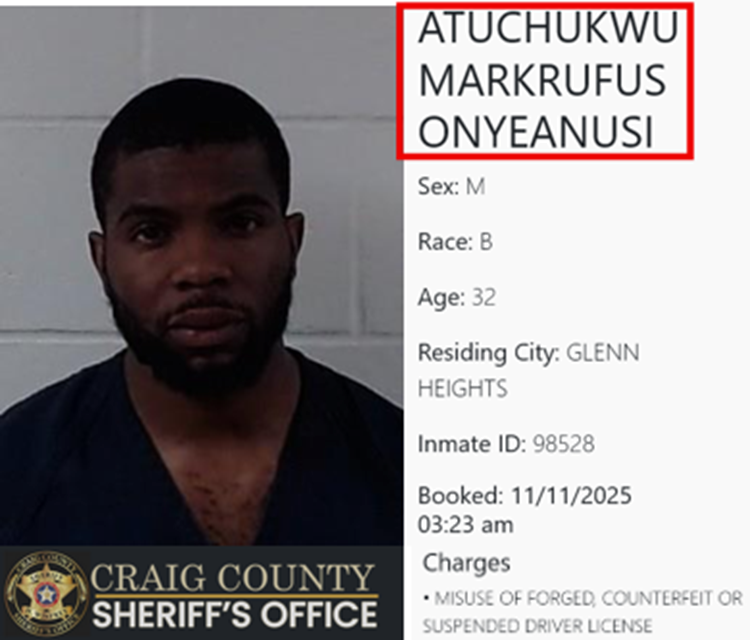
According to court records, the investigation began on November 10, 2025, when law enforcement officers in Oklahoma stopped a vehicle being driven by Onyeanusi for a speeding violation.
During the traffic stop, officers discovered that he was carrying a Texas commercial driver’s licence bearing his photograph but issued in the name of another individual.
Further inquiries revealed that Onyeanusi was also in possession of an employee identification card belonging to the Great Plains Tribal Leaders’ Health Board, an organisation based in Rapid City, South Dakota. The identification card carried the same false identity that appeared on the commercial driver’s licence.
Authorities said the employment card listed Onyeanusi’s position as a “Cyber Threat Analyst,” suggesting that he had gained access to professional employment using the assumed identity.
Investigators subsequently uncovered evidence that the Nigerian national had used the fraudulent Texas commercial driver’s licence, together with a counterfeit Social Security card carrying the same false name, to secure employment with the organisation.
Federal prosecutors said the false documents enabled him to present himself as another individual and satisfy employment verification requirements.
The investigation further established that Onyeanusi had falsely claimed to be a United States citizen while completing an employment immigration verification form required by federal law.
Such forms are used by employers to confirm an employee’s legal eligibility to work in the United States and require applicants to provide truthful information regarding their immigration or citizenship status.
Authorities said the false declaration of U.S. citizenship constituted a serious violation of federal immigration and employment laws and formed part of the charges that ultimately led to his conviction.
In announcing the sentencing, the Department of Justice noted that the case was prosecuted as part of a broader national initiative known as Operation Take Back America.
The programme, launched by federal authorities, is aimed at strengthening immigration enforcement, combating transnational criminal organisations, and addressing various forms of fraud and criminal activity across the United States.
According to the Justice Department, the initiative seeks to mobilise the full resources of federal law enforcement agencies to address illegal immigration, dismantle criminal networks, and improve public safety.
The statement explained that Operation Take Back America combines the efforts of several federal programmes, including the Organized Crime Drug Enforcement Task Forces (OCDETFs) and Project Safe Neighborhoods (PSN), in an effort to streamline enforcement operations and increase coordination among agencies.
Federal officials said the prosecution of Onyeanusi falls within the wider objective of ensuring compliance with immigration, identity and employment laws.
The investigation into the case was conducted by Homeland Security Investigations (HSI) in collaboration with the Craig County Sheriff’s Office in Vinita, Oklahoma.
Assistant United States Attorney Benjamin Schroeder handled the prosecution on behalf of the federal government.
While the sentence imposed spared Onyeanusi from additional jail time beyond the months already served in custody, legal experts note that convictions involving immigration fraud, false identity claims and misrepresentation of citizenship status can carry significant long-term consequences, including potential immigration-related actions and restrictions.
The case highlights the increasing scrutiny being applied by U.S. authorities to document fraud, employment verification violations and identity-related offences, particularly in sectors involving sensitive professional responsibilities.
With the conclusion of the case, federal authorities say they remain committed to investigating and prosecuting individuals who obtain employment or benefits through fraudulent means or who misrepresent their identity or immigration status in violation of U.S. law.