The Economic and Financial Crimes Commission (EFCC) has secured the conviction of 12 individuals for offences bordering on the mutilation and abuse of the Nigerian currency, the naira, before the Federal High Court sitting in Warri, Delta State.
The convictions were secured before Justice Hyeladzira Nganjiwa following the successful prosecution of the suspects by the Benin Zonal Directorate of the anti-graft agency.
The EFCC disclosed the development in a statement published on its official X handle, stating that the defendants were arrested and prosecuted for violating provisions of the Central Bank of Nigeria (CBN) Act by spraying naira notes at a social event.
According to the commission, the convicts were found guilty of tampering with the national currency during a birthday celebration, an offence prohibited under Section 21(3) of the Central Bank of Nigeria Act, 2007.
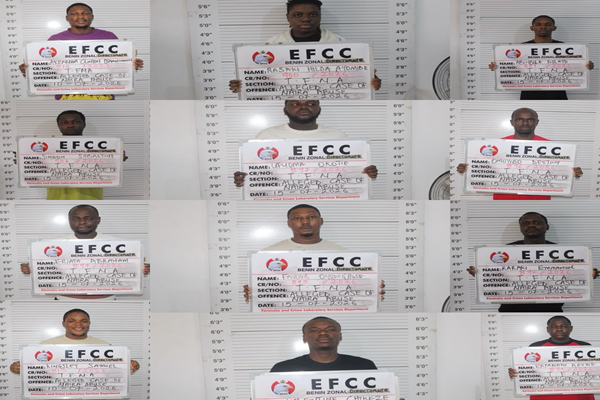
The agency identified the convicted persons as Abimbola Dolapo, Ufuoma Okotie, Samuel Kingsley, Rasaki Ayomide, Ekpmamuku Oghenekewvwe, Abraham Eriata, Favour Onowighose, Karaki Emmanuel Ejioghene, Simeon Sabastine, Valentine Chikeze, Omoyibo Destiny Prince and Akenuwa Clinton Osamudiamen.
The EFCC explained that investigations revealed the defendants engaged in the indiscriminate spraying of naira notes while dancing during the celebration, an act considered a violation of Nigeria’s currency laws.
One of the charges, specifically filed against Akenuwa Clinton Osamudiamen, alleged that he tampered with the sum of ₦20,000 in ₦200 denominations issued by the Central Bank of Nigeria by spraying the notes while dancing at the event.
According to the charge, the act constituted an offence punishable under the provisions of the Central Bank of Nigeria Act.
During the court proceedings, the defendants pleaded guilty to the charges preferred against them.
Following their guilty pleas, prosecution counsel, Francis Jirbo, urged the court to convict and sentence the defendants in accordance with the law.
Jirbo argued that the prosecution had established the offences against the defendants beyond reasonable doubt through their voluntary admissions and the evidence presented before the court.
Counsel representing the defendants, however, pleaded with the court to exercise leniency in sentencing, stressing that the convicts had shown genuine remorse for their actions.
The defence lawyers appealed to the court to temper justice with mercy, noting that the defendants were first-time offenders who had acknowledged their wrongdoing and expressed willingness to obey the law in the future.
After considering the submissions of both parties, Justice Nganjiwa convicted all 12 defendants.
The court sentenced 11 of the convicts to six months imprisonment each, with an option of a ₦150,000 fine.
Akenuwa Clinton Osamudiamen received a slightly stiffer financial penalty, with the court sentencing him to six months imprisonment or the payment of a ₦200,000 fine.
In addition to the custodial sentences and fines, the court directed all the convicts to sign written undertakings pledging to maintain good conduct and refrain from engaging in acts that violate the country’s currency regulations.
The EFCC noted that the undertakings formed part of measures aimed at discouraging repeat offences and promoting greater respect for the Nigerian currency.
The convictions represent another step in the commission’s ongoing campaign against the abuse of the naira, particularly the widespread practice of spraying, mutilating and defacing banknotes during weddings, birthdays, funerals and other social events.
The anti-corruption agency has repeatedly warned that the naira remains a national symbol whose integrity must be protected, urging Nigerians to handle the currency with dignity and in accordance with existing laws.
In a related development, the EFCC disclosed that the same court also granted a final forfeiture order involving several high-value assets linked to convicted internet fraudsters.
According to the commission, Justice Nganjiwa on Friday, July 17, 2026, ordered the forfeiture of seven luxury vehicles to the Federal Government after finding that the automobiles were proceeds of criminal activities.
The anti-graft agency stated that the vehicles had been recovered during investigations into internet fraud and other financial crimes prosecuted by the commission.
The forfeited vehicles include a Mercedes-Benz GLK, a Lexus RX 330, a Mercedes-Benz ML, a Lexus ES 350, a Mercedes-Benz GLKC, a Mercedes-Benz GLC and another Mercedes-Benz GLK.
The EFCC described the court’s decision as a significant victory in its efforts to deprive criminals of assets acquired through unlawful means.
The commission reiterated its commitment to enforcing laws protecting the Nigerian currency while intensifying efforts to trace, recover and forfeit proceeds of crime.
It also urged members of the public to refrain from abusing the naira during social events, warning that anyone found violating the provisions of the Central Bank of Nigeria Act would be investigated and prosecuted in accordance with the law.