Nigeria’s political landscape experienced a dramatic realignment on Sunday as former presidential candidates Peter Obi and Rabiu Musa Kwankwaso formally exited the African Democratic Congress to join the Nigeria Democratic Congress NDC, marking a significant shift in opposition politics ahead of the 2027 general elections.
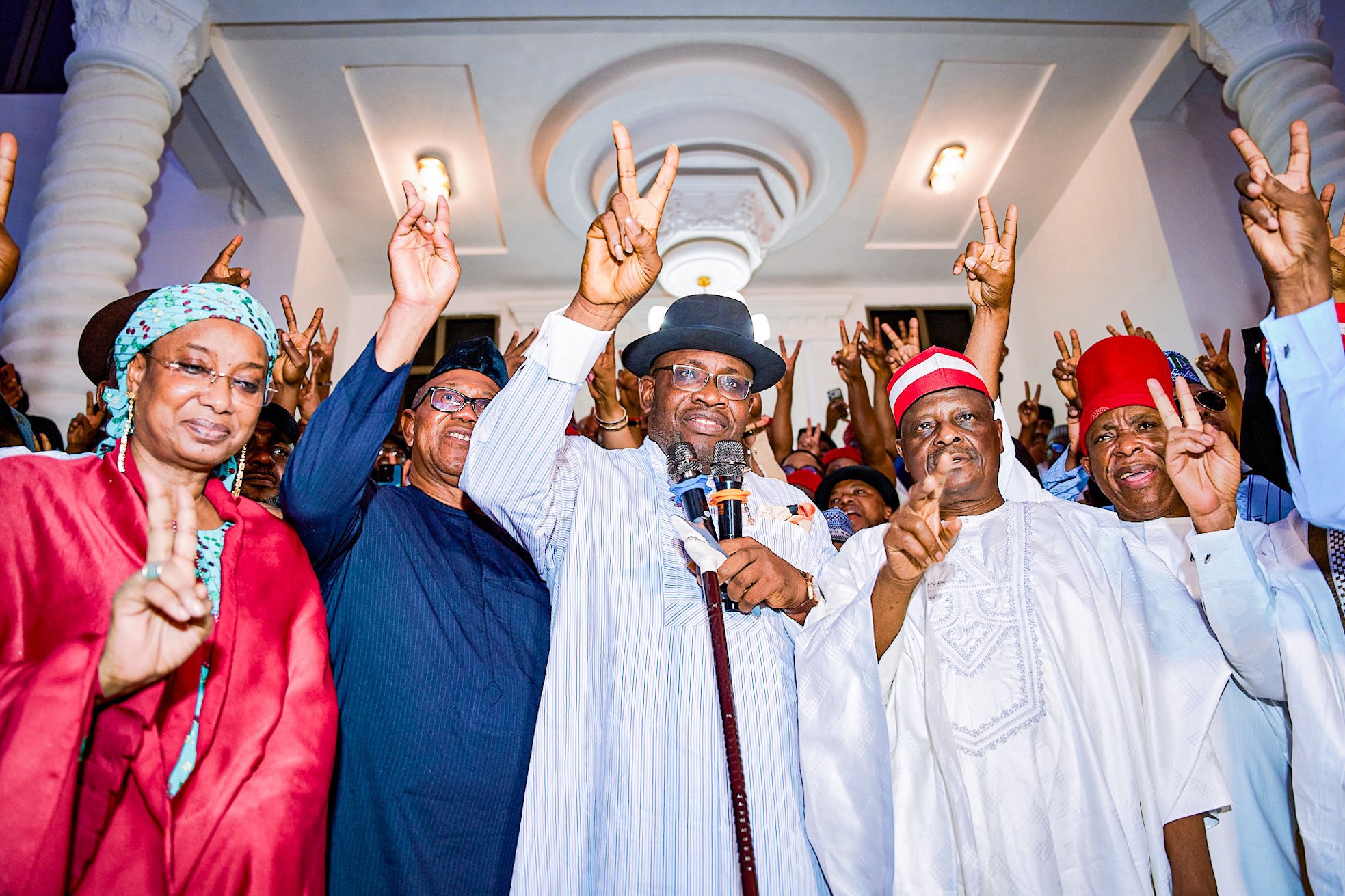
The high-profile defections were sealed in Abuja, where both leaders, accompanied by a large number of supporters and federal lawmakers, arrived at the NDC National Secretariat to conclude their formal entry into the party. Their move signals a consolidation of opposition forces under a new political platform that is rapidly gaining traction across the country.
The development came barely hours after Obi publicly announced his resignation from the ADC, citing deep-rooted structural and internal challenges that he described as increasingly difficult to manage. His exit had already sparked speculation about his next political destination, with the NDC emerging as the most likely platform.
Kwankwaso, who had in recent weeks alluded to ongoing consultations with political allies and stakeholders, confirmed that both he and Obi had reached a consensus to leave the ADC. According to him, the decision was informed by growing uncertainty surrounding the party’s legal and organisational stability.
Sources within the political circle revealed that prior to their arrival at the NDC Secretariat, Obi and Kwankwaso led a delegation of political associates and supporters to the Abuja residence of the party’s National Leader, Seriake Dickson. The meeting, described as strategic and high-level, reportedly focused on finalising the terms of their integration into the party and aligning on a shared political vision.
Following the closed-door session, the delegation proceeded to the party’s headquarters, where they were formally received by members of the National Working Committee and other key stakeholders. The reception underscored the significance of their defection, which is widely seen as one of the most consequential political developments in recent times.
Insiders within the NDC have indicated that the party may have already resolved its presidential ticket ahead of the 2027 elections. According to these sources, Obi is expected to emerge as the party’s presidential candidate, with Kwankwaso likely to serve as his running mate. Although no official announcement has been made, the arrangement is believed to be part of a broader strategy to present a unified and formidable opposition front.
The impact of the defections has been particularly pronounced within the National Assembly, where the ADC is reported to have lost a significant portion of its legislative strength. Many of the lawmakers who had previously aligned with the ADC have now shifted their allegiance to the NDC, effectively weakening the party’s influence at the federal level.
Among those leading the legislative movement is Victor Umeh, who is expected to coordinate the transition of several lawmakers from the South-East region into the NDC. His involvement is seen as critical to consolidating support for the party in that geopolitical zone.
Similarly, Kwankwaso is reportedly spearheading the defection of lawmakers who were originally affiliated with the New Nigeria Peoples Party, further expanding the NDC’s reach and influence. The movement is also said to include key political figures such as Nasiru Gawuna, the 2023 governorship candidate of the All Progressives Congress in Kano State, as well as former Deputy Governor Aminu Gwarzo.
The wave of defections highlights the growing appeal of the NDC as an alternative political platform for opposition figures seeking stability and strategic positioning ahead of the next electoral cycle.
The collapse of the coalition that had begun to form within the ADC appears to have been accelerated by a series of legal and institutional challenges. Kwankwaso had earlier raised concerns about what he described as a “precarious” situation within the party, including uncertainties stemming from a Supreme Court ruling and an application reportedly filed by the Attorney General of the Federation seeking the party’s deregistration.
Although the ADC’s National Publicity Secretary, Bolaji Abdullahi, had dismissed reports suggesting the party was on the verge of collapse, the departure of its most prominent figures and a substantial segment of its legislative base has dealt a severe blow to its credibility and prospects.
Political analysts note that the ADC’s current predicament underscores the challenges faced by opposition parties in maintaining cohesion amid internal disputes and external pressures. The loss of key stakeholders is expected to significantly diminish the party’s capacity to mount a competitive challenge in the 2027 elections.
In contrast, the NDC is rapidly positioning itself as the central hub for opposition realignment. The entry of Obi and Kwankwaso, both influential political figures with established support bases, is likely to enhance the party’s national profile and electoral viability.
Observers believe that the emerging alliance could reshape the dynamics of the 2027 contest, particularly if the NDC succeeds in consolidating support across multiple regions and political blocs. The potential Obi-Kwankwaso ticket is also seen as a strategic combination that could appeal to a broad spectrum of voters.
However, questions remain about how the ruling APC will respond to the growing opposition coalition and whether further defections are likely in the coming months. The evolving political landscape suggests that the period leading up to the 2027 elections will be marked by intense negotiations, shifting alliances, and heightened competition.
For now, the focus remains on the NDC’s ability to integrate its new members, build a cohesive structure, and articulate a compelling policy agenda that resonates with Nigerians.
As the dust settles on this latest political development, one thing is clear: the race toward 2027 has entered a new phase, with the emergence of a reconfigured opposition bloc that could significantly alter the trajectory of Nigeria’s democratic contest.