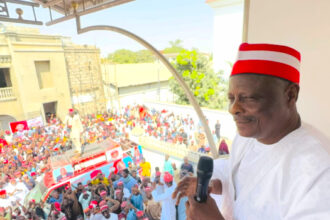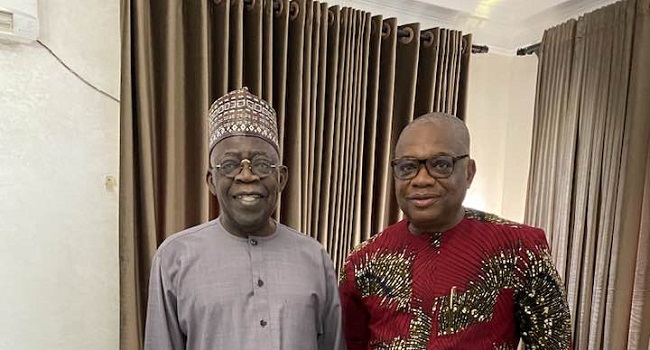
The Chairman of the Senate Committee on the South-East Development Commission, Orji Uzor Kalu, has expressed strong confidence in the political standing of President Bola Ahmed Tinubu ahead of the 2027 general elections, asserting that the incumbent would be difficult to defeat under credible electoral conditions.
Speaking to Senate correspondents on Tuesday prior to an abridged plenary session, the former Abia State governor maintained that the ruling All Progressives Congress (APC) has continued to expand its influence nationwide, while opposition parties remain fragmented and lacking in viable alternatives.
“I don’t think anyone can defeat President Tinubu in a free and fair election,” Kalu stated, projecting confidence in the president’s political machinery and support base. He added that the APC’s growing presence across different regions of the country positions it advantageously ahead of the next electoral cycle.
His remarks come against the backdrop of ongoing political realignments and coalition talks among opposition figures. Notably, discussions have been underway within the African Democratic Congress (ADC) as a potential platform for a broad opposition alliance. Key political actors such as Peter Obi, Atiku Abubakar, and Rotimi Amaechi have been linked to these efforts, which are aimed at presenting a united front against the ruling party in 2027.
Despite these moves, Kalu downplayed the strength of the opposition, describing it as disjointed and lacking the cohesion necessary to mount a serious electoral challenge. He argued that political alliances built on convenience rather than shared ideology or long-term vision are unlikely to pose a significant threat to the APC.
However, the senator’s optimism contrasts with the outcome of the 2023 presidential election, where the combined votes of opposition candidates—including Obi, Atiku, and Rabiu Musa Kwankwaso—surpassed the total secured by Tinubu. Analysts have often pointed to this statistic as evidence that a united opposition could potentially alter the electoral landscape in future contests.
Nevertheless, Kalu insisted that the political dynamics have since shifted, with the APC consolidating its position through strategic alliances and increased support from state governors. According to him, the backing of over 30 governors across the federation reflects the party’s growing dominance and organisational strength ahead of the 2027 polls, which are scheduled for January and February of that year.
Addressing allegations that the APC is interfering in the operations of the Independent National Electoral Commission (INEC), Kalu firmly rejected such claims. He described the electoral commission as an independent institution that deserves public confidence and respect.
“The APC has nothing to do with INEC,” he said. “It is an independent body, and we respect its leadership. Nigerians should take democracy seriously instead of making baseless allegations.”
He further criticised opposition parties and commentators who have raised concerns about the neutrality of the electoral process, warning that such claims, if unsubstantiated, could undermine Nigeria’s democratic credibility both domestically and internationally.
Kalu also dismissed suggestions that the ruling party is exerting undue pressure on governors and political actors to defect to its ranks. According to him, party affiliation remains a matter of individual choice and strategic calculation, rather than coercion.
“If a governor decides to join the APC, that is his business,” he said. “Nobody is forcing anyone. Politics is about negotiation and personal conviction.”
His comments come at a time when Nigeria’s political landscape has witnessed a series of defections, with politicians switching parties in anticipation of the next election cycle. Such movements are often driven by considerations of political survival, access to resources, and alignment with influential power blocs.
On the issue of zoning, particularly speculation that the Senate Presidency might be allocated to the South-East in 2027, Kalu adopted a cautious stance. He stated that he was not aware of any formal arrangement regarding zoning and emphasised that such decisions fall within the prerogative of party leadership.
“It is for the party leadership to decide,” he said. “If anything is given to me, I will accept, but I am not seeking any position.”
The senator also addressed longstanding concerns about the alleged marginalisation of the South-East region in national politics. He dismissed these claims, arguing that successive administrations—including that of former President Muhammadu Buhari—have contributed to the development of the region through various projects and policy initiatives.
According to Kalu, narratives of exclusion are often exaggerated and fail to account for the broader context of national development efforts. He maintained that the current administration has continued to engage with leaders across different regions and generations, fostering a sense of inclusion and cooperation.
Turning to the state of the economy, Kalu acknowledged that while there have been improvements at the macroeconomic level, many Nigerians are yet to feel the impact at the grassroots. He pointed to factors such as insecurity and structural challenges as impediments to the full realisation of economic reforms.
“There is progress at the top level, especially in terms of investor confidence,” he noted. “But at the lower level, people are still facing difficulties. Economic reforms take time to yield tangible results.”
He emphasised that the government’s policy measures should be viewed as part of a long-term strategy aimed at stabilising the economy and creating sustainable growth. While acknowledging public concerns, he urged patience, noting that structural reforms often involve short-term sacrifices before delivering long-term benefits.
As political activities gradually intensify ahead of 2027, Kalu’s remarks reflect the confidence within the ruling party as well as the broader contest for narrative dominance in Nigeria’s evolving political landscape. With opposition forces exploring coalition options and the APC consolidating its base, the stage is being set for what could become a highly competitive electoral cycle.
For now, the senator remains firm in his position: that under conditions he considers credible and transparent, President Tinubu retains a decisive advantage. Whether that assessment holds in the face of shifting alliances and voter sentiment will ultimately be determined at the ballot box.