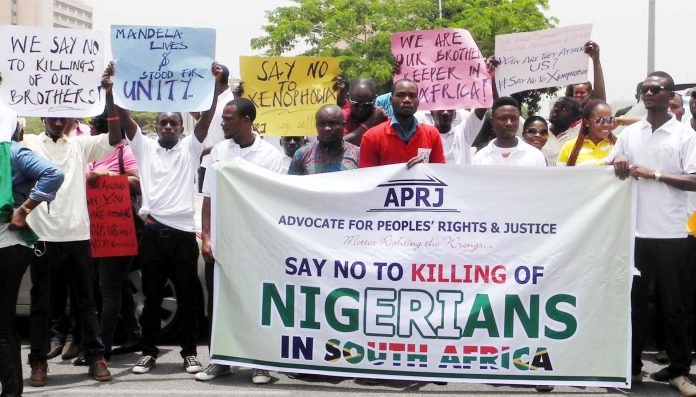
The Federal Government of Nigeria has expressed deep concern over a renewed wave of anti-foreigner protests in South Africa, warning that the situation poses a serious threat to the safety of Nigerians living in the country. The development was disclosed by the Minister of Foreign Affairs, Bianca Odumegwu-Ojukwu, in a detailed situation report issued on Sunday.
According to the minister, President Bola Tinubu has directed that developments be closely monitored, while also calling for stronger protective measures by South African authorities to safeguard Nigerians and other foreign nationals.
Odumegwu-Ojukwu stated that recent weeks have witnessed a surge in protests targeting immigrants, with Nigerians among those most affected. She described the situation as one that has generated widespread anxiety within Nigeria’s diplomatic and diaspora communities.
“There is heightened concern over the series of anti-foreigner protests, which have in several instances targeted Nigerians in select cities across South Africa,” she said, noting that the President had been fully briefed on the matter and had expressed grave concern.
She added that President Tinubu had urged South African security agencies to take more decisive action to prevent escalation and ensure that law and order are maintained.
The minister pointed to disturbing visuals circulating across social media and mainstream platforms, which she said have captured scenes of violence, hostility, and xenophobic rhetoric directed at foreign nationals. These images, she noted, have sparked global condemnation and renewed scrutiny of South Africa’s handling of such incidents.
“The images pervading both mainstream and social media—depicting violence, carnage, and targeted xenophobic attacks—alongside demonstrations marked by hate speech and anti-migrant sentiments, have drawn widespread international criticism,” she said.
Despite these developments, Odumegwu-Ojukwu acknowledged that senior South African officials have publicly condemned xenophobia and extrajudicial violence. Among those who have spoken out are President Cyril Ramaphosa, Home Affairs Minister Leon Schreiber, and Police Affairs Minister Firoz Cachalia, all of whom have reiterated their government’s commitment to protecting all residents regardless of nationality.
She explained that protests organised by a local anti-migration group took place in major urban centres, including Pretoria and Johannesburg, between April 27 and 29, 2026. The demonstrations, she said, were largely contained by a heavy deployment of security personnel.
“The protests, spearheaded by an anti-migration movement, were monitored by heavily armed police officers who employed crowd-control measures, including the use of teargas, to prevent escalation into violence,” she said.
According to the report, no deaths or destruction of Nigerian-owned property were recorded during those specific demonstrations. However, the minister confirmed two separate incidents involving the deaths of Nigerian nationals, allegedly linked to actions by security personnel.
One of the victims, identified as Amamiro Chidiebere Emmanuel, reportedly died on April 25, 2026, after sustaining severe injuries from an alleged assault by members of the South African National Defence Force on April 20 in Port Elizabeth.
In a separate case, Nnaemeka Matthew Andrew was said to have died following an encounter with officers of the Tshwane Metro Police. His body was later discovered at the Pretoria Central Mortuary on April 20, raising further concerns about the treatment of Nigerians by law enforcement agencies.
Odumegwu-Ojukwu described both incidents as unacceptable and called for immediate accountability.
“These incidents are utterly condemnable and cannot be tolerated. The Nigeria High Commission in South Africa is closely monitoring ongoing investigations, and we demand that justice be served,” she said.
The minister further disclosed that another round of protests is expected to take place between May 4 and May 8, 2026, prompting heightened diplomatic engagement between both countries.
As part of its response, Nigeria has summoned South Africa’s High Commissioner to Abuja to provide explanations regarding the unrest and the safety of Nigerian citizens.
Odumegwu-Ojukwu noted that Nigerian diplomatic missions in South Africa are actively collaborating with local authorities to enhance security for Nigerians. She also revealed that the government is making arrangements for voluntary evacuation for citizens who wish to return home.
“The President has made it clear that the safety of Nigerians remains our top priority. We are currently compiling data for Nigerians interested in voluntary repatriation,” she said.
She added that at least 130 individuals had already registered for the evacuation programme, with the number expected to increase as awareness grows.
Reflecting on historical ties, the minister recalled Nigeria’s significant role in supporting South Africa during the anti-apartheid struggle, stressing that such solidarity should not be forgotten.
“Nigeria played a frontline role in the liberation of South Africa, making immense sacrifices during that period. It is therefore deeply troubling that Nigerian lives and businesses are now at risk in that same country,” she said.
She urged South African authorities to renew their commitment to protecting all residents and to ensure that perpetrators of xenophobic violence are held accountable.
Odumegwu-Ojukwu also highlighted concerns that such incidents have become cyclical, often intensifying during politically sensitive periods such as elections.
“This pattern of xenophobic violence has become recurrent, particularly in the lead-up to elections in South Africa,” she observed.
In response to the recurring crisis, Nigeria recently entered into a bilateral agreement with South Africa aimed at establishing early warning mechanisms to detect and prevent violence against citizens of both countries during periods of heightened tension.
The minister reaffirmed Nigeria’s commitment to working collaboratively with South Africa to address the root causes of xenophobia while ensuring the safety and dignity of all foreign nationals.
As tensions persist, the Nigerian government continues to monitor developments closely, balancing diplomatic engagement with protective measures for its citizens abroad. The unfolding situation underscores the urgent need for sustained intervention to prevent further escalation and restore confidence among affected communities.