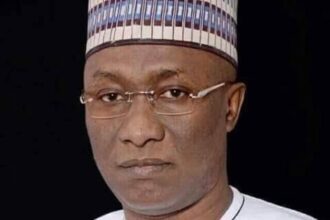
Governor Bala Mohammed of Bauchi State has formally announced his resignation from the Peoples Democratic Party, citing the protracted leadership crisis and deepening internal divisions within the party as the primary reasons for his decision. He has now aligned with the Allied Peoples Movement APM in what he described as a strategic political repositioning aimed at sustaining governance and ensuring electoral viability ahead of future contests.
The governor made the announcement on Saturday following a high-level meeting with political stakeholders in Bauchi State. The meeting was convened to review the implications of a recent ruling by the Supreme Court of Nigeria on the lingering internal disputes within the PDP. According to Mohammed, the judgment has significantly altered the party’s internal dynamics and created further uncertainty about its organisational structure and leadership legitimacy.
Speaking at the gathering, Mohammed disclosed that he had spent over a week in Abuja engaging in consultations with party leaders and stakeholders in an attempt to resolve the crisis. He said these efforts were aimed at restoring cohesion and stability within the PDP, which has been grappling with factional disagreements and competing leadership claims.
However, he noted that the Supreme Court’s decision—particularly its nullification of parallel conventions conducted by rival factions—had effectively deepened the crisis rather than resolving it. The ruling, he explained, stripped both factions of legal standing, thereby leaving a vacuum in the party’s leadership structure.
According to him, the situation has temporarily placed the party’s Board of Trustees in a supervisory role, but without a clear pathway to sustainable resolution. This, he argued, has further complicated efforts to rebuild trust and unity within the party.
“After careful consideration and wide consultations with leaders and stakeholders across the country, it has become clear that our efforts to restore stability have not yielded the desired results,” Mohammed said, explaining the rationale behind his departure.
Despite his decision to leave, the governor expressed gratitude to the PDP for the opportunities it had provided him over the years. He acknowledged the party’s role in his political journey and emphasised that his exit should not be interpreted as an act of hostility or resentment.
“We remain PDP at heart. We are leaving not out of bitterness, but out of necessity—to continue the struggle for good governance,” he stated, framing the move as a pragmatic response to evolving political realities rather than a rejection of the party’s ideals.
Mohammed described his defection to the APM as a calculated step designed to secure a stable political platform free from the legal and organisational challenges currently facing the PDP. He emphasised that the APM offers a structure that is not encumbered by ongoing litigation or leadership disputes, making it a more viable vehicle for political continuity.
He further revealed that members of the Bauchi State Executive Council who intend to contest elective positions have already resigned from their offices in compliance with constitutional and electoral requirements. This, he said, is part of a broader transition strategy aimed at ensuring a smooth realignment of political structures within the state.
Outlining the roadmap for the transition, Mohammed announced the establishment of a compliance committee to oversee the integration process into the APM. He also disclosed plans to commence online membership registration to facilitate the influx of supporters into the new party structure.
In addition, he said his administration would intensify engagement with the national leadership of the APM to strengthen collaboration and align political objectives. This includes planned interactions with the Independent National Electoral Commission to ensure full compliance with electoral regulations and to formalise the transition process.
The governor urged his supporters and political allies to remain calm, focused, and united during the transition period. He emphasised that the move was not abrupt but the result of deliberate consultations and strategic planning.
“This is a deliberate political repositioning,” he said, assuring stakeholders that the decision was taken in the best interest of Bauchi State and its people.
In a related development, the National Chairman of the APM, Yusuf Dantalle, formally welcomed Mohammed and his supporters into the party. Dantalle described the governor’s defection as a significant milestone for the APM and a testament to its growing appeal as an alternative political platform.
He characterised the APM as a party built on principles of integrity, sacrifice, and service, noting that it operates strictly in accordance with its constitution and has remained largely free from internal crises.
“The APM has no internal crisis and continues to function within the framework of its constitution,” Dantalle said, contrasting the party’s stability with the challenges facing other political organisations.
He also highlighted the party’s recent electoral successes, including victories in councillorship positions during local government elections, as evidence of its increasing relevance and grassroots acceptance.
As part of the formal reception, Dantalle presented Mohammed with his membership card and party insignia, symbolising his official entry into the APM. He explained that the party’s symbol—the cassava plant—represents resilience, sustainability, and economic value, qualities he said align with the party’s vision for national development.
Political analysts have described Mohammed’s defection as a major development with potential ripple effects across Bauchi State and beyond. As a sitting governor with significant political influence, his move is expected to reshape the state’s political landscape and possibly trigger further defections.
The development also adds to the growing uncertainty surrounding the PDP, which continues to grapple with unresolved leadership disputes and internal fragmentation. Observers note that the party’s ability to resolve its crisis will be critical to its prospects in future elections.
For the APM, the entry of a high-profile figure like Mohammed represents a significant boost, enhancing its visibility and strengthening its claim as a credible alternative platform in Nigeria’s evolving political environment.
As the political realignments continue to unfold, Mohammed’s decision underscores the shifting dynamics within Nigeria’s party system, where stability, legal clarity, and organisational coherence are increasingly shaping political choices.
With preparations for future elections already underway, the governor’s move signals a new phase in Bauchi State politics—one defined by strategic repositioning, emerging alliances, and a renewed contest for political relevance.