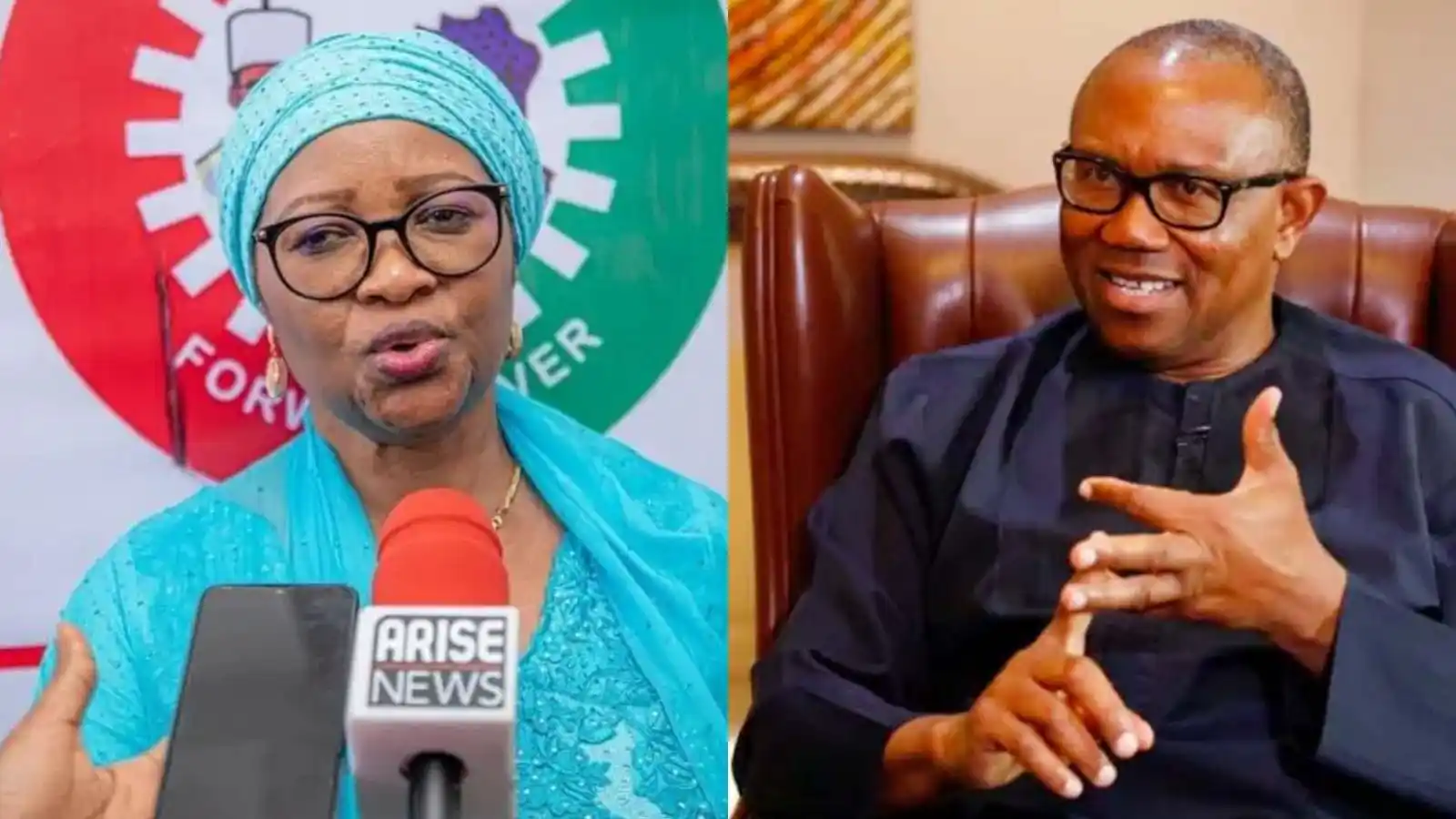
The interim National Chairman of the Labour Party Nigeria, Nenadi Usman, has stated that the party’s 2023 presidential candidate, Peter Obi, may be legally unable to contest the 2027 general election under its platform due to statutory deadlines governing party membership registration.
Speaking during an interview on Arise Television on Wednesday, Usman explained that provisions of the Electoral Act impose strict timelines that political parties must adhere to in compiling and submitting their membership registers ahead of primary elections. According to her, once these timelines lapse, it becomes legally impossible for any aspirant who is not already duly registered to participate in the primaries.
She clarified that the party is required to close its membership register at least 21 days before conducting its primaries and subsequently submit the updated electronic register to the Independent National Electoral Commission (INEC). After this submission, no new entrant can be added for the purpose of contesting elections.
“It will be too late for him to return under such circumstances,” Usman said, noting that the law does not permit retroactive registration. “Once the register is closed and submitted, you cannot bring someone in from outside and expect them to contest. That would be legally impossible.”
Her remarks come amid continued uncertainty surrounding Obi’s political future, following his departure from the Labour Party after months of internal conflict. While Obi has not formally declared his next political move, speculation has persisted about whether he might seek to return to the party that powered his unexpected surge in the 2023 presidential election.
Usman acknowledged Obi’s pivotal role in elevating the Labour Party’s national profile during that election cycle. She revealed that she herself was among those persuaded by Obi to join the party at the time, leaving the Peoples Democratic Party (PDP) in what she described as a principled decision rooted in fairness and equity.
“Peter Obi convinced many of us to come to the Labour Party,” she said. “We believed in the ideals he represented—equity, fairness, and justice. That was what drew a lot of people into the movement.”
She explained that her defection from the PDP was largely influenced by the party’s decision not to zone its presidential ticket to the southern region ahead of the 2023 election. According to her, allowing the contest to remain open, with strong indications that a northern candidate would emerge, undermined the principle of regional balance.
“Even though I come from the North, I believed it was not fair,” she said. “The expectation was that the presidency should rotate to the South, but that did not happen.”
Despite Obi’s past contributions, Usman maintained that the Labour Party must operate within the confines of the law, emphasizing that no individual—regardless of influence—can override statutory requirements.
The developments are unfolding against the backdrop of a prolonged leadership crisis that has engulfed the Labour Party since its strong performance in the 2023 elections. The crisis has revolved around competing claims to the party’s national leadership, particularly between Usman’s caretaker committee and the faction led by former national chairman Julius Abure.
The dispute escalated into a series of legal battles, culminating in a landmark ruling by the Supreme Court in April 2025, which held that Abure’s tenure had expired. This decision was subsequently reinforced by a Federal High Court in Abuja, which formally removed him from office and directed INEC to recognise Usman’s committee as the legitimate leadership pending the conduct of a national convention.
Following these rulings, Usman’s faction assumed control of the party’s national secretariat located in Utako, Abuja. The transition, however, was not without controversy, as allegations emerged from both sides. Usman’s camp accused loyalists of the former chairman of vandalising party property and removing key documents, claims that further deepened divisions within the party.
In a more recent development, the Court of Appeal in Abuja dismissed Abure’s challenge to the earlier rulings, unanimously affirming Usman’s position as interim chairman. The appellate court also directed INEC to engage exclusively with her leadership in all official matters concerning the party.
Despite these legal setbacks, Abure has indicated his intention to approach the Supreme Court once again, suggesting that the leadership tussle is far from over.
The internal crisis has had significant political consequences for the Labour Party. Once buoyed by a surge of grassroots support and youth-driven enthusiasm in 2023, the party has since experienced a wave of defections, shrinking representation in the National Assembly, and a weakening organisational structure at the grassroots level.
Observers note that the instability has eroded much of the momentum that positioned the party as a formidable third force in Nigerian politics.
Obi himself has cited the prolonged leadership disputes as a major factor in his decision to step away from the party. His exit marked a turning point, raising questions about the party’s ability to retain its relevance ahead of the 2027 elections.
In response to the crisis, Usman’s leadership has initiated a process of membership revalidation aimed at rebuilding the party’s base and restoring internal order. As part of its strategic planning for the next election cycle, the party has also zoned its 2027 presidential ticket to the southern region, a move intended to align with broader expectations of political balance.
However, the question of Obi’s potential return—and whether it would be legally feasible—remains a subject of intense debate.
Legal analysts point out that while party constitutions and electoral laws provide frameworks for participation, political negotiations and alliances often play a significant role in shaping outcomes. Nonetheless, Usman’s position underscores a strict interpretation of the law, suggesting that timelines and procedural compliance will be decisive factors.
As the 2027 elections draw closer, the Labour Party faces the dual challenge of resolving its internal disputes and redefining its political strategy in a rapidly evolving landscape.
For now, Usman’s message is clear: the party is open to rebuilding and repositioning, but it will do so within the boundaries of the law—regardless of the stature of those seeking to return.