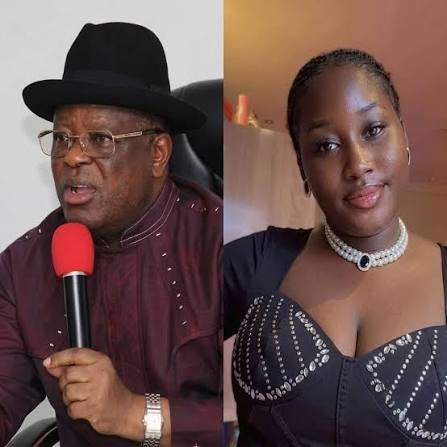
Minister of Works, Senator David Umahi, has publicly addressed the controversy surrounding the death of Miss Mary Habila, a staff member who died at a government guest house within his residence in Uburu, Ebonyi State, insisting that he has no reason to suspect foul play and describing attempts to implicate him in the incident as “politics taken too far.”
Speaking on Thursday during a press conference in Abuja convened to brief journalists on newly approved infrastructure projects by President Bola Tinubu, Umahi gave his first comprehensive account of the circumstances surrounding Habila’s death, which has generated widespread public concern and intense media scrutiny.
The minister described the deceased as someone who was “like a daughter” to him, revealing that she had lived and worked with him for approximately three years and maintained a close relationship with his family throughout that period.
Umahi also clarified reports regarding Habila’s professional background, stating that she was a nurse employed by the Federal University of Health Sciences, Ebonyi State, and not a physiotherapist as had been widely reported in sections of the media.
According to him, the young woman had been battling recurring health challenges long before her death, and he had personally taken responsibility for financing her medical treatment.
“My lawyers have already spoken on my behalf, but there is one important issue I need to correct,” Umahi said.
“The lady in question was like a daughter to me. She stayed with me for about three years. She was a staff member of the Federal University of Health Sciences. She was a nurse and not a physiotherapist. Her family and my family are very close.”
The minister disclosed that Habila had been receiving treatment at a Turkish hospital, with the cost of her medical care reportedly paid by him.
According to Umahi, medical records documenting her treatment were available and could be verified.
“She has her medical records at the Turkish Hospital. We have been paying for her treatment. The last payment was made on April 5, and it cost me N2.2 million. The records are there, and I personally paid the money,” he said.
Giving further details about the events leading to her death, Umahi narrated what he described as Habila’s final conversation with her boyfriend, claiming that she complained of bleeding from her nose shortly before communication between them ended.
According to the minister, the boyfriend advised her to immediately report the bleeding, but she reportedly replied that it had already stopped.
Umahi recounted that the boyfriend initially ended the call after expressing concern that continuing the conversation might worsen the bleeding.
However, he said Habila pleaded with him not to disconnect before the call eventually ended.
“She spoke with her boyfriend around the time she died and told him she was bleeding from the nose,” Umahi said.
“The boyfriend advised her to report it immediately. She told him the bleeding had stopped. He then said he didn’t want to continue talking because it might worsen the situation.”
“She pleaded with him not to end the call, but he eventually did. Three minutes later, he called back, but she was no longer responding.”
The minister added that Habila had also informed her boyfriend that she intended to take a bath before communication suddenly ceased.
According to him, concern was raised after repeated attempts to reach her failed, prompting those around to force open her room.
“Earlier that morning, she had told her boyfriend she was going to take her bath because she had already locked herself inside the room,” Umahi explained.
“When they noticed something was wrong, the door was broken open and she was found dead. The water tap was still running.”
Umahi stressed that the guest house where Habila died was separate from his personal residence and accommodated medical personnel attached to his office.
He argued that it was unfair to hold him personally responsible simply because the incident occurred within premises linked to the Ministry of Works.
“What surprises me in this country is that every unfortunate incident immediately becomes an opportunity for political attacks,” he said.
“There is a guest house where she and other medical personnel stayed. That guest house is very far from where I live.”
“Does it mean that because someone dies in a Ministry of Works guest house, the Minister of Works must automatically be held responsible?”
The minister accused some individuals of exploiting the tragedy for political purposes and urged Nigerians to allow investigators to carry out their work without unnecessary speculation.
“People should be careful about using the unfortunate death of a young woman for politics,” he cautioned.
“If we had any hand in her death, it would affect us and our families. But if we had no involvement and people are making false allegations, they should be careful. Life is spiritual.”
Umahi admitted that Habila’s death had deeply affected him personally, describing her as one of the most committed members of his team.
“It is very painful to me that she died,” he said.
“It will be very difficult to replace her because she was one of my best workers.”
The minister disclosed that despite repeated appeals, members of Habila’s family had so far declined to approve an autopsy because of cultural beliefs.
According to him, he has insisted that the procedure must be carried out before her body is released for burial.
“We have continued to plead with her parents to allow an autopsy because they said it is against their culture,” he explained.
“Through our lawyers, we insisted that an autopsy must be conducted, and I have directed that the body should not be released until that happens.”
Umahi further revealed that he had requested the Inspector-General of Police to transfer the investigation from Ebonyi State to Abuja to ensure maximum transparency and to facilitate further engagement with the deceased’s family.
“We have written to the Inspector-General of Police to transfer the case to Abuja,” he said.
“Let the police also speak with the family and persuade them to allow the autopsy. I am personally appealing to them to meet with the Inspector-General so that this issue can be resolved.”
He also claimed that Habila had experienced similar episodes of nosebleeding during previous official assignments outside Ebonyi State.
According to the minister, the deceased’s boyfriend informed investigators that she had suffered a similar incident while accompanying him on an official trip to Lagos.
“The boyfriend also confirmed that while we were in Lagos, she called him complaining of bleeding from the nose,” Umahi said.
“He advised her to report the matter to me so I could send her back to the hospital, but she refused because she did not want to disturb me. Instead, he advised her to seek treatment at a nearby hospital.”
Umahi urged investigators to obtain the call records between Habila and her boyfriend, insisting that they would provide useful evidence regarding her final moments.
“I have instructed the police to retrieve both call logs,” he said.
“They should examine the conversations between the girl and her boyfriend because they contain the last discussion she had before her death.”
While maintaining that investigations should continue without interference, Umahi insisted that all available information pointed away from criminal activity.
“I do not suspect foul play,” he stated.
“The other lady who shared the apartment with her was asleep in the same room. The room remained locked from the inside and had to be forced open before she was found. The tap was still running because she appeared to have been preparing to bathe.”
The minister also condemned the circulation of photographs allegedly taken after Habila’s death, accusing some police personnel of leaking sensitive images that fueled speculation and misinformation.
He said the controversial photographs were taken at the mortuary before the deceased’s body was prepared.
“When they took her to the mortuary, that was where the photographs were taken,” Umahi alleged.
“They did not even dress her body before taking the pictures and circulating damaging information.”
He vowed to pursue legal action against individuals and media organisations he accused of spreading false reports and engaging in cyberbullying over the incident.
“I have directed my lawyers to take legal action against those involved in cyberbullying and the publication of false information,” he said.
“We are prepared to test the law on this matter.”
The death of Mary Habila has continued to attract nationwide attention, with calls from various groups and members of the public for a transparent investigation into the circumstances surrounding her death. Police investigations remain ongoing, while an autopsy—widely regarded as critical to establishing the exact cause of death—has yet to be conducted due to objections reportedly raised by the deceased’s family on cultural grounds.