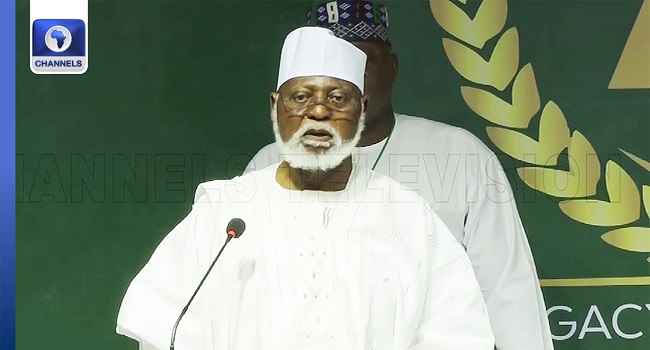
Former Nigerian Head of State, General Abdulsalami Abubakar (retd.), has firmly rejected persistent allegations that the late Chief Moshood Kashimawo Olawale (MKO) Abiola was poisoned while in detention, revealing that an international team of medical experts concluded that the acclaimed winner of the June 12, 1993 presidential election died of natural causes.
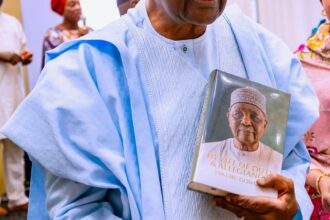
Abdulsalami made the disclosure in his newly released autobiography, Call of Duty, where he provided a detailed account of the events surrounding Abiola’s death on July 7, 1998, while in government custody. The former military leader used the memoir to address longstanding controversies and conspiracy theories that have surrounded one of the most sensitive episodes in Nigeria’s political history.
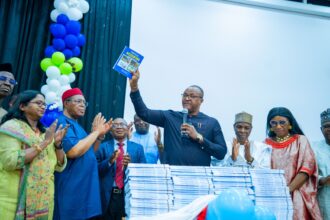
The 264-page autobiography was unveiled during a ceremony held at the Presidential Villa in Abuja as part of activities marking Abdulsalami’s 84th birthday. In the book, he recounted the final moments of Abiola’s life and defended the actions of his administration following the detention of the businessman and politician who became a symbol of Nigeria’s democratic struggle.
According to Abdulsalami, there was no evidence whatsoever to support claims that Abiola was deliberately poisoned. He stated that following the politician’s death, members of the family requested an independent autopsy, prompting the government to assemble a team of pathologists from four countries to determine the actual cause of death.
“I do not believe Abiola was poisoned,” Abdulsalami wrote. “The family requested an autopsy and we assembled American, British, Nigerian and Canadian pathologists to conduct it. The autopsy report attributed his death to natural causes.”
Abiola’s death remains one of the most debated events in Nigeria’s political history. He had been detained since 1994 after declaring himself president following the annulment of the June 12, 1993 presidential election, an election widely regarded as the freest and fairest in the country’s history.
His detention became a rallying point for pro-democracy activists both within and outside Nigeria. Consequently, his sudden death in custody in 1998 sparked widespread outrage and fuelled numerous conspiracy theories. Many Nigerians believed he had been deliberately eliminated to prevent his release and possible assumption of office.
Abiola died barely one month after the sudden death of General Sani Abacha, the military ruler under whose regime he had been detained. The close timing of both deaths further intensified public suspicion and speculation.
However, Abdulsalami’s memoir presents a different narrative, one rooted in medical evidence and eyewitness accounts.
The former Head of State disclosed that Abiola had a history of serious health challenges before his death. He referenced a medical examination conducted in 1994 by Colonel (Dr.) O. Awofeso, then Chief Consultant Radiologist at the Nigerian Army Defence Hospital in Sokoto.
According to the medical findings cited in the book, Abiola had an enlarged heart and symptoms consistent with hypertensive heart disease, conditions that could significantly increase the risk of fatal cardiovascular complications.
Abdulsalami argued that these pre-existing health conditions played a major role in the events that led to Abiola’s death and should not be ignored in any objective assessment of the circumstances.
The former military ruler also drew from the memoir of former United States Assistant Secretary of State for African Affairs, Susan Rice, titled Tough Love: My Story of the Things Worth Fighting For. Rice was part of the American delegation that met with Abiola on the day he died.
According to Rice’s account, the meeting began normally but quickly took a troubling turn when Abiola developed a persistent cough. What initially appeared to be a minor discomfort soon escalated into severe and continuous coughing.
Rice reportedly observed that Abiola’s ankles were swollen, a symptom often associated with cardiovascular problems and fluid retention.
Abdulsalami stated that during the meeting, Abiola complained about feeling unusually hot and requested that the air-conditioning in the room be increased. Shortly thereafter, his condition deteriorated rapidly.
The former Head of State also cited remarks attributed to former U.S. Undersecretary of State for Political Affairs, Tom Pickering, who was also present during the meeting.
According to Pickering, Abiola experienced breathing difficulties and at one point excused himself to use the restroom. When he returned, he appeared visibly distressed and unwell.
“Had trouble breathing, went into the toilet and came out obviously very distressed,” Pickering reportedly recalled.
Witnesses at the meeting immediately recognised that the situation was serious and rushed to assist him.
Pickering recounted how those present acted swiftly to secure medical attention after discovering that an ambulance was not immediately available.
“We all helped to put him in a car; there was no ambulance immediately available. We followed him to the clinic of the Head of State of Nigeria, where doctors immediately began to work on him, but unfortunately at the end of their efforts it was not possible and he died,” Pickering was quoted as saying.
Abdulsalami also offered a personal account of how he received the news of Abiola’s death, describing it as one of the most shocking moments of his presidency.
According to him, his Chief Security Officer, Abdulrasheed Aliyu, contacted him with the devastating information.
“Aliyu, my CSO, called me. As soon as I picked, he said, in a shaky voice, that there was a problem. I asked, ‘What problem again?’ He said Abiola was dead. My head went blank,” Abdulsalami wrote.
He further described the emotional atmosphere that followed, particularly during his interaction with members of Abiola’s family. The former military leader recalled that one of Abiola’s daughters broke down in tears upon receiving the news and was comforted by Susan Rice.
Addressing public suspicions that have lingered for nearly three decades, Abdulsalami argued that permitting the American delegation to meet with Abiola on the day of his death actually helped prevent more damaging allegations from emerging.
According to him, had the government denied the delegation access to the detained politician, critics would likely have accused the administration of concealing the circumstances of his death.
“If we had not allowed the American delegation to see him and he had died in custody, it would have been a different story. It would have been insinuated that he had long died and we were trying to cover it up,” he stated.
Beyond the Abiola controversy, Abdulsalami also used the memoir to respond to another longstanding allegation—that he received $500 million following the death of General Sani Abacha.
The former military ruler categorically denied the claim, describing it as baseless fiction.
“I want to put it on record that nobody gave me $500 million or any amount, bigger or smaller,” he wrote.
Questioning the credibility of the allegation, he added: “Is it possible to collect half a billion dollars in cash and only one person in the world would know about it?”
Abdulsalami succeeded Abacha as Nigeria’s Head of State in June 1998 and is widely credited with overseeing the transition from military rule to democratic governance. His administration organised elections that culminated in the inauguration of former President Olusegun Obasanjo on May 29, 1999, bringing an end to decades of military dominance in Nigerian politics.
With the publication of Call of Duty, Abdulsalami has sought to provide his own account of some of the most controversial events in Nigeria’s recent history, including the death of MKO Abiola—an event that continues to shape national discourse on democracy, justice, and political accountability.