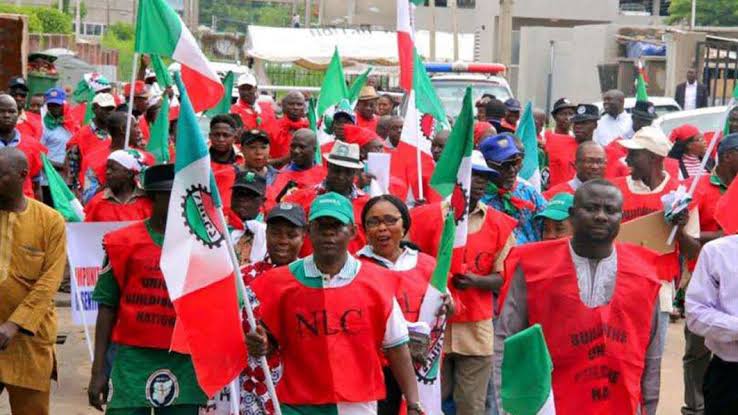
The Nigeria Labour Congress (NLC) has condemned the latest increase in the price of Premium Motor Spirit (PMS), popularly known as petrol, describing the development as “avoidable and unacceptable” and questioning why the Federal Government has not done enough to guarantee adequate supplies of Nigerian crude to the Dangote Petroleum Refinery.
The labour centre warned that the latest increase would further worsen the economic hardship confronting millions of Nigerians, particularly workers and low-income households already struggling with rising transportation costs, food prices and other basic expenses.
The acting General Secretary of the NLC, Benson Upah, stated this in an interview while reacting to the latest adjustment in petrol prices.
Upah expressed concern that the continuous increases were placing additional pressure on households whose incomes have already been severely affected by the high cost of living.
“This adds to the increasing difficulties of the average Nigerian for whom life has been Hobbesian,” he said.
The NLC official also questioned the rationale behind the latest increase, arguing that it was difficult to justify at a time when international crude oil prices were falling and Nigeria was seeking to increase domestic refining.
According to Upah, the Federal Government should do more to ensure that domestic refineries, particularly the Dangote refinery, have access to sufficient quantities of Nigerian crude.
“The latest increase is avoidable and unacceptable in light of falling prices in the international market and our local capacity to sell more crude oil to Dangote. Why are we not doing so?” he asked.
The labour movement’s reaction followed another increase in the price of petrol by the Dangote Petroleum Refinery, which has generated fresh concerns among motorists, transport operators, businesses and households.
The refinery reportedly increased its petrol gantry price by N65 per litre on Saturday, raising it from N1,200 to N1,265 per litre.
The latest adjustment came only three days after the refinery had raised the price from N1,185 to N1,200 per litre.
It was the third adjustment recorded by the refinery within eight days. On August 21, the company increased its gantry price from N1,165 to N1,185 per litre.
Cumulatively, the three adjustments added N100 to the refinery’s petrol price, representing an increase of about 8.6 per cent within eight days.
The latest development has begun to affect prices across the downstream petroleum market, with retail prices varying depending on location, transportation expenses, logistics and distribution costs.
Reports indicated that petrol was selling for around N1,310 per litre in some parts of Lagos and Ogun States. In some northern states and areas farther away from the refinery, prices had reportedly risen to N1,350 or more, with the commodity approaching N1,400 per litre in some locations.
The price increases have renewed concerns over the continuing impact of the removal of petrol subsidy in 2023.
The subsidy removal fundamentally changed Nigeria’s petroleum pricing structure, exposing consumers to fluctuations in international crude oil prices, foreign exchange movements and other market-related costs.
Before the subsidy was removed, petrol prices were heavily regulated by the government, with the state absorbing a significant portion of the cost. Since the policy change, however, petrol prices have undergone several adjustments, each of which has had wider implications for the Nigerian economy.
The latest increase has consequently revived questions about the extent to which domestic refining can shield Nigerians from international market pressures.
Nigeria is one of Africa’s major crude oil producers, while the Dangote refinery represents one of the largest investments in the country’s downstream petroleum sector.
The refinery has a stated capacity to process about 650,000 barrels of crude oil per day and was expected to significantly reduce Nigeria’s dependence on imported refined petroleum products.
However, access to sufficient quantities of locally produced crude has remained a contentious issue.
The supply challenge has raised questions about how effectively Nigeria’s crude resources are being connected to its expanding domestic refining capacity.
Recent figures from the Nigerian Upstream Petroleum Regulatory Commission indicated that oil producers offered 68.1 million barrels of crude to the Dangote refinery during the second quarter of 2026.
The refinery’s stated requirement for the period was 63 million barrels. However, the refinery reportedly accepted 52.6 million barrels, leaving the volume actually taken below both the amount offered and the refinery’s stated requirement.
The figures have added complexity to the debate over domestic crude supply, suggesting that the issue is not simply about the quantity of crude available.
Questions around pricing, commercial arrangements, crude quality, transportation and delivery terms can also affect transactions between producers and domestic refineries.
The NLC’s position, nevertheless, is that the Federal Government must take stronger steps to address the structural challenges affecting domestic refining.
The labour movement believes greater access to locally produced crude could help domestic refineries operate more efficiently and potentially reduce some of the pressures contributing to rising prices.
The debate is particularly significant because the emergence of large-scale domestic refining was expected to strengthen Nigeria’s energy security.
For decades, Nigeria exported crude oil while importing substantial quantities of refined petroleum products. This created a structural vulnerability in which consumers remained exposed to international petroleum prices, shipping costs, foreign exchange pressures and disruptions in global supply chains.
The development of domestic refining capacity was expected to reverse part of that pattern by allowing more Nigerian crude to be processed within the country.
But for ordinary Nigerians, the benefits remain difficult to appreciate when petrol prices continue to rise.
The latest price increase is particularly significant because of the central role petrol plays in the Nigerian economy.
Transportation is heavily dependent on petrol, meaning increases at the pump can quickly translate into higher fares for commuters and increased distribution costs for businesses.
The impact also extends to food prices. Farmers and traders depend on transportation to move agricultural produce from rural communities to urban markets. When fuel costs increase, the additional expense can be transferred through the supply chain until it reaches consumers.
Small and medium-sized businesses are also affected. Many enterprises rely on petrol-powered generators because of persistent electricity challenges. An increase in petrol prices therefore raises their operating costs and can force them to increase the prices of goods and services.
For workers, particularly those on fixed incomes, the consequences can be severe.
Higher transport fares consume a larger portion of monthly salaries, leaving households with less money for food, rent, healthcare, education and other necessities.
This explains the NLC’s concern that the latest petrol price adjustment could deepen the economic difficulties already confronting Nigerian workers.
The labour movement has consistently argued that wage increases alone cannot adequately protect workers if the prices of essential goods and services continue to rise rapidly.
The latest development has therefore placed renewed pressure on the government to address the factors responsible for rising energy costs while ensuring that the country’s natural resources generate tangible benefits for citizens.
The reported increase in Nigeria’s crude production also adds another dimension to the debate.
According to the figures contained in the report, Nigeria’s crude production averaged 1.72 million barrels per day in the second quarter of 2026, compared with 1.55 million barrels per day in the first quarter.
The combination of higher crude production and increased domestic refining capacity has consequently intensified expectations that Nigerians should begin to experience greater stability in petroleum prices.
For the NLC, the central issue is whether Nigeria is maximising its domestic resources to protect consumers from unnecessary economic pressure.
While the government operates within a market-oriented petroleum pricing environment, Upah’s comments suggest that labour believes policy decisions regarding crude allocation and domestic refining can still influence the final cost paid by consumers.
The latest petrol price increase has thus reopened a broader debate about Nigeria’s petroleum reforms and whether the country is adequately leveraging its crude resources and refining capacity.
As motorists, transport operators, businesses and households adjust to the new prices, the NLC is demanding greater government intervention in the domestic crude supply framework.
At the heart of the labour movement’s position is a simple question: if Nigeria is producing crude oil and has a major refinery capable of processing it locally, why should Nigerians continue to face repeated and substantial increases in the price of petrol?
For the NLC, finding a credible answer to that question is essential to preventing further deterioration in the living standards of ordinary Nigerians.