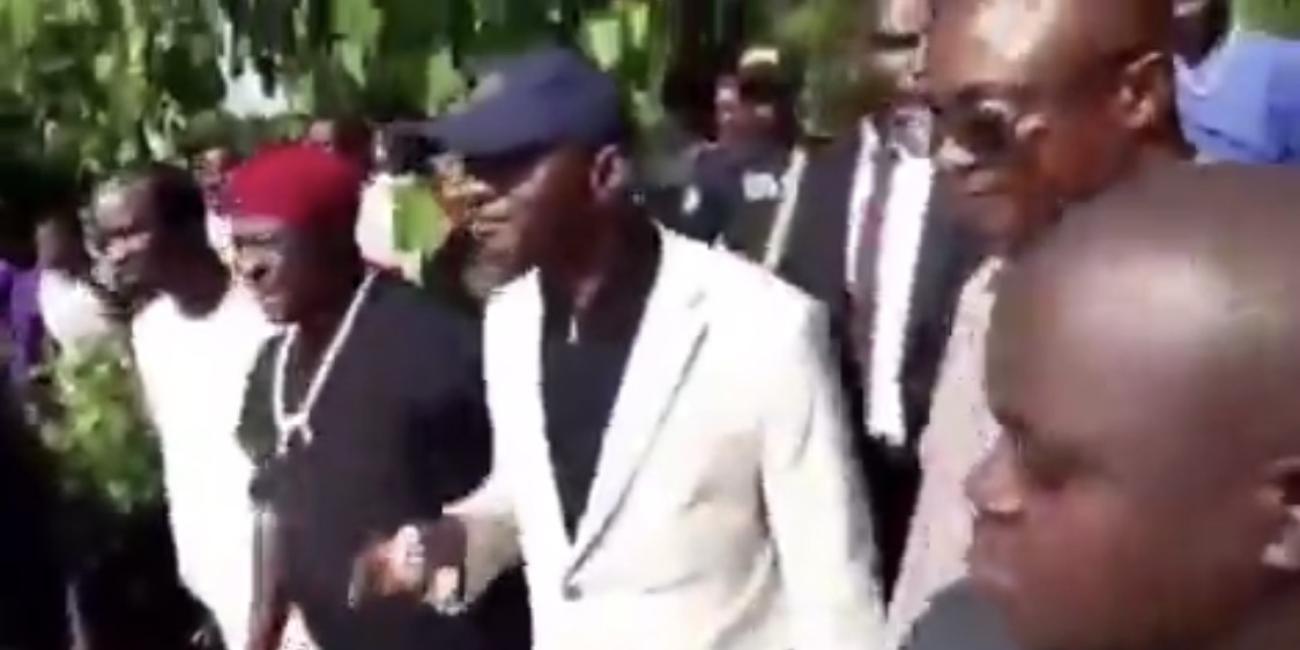
Senator Peter Nwebonyi, representing Ebonyi North Senatorial District, has come under criticism after campaigning in a community where the absence of a bridge prevented him from physically crossing a river to meet residents.
Nwebonyi, a member of the All Progressives Congress (APC), was captured in a video addressing residents from the opposite bank of the river during a political campaign. The unusual scene has generated widespread reactions on social media, with many Nigerians questioning the state of infrastructure in the community and the priorities of elected officials seeking the support of residents.
The video showed the senator speaking to residents gathered on the other side of the river while he remained unable to cross because the community reportedly has no bridge connecting the two sides.
The incident has drawn attention to what critics described as the infrastructure deficit confronting some rural communities in Ebonyi State, particularly the lack of basic road and bridge infrastructure needed to facilitate movement, economic activities and access to essential services.
During the campaign, Nwebonyi appealed to residents to support the APC, describing the party as the dominant political platform in the state.
He also declared that it was the turn of the Izzi people to produce the next governor of Ebonyi State, apparently referring to the political arrangement within the state ahead of the 2027 elections.
“It is Izzi’s turn for governorship. We don’t want any other party in Izzi. Anyone who allows other political parties to exist in his village is an enemy of Izzi,” Nwebonyi said in the video.
He further dismissed opposition parties, including the Peoples Democratic Party (PDP) and the All Progressives Grand Alliance (APGA), while urging residents to remain committed to the APC.
“The only working party is APC. Some came calling themselves APGA, PDP; don’t mind them. The only party we have is APC,” he said.
The senator also acknowledged the immediate challenge posed by the river and the lack of a crossing facility.
“What we are praying for now is for water to subside in this river. Any moment the water subsides in this river, we will start work here,” he said.
The statement has become a major point of discussion, particularly because it appeared to suggest that work on the area could commence after the water level receded.
Critics, however, questioned why such basic infrastructure had not already been provided in the community, especially given that the area is represented at the National Assembly by an elected senator.
The video quickly spread across social media platforms, prompting reactions from Nigerians who expressed frustration over what they described as the contradiction between political campaigning and the condition of the community.
Some commentators argued that the scene symbolised the disconnect between politicians and the communities they represent, particularly where residents continue to struggle with inadequate roads, bridges, healthcare facilities, schools and other basic infrastructure.
One social media user, @mouthpieceof042, drew attention to Nwebonyi’s previous comments concerning villages and informal settlements around the Nnamdi Azikiwe International Airport in Abuja.
The user accused the senator of being more concerned about infrastructure and appearances in Abuja than conditions in his constituency.
Another user, @Ndubuezemartin1, criticised the senator’s campaign appearance and questioned why residents would vote for a politician whom the user accused of abandoning them after elections.
“What a shame. Our politicians have no shame at all!” another user, @idris_senator, wrote in reaction to the video.
Other reactions focused specifically on the irony of a senator campaigning for votes from across a river that lacked a bridge.
One user, @emzyngb1, wrote that the river could become an obstacle that politicians would conveniently forget after the election.
The reactions reflected a broader frustration among some Nigerians over what they regard as the tendency of politicians to seek votes from communities without adequately addressing their most pressing developmental needs.
Another user, @Azuanuuka1, expressed concern that residents had gathered to listen to the campaign despite the obvious infrastructure challenges confronting the community.
Similarly, @ghostmode0013 called on Nigerians to become more politically conscious and demand accountability from elected representatives.
The controversy also generated comments about regional development disparities, with some users comparing the situation with infrastructure standards in other parts of the country.
Nwebonyi’s campaign remarks must also be viewed against the political significance of Izzi in Ebonyi State. The incumbent governor, Francis Nwifuru, hails from Ebyia Development Centre in Izzi Local Government Area, making the senator’s declaration about the governorship aspirations of the Izzi people politically significant.
By openly stating that “it is Izzi’s turn” to produce the next governor, Nwebonyi appeared to be reinforcing a local political argument concerning power rotation and the distribution of political offices in the state.
His insistence that there should be no opposition parties in Izzi also attracted criticism, with some Nigerians describing the statement as incompatible with the principles of multiparty democracy.
Nigeria’s Constitution provides for democratic participation and political competition, while political parties remain central to the electoral process. Critics therefore argued that residents should be free to support whichever political party or candidate they choose without being branded enemies of their community.
The incident has consequently generated two separate but related debates: the condition of infrastructure in the affected community and the tone of political mobilisation ahead of the 2027 elections.
For residents of rural communities, the absence of bridges can have serious consequences, affecting access to markets, schools, healthcare facilities and employment opportunities. During periods of high water levels, such communities may become particularly difficult to access, further isolating residents.
The situation also raises questions about the responsibilities of elected representatives. While senators primarily perform legislative and oversight functions at the federal level, constituents often expect them to facilitate development projects and advocate for infrastructure that addresses pressing local needs.
Nwebonyi’s promise that work would begin once the water level subsides may therefore increase expectations among residents who have long needed a reliable means of crossing the river.
The episode has also highlighted the increasingly important role of social media in scrutinising political activities. A short campaign video that might once have remained within the local community has now generated national attention, allowing Nigerians to debate the condition of infrastructure and the performance of elected officials.
As the 2027 political season approaches, the incident is likely to reinforce demands for politicians to focus their campaigns not only on party loyalty and electoral calculations but also on concrete development plans.
For communities facing basic infrastructure challenges, promises of political representation may mean little without tangible improvements in roads, bridges, education, healthcare, water supply and economic opportunities.
The controversy surrounding Nwebonyi’s riverbank campaign has therefore become more than an unusual campaign moment. It has exposed a deeper question about the relationship between politicians and the people they seek to represent: whether elections should be primarily about securing votes or providing measurable solutions to the everyday problems confronting constituents.
With the 2027 elections approaching, residents across Ebonyi and other parts of Nigeria will increasingly be watching political campaigns through the lens of performance, accountability and development. In communities where people still struggle to cross rivers because there are no bridges, such expectations are likely to be particularly strong.
Watch video: