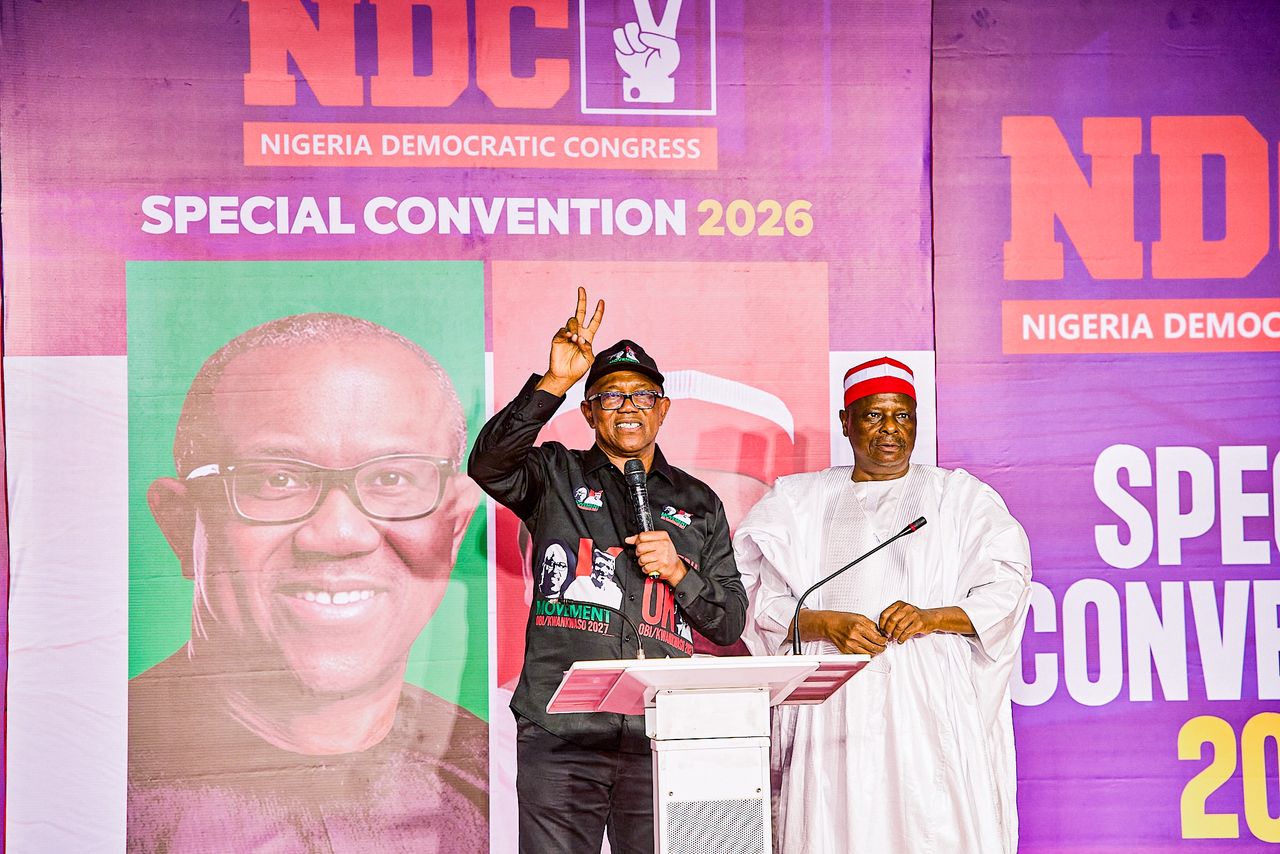
The presidential candidate of the Nigeria Democratic Congress (NDC), Mr. Peter Obi, has formally unveiled Senator Rabiu Musa Kwankwaso as his running mate for the 2027 presidential election, promising that the former Kano State governor will play a central role in governance and decision-making if the party wins power.
Obi made the declaration during his acceptance speech after being affirmed as the NDC presidential candidate, describing the vice-presidential position under his administration as a true partnership rather than a ceremonial office.
According to Obi, his administration would depart from the traditional practice where vice presidents are often sidelined from major policy decisions, stressing that Kwankwaso would be actively involved in shaping and implementing government programmes.
“I will make democracy work, and the Vice President will be a partner, not a spare tyre,” Obi stated while formally accepting the party’s nomination and announcing Kwankwaso as his running mate.
The announcement marks a major political alliance ahead of the 2027 general elections, bringing together two of the most influential opposition figures in Nigeria. Both Obi and Kwankwaso contested the 2023 presidential election on separate platforms and emerged among the strongest challengers to the ruling establishment.
In the 2023 election, Obi, who contested under the Labour Party, finished third, while Kwankwaso, who flew the flag of the New Nigeria Peoples Party (NNPP), came fourth. Former Vice President Atiku Abubakar and President Bola Ahmed Tinubu placed second and first respectively.
Kwankwaso’s strong political base in Kano State and his extensive grassroots network through the Kwankwasiyya movement are expected to strengthen the NDC’s electoral prospects, particularly in northern Nigeria.
In his acceptance speech, Obi described his nomination as a solemn call to national service at a time when Nigeria faces serious economic, social, and security challenges.
He expressed gratitude to the leadership of the NDC, including National Chairman Seriake Dickson, the National Secretary, members of the National Working Committee, and party supporters across the country for their confidence in his leadership.
According to Obi, Nigeria currently stands at a critical crossroads and requires courageous, visionary, and accountable leadership to address the mounting challenges confronting citizens.
He said the nation was facing growing insecurity, widespread poverty, rising unemployment, declining public trust in government institutions, and deepening divisions that threaten national cohesion.
Obi emphasized that the central objective of his administration would be the construction of a “New Nigeria” founded on justice, inclusiveness, economic productivity, national unity, and accountable governance.
Speaking on national unity, the former Anambra State governor warned against the politics of ethnicity, religion, and regionalism, arguing that Nigeria’s diversity should be a source of strength rather than conflict.
He stressed that the country can only achieve meaningful progress when citizens begin to see themselves first as Nigerians regardless of ethnic, religious, or regional differences.
On security, Obi expressed concern over what he described as the worsening security situation across the country, citing international assessments that show Nigeria’s increasing vulnerability to terrorism and violent criminal activities.
He noted that Nigeria had moved from being ranked among the countries most affected by terrorism to occupying increasingly troubling positions in global terrorism impact reports.
According to him, the country’s worsening security profile contrasts sharply with its historical reputation as a leading contributor to international peacekeeping and conflict resolution efforts.
Obi recalled the significant role Nigerian military personnel have played in peacekeeping operations across Africa and beyond, including missions in Liberia, Sierra Leone, Rwanda, Sudan, Mali, Congo, Lebanon, Cambodia, Haiti, Western Sahara, and Kuwait.
He praised the professionalism and sacrifice of Nigerian military personnel and pledged to provide them with the necessary support, equipment, intelligence resources, and welfare packages to effectively combat insecurity.
“The primary responsibility of government is the protection of lives and property. No nation can prosper while its citizens live in fear,” Obi said.
Turning to healthcare, the NDC candidate lamented the poor state of Nigeria’s health sector, noting that only a small percentage of the country’s primary healthcare centres are currently functioning effectively.
He observed that health insurance coverage remains extremely low and inadequate for a population exceeding 200 million people.
Obi promised that his administration would significantly increase investments in healthcare, expand insurance coverage, rehabilitate primary healthcare facilities in all 8,809 wards nationwide, and improve training and welfare packages for health workers.
He pledged to raise healthcare funding to at least 10 percent of Gross Domestic Product and expand health insurance coverage to more than 20 percent within his first term in office.
In the education sector, Obi described investment in human capital development as the foundation of sustainable national growth.
He promised increased funding for schools, teacher development programmes, vocational training institutions, and technology-driven learning systems.
According to him, quality education remains the most reliable pathway to productivity, innovation, economic growth, and national competitiveness.
Addressing food security and agriculture, Obi warned that millions of Nigerians continue to face severe food insecurity despite the country’s vast agricultural potential.
He noted that Nigeria possesses enormous tracts of fertile but uncultivated land that could be transformed into productive agricultural assets capable of creating jobs, generating exports, and reducing hunger.
He pledged substantial investments in mechanised agriculture, irrigation systems, agricultural value chains, and rural infrastructure to boost food production and lower food prices.
On the economy, Obi expressed concern about unemployment and underemployment, particularly among young Nigerians.
He argued that official unemployment figures fail to capture the true extent of economic hardship, maintaining that youth unemployment remains one of the most pressing challenges facing the country.
To tackle the problem, he promised policies aimed at supporting micro, small, and medium-sized enterprises through improved access to finance, tax incentives, and targeted interventions for productive sectors of the economy.
He also pledged to strengthen entrepreneurship, innovation, and digital skills development to create sustainable employment opportunities.
In the energy sector, Obi noted that Nigeria’s electricity generation remains significantly below the requirements of its population and economy.
He described the current power supply situation as a major obstacle to industrialisation and economic growth.
According to him, his administration would prioritise investment in power generation, transmission, and distribution with the goal of increasing electricity output by at least 10,000 megawatts within four years.
Obi further promised to reduce the cost of governance, strengthen democratic institutions, uphold the rule of law, and implement robust anti-corruption measures.
He said transparency, accountability, and efficient public service delivery would form the cornerstone of his administration.
With the formal emergence of Peter Obi and Rabiu Musa Kwankwaso as the NDC presidential ticket, political observers believe the alliance could significantly reshape the political landscape ahead of the 2027 elections, setting the stage for what is expected to be one of the most competitive presidential contests in Nigeria’s democratic history.