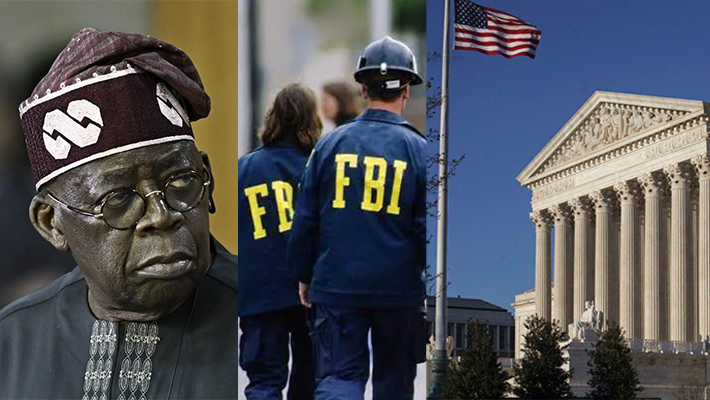
The United States Federal Bureau of Investigation (FBI) has warned that releasing certain investigative records relating to President Bola Ahmed Tinubu could expose its informants and agents to the risk of violent retaliation.
The warning was contained in a court filing submitted on Friday, August 28, in ongoing Freedom of Information Act (FOIA) litigation before Judge Beryl Howell of the U.S. District Court for the District of Columbia in Washington, D.C.
The legal dispute centres on requests for the release of records concerning Tinubu that are reportedly held by the FBI and other United States government agencies. The documents sought include records relating to allegations of drug trafficking, immigration matters and possible connections with the Central Intelligence Agency (CIA).
The case originated from FOIA requests filed by American transparency activist Aaron Greenspan, who is the lead plaintiff in the litigation. Greenspan has been seeking access to documents relating to allegations concerning Tinubu dating back to the 1980s and 1990s.
Court filings from 2022 and 2023 show that Greenspan also sought records concerning Tinubu from several U.S. federal agencies, including the FBI, CIA, Internal Revenue Service (IRS), Drug Enforcement Administration (DEA) and immigration authorities.
The latest FBI filing was made in response to a directive from Judge Howell, who had asked the agency to explain why the records should continue to be withheld. The judge also requested that the FBI submit certain documents privately for judicial review.
The FBI relied, among other provisions, on Exemption 7(F) of the FOIA law, which permits federal agencies to withhold information when its disclosure could reasonably be expected to endanger the life or physical safety of an individual.
According to the bureau, releasing names and other identifying information contained in the investigative records could expose individuals who assisted or participated in the investigation to threats from people connected to the alleged criminal activities.
The FBI argued that some individuals referenced in the records could become targets if their identities or involvement in the investigation became public.
The agency said the information could potentially reveal details concerning alleged criminal activities involving third parties and could therefore expose law enforcement personnel, informants or other participants to retaliation.
The bureau further maintained that the people whose identities appear in the records could be viewed by those involved in the investigation as having provided information that was damaging or incriminating.
The FBI therefore concluded that disclosure of names and related information could create a significant threat to the personal safety of individuals associated with the investigation.
The filing also referenced other FOIA exemptions, including provisions designed to protect personal privacy and confidential law-enforcement information.
The development has added another layer to a long-running legal battle over access to records concerning Tinubu’s past activities in the United States.
Tinubu has previously been the subject of scrutiny over his activities in the United States during the 1990s, including a forfeiture involving $460,000 that has been referenced in previous court proceedings and media reports.
The Nigerian president has consistently faced political controversy over the interpretation of those records, particularly allegations concerning narcotics-related activities. However, the allegations contained in FOIA requests and legal filings should not be treated as established facts unless confirmed by competent authorities or supported by evidence made public through the courts.
The FBI had previously indicated in 2023 that it planned to begin releasing thousands of pages of records concerning Tinubu. Reports at the time indicated that approximately 2,500 pages could be released in batches, with the proposed schedule involving monthly releases.
The anticipated disclosure, however, did not proceed as initially expected.
The dispute has since continued through the U.S. courts, with the FBI and DEA facing pressure to explain their handling of the records and the reasons for continued withholding of some documents.
The latest filing followed an August 28 deadline set by Judge Howell for the FBI to provide further justification for withholding the documents.
The judge’s involvement underscores the fact that the issue is not simply an administrative decision by the FBI but part of an ongoing judicial review of the government’s obligations under the FOIA.
Under U.S. law, federal agencies may withhold certain categories of information from public disclosure when releasing such material could compromise ongoing investigations, expose confidential sources, violate personal privacy or endanger individuals.
The FBI’s latest position therefore does not necessarily mean that all documents concerning Tinubu will remain permanently classified or unavailable to the public. Rather, the agency is arguing that specific information contained in the records falls within legally protected categories.
The court will ultimately determine whether the FBI has provided sufficient legal grounds for withholding the documents.
The controversy has also attracted political interest in Nigeria, where Tinubu’s political opponents and supporters have closely followed developments surrounding the records.
The dispute is particularly sensitive because of Tinubu’s position as Nigeria’s sitting president and the significance attached to any historical records concerning his activities abroad.
Supporters of the president have previously argued that allegations based on old U.S. records are being politically exploited, while critics have maintained that public access to the documents is necessary to establish the facts independently.
For now, the FBI’s latest filing means that the fate of the disputed records remains before the U.S. federal court.
Judge Howell is expected to examine the agency’s justification, including its reliance on FOIA exemptions designed to protect law enforcement personnel, informants and other individuals whose safety could allegedly be compromised.
The court’s eventual decision could determine whether some or all of the requested records are released, withheld or disclosed in a redacted form.
Until such a ruling is made, claims surrounding the contents of the records remain part of an ongoing legal and political dispute rather than established findings against the Nigerian president.
The case continues to attract attention in both the United States and Nigeria because of the potential implications of any future disclosure and the questions surrounding the balance between government transparency, public interest, privacy and the protection of individuals involved in law enforcement investigations.
If you want, I can also give you a stronger newspaper-style headline and a more punchy 1,000-word version suitable for DailyBlastNG.com.