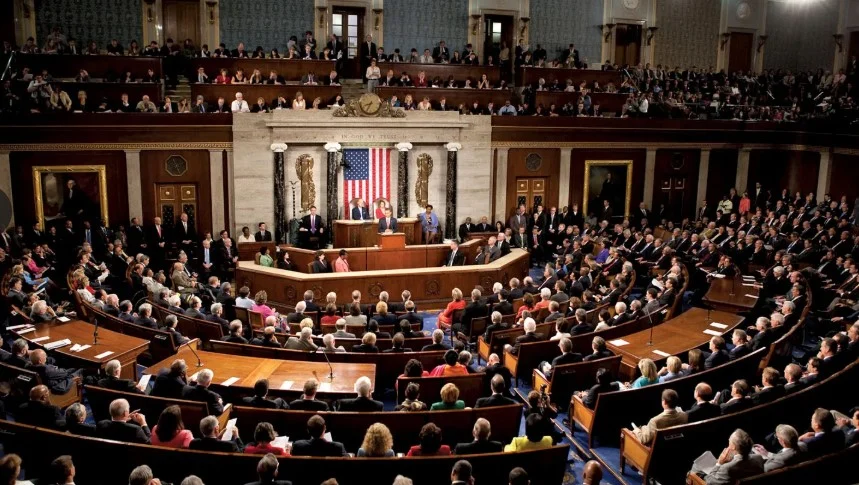
The United States House of Representatives has approved a fiscal year appropriations bill containing a controversial provision that would suspend all American foreign assistance to Nigeria until the US government certifies that the Nigerian authorities are taking concrete and measurable steps to protect Christians and other vulnerable communities from violence.
The legislation, which forms part of the Fiscal Year 2027 National Security, Department of State and Related Programs (NSRP) Appropriations Act, seeks to make future US assistance to Nigeria contingent upon improvements in religious freedom and the protection of communities affected by violent attacks.
According to the bill, all foreign assistance to Nigeria would be withheld until the US government determines that the Nigerian government is effectively addressing violence against Christian communities and ensuring greater protection for victims of religious persecution.
The measure is one of several provisions included in the spending package aimed at strengthening US efforts to promote religious freedom globally while holding foreign governments accountable for alleged violations of fundamental human rights.
Lawmakers behind the proposal argued that governments receiving American assistance should demonstrate commitment to safeguarding citizens regardless of their religious beliefs.
The bill specifically calls for “holding foreign governments and bad actors accountable for persecuting people of faith.”
It further proposes restricting US assistance to Nigeria until authorities can demonstrate measurable actions to protect Christian communities affected by religiously motivated violence.
In addition, the legislation provides support for international religious freedom initiatives and strengthens protections for faith-based organisations involved in delivering humanitarian assistance abroad.
The provision targeting Nigeria was championed by Republican Congressman Riley Moore and received support from several other Republican lawmakers, including Florida Representative Jeff Steube.
The proposal was first introduced before the House in April as lawmakers debated the annual appropriations legislation.
Following the passage of the bill, Representative Steube welcomed the outcome in a statement posted on his official X account, arguing that American taxpayers should not finance governments that fail to adequately protect religious communities from violence.
He stated that American taxpayers should never be required to bankroll governments that allegedly ignore the abduction, torture and killing of Christians.
Representative Moore, who has repeatedly accused the Nigerian government of failing to adequately protect Christian communities, argued before the House that stronger conditions were necessary to encourage greater action against violent groups operating in parts of the country.
According to Moore, the Nigerian government has not done enough to confront armed Fulani Islamist terrorists operating in the Middle Belt region, whom he blames for repeated attacks on Christian communities.
He maintained that conditioning American assistance on improved protection of religious minorities would encourage Nigerian authorities to strengthen security measures and ensure greater accountability.
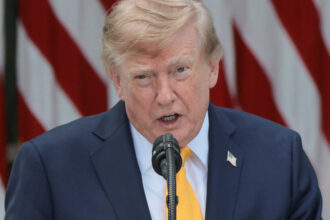
Moore said the provision aligns with the foreign policy priorities of the administration of President Donald Trump by combining assistance with accountability measures.
According to him, the objective is to support Nigeria in defending vulnerable Christian populations while ensuring that President Bola Tinubu’s administration is held responsible if sufficient progress is not achieved.
The legislation initially proposed withholding 50 per cent of US foreign assistance to Nigeria pending certification by the US government.
However, during debate on the House floor, Representative Jeff Steube introduced an amendment seeking a more stringent measure.
Steube argued that withholding only half of the available assistance could still be interpreted as rewarding the Nigerian government despite what he described as its failure to adequately protect its citizens.
His amendment proposed increasing the restriction from 50 per cent to a complete suspension of all foreign assistance.
The House subsequently adopted the amendment, resulting in the bill now calling for the withholding of 100 per cent of US foreign assistance to Nigeria unless the required certification is issued.
The legislation, however, has not yet become law.
Before taking effect, it must still be considered and approved by the United States Senate.
If passed by the Senate, it would then require the signature of President Donald Trump before becoming legally binding.
The development comes against the backdrop of evolving US-Nigeria relations under the Trump administration.
Shortly after assuming office, President Trump announced a broad review of American foreign aid programmes, temporarily pausing several international assistance initiatives and dismantling the United States Agency for International Development (USAID).
Despite those changes, the United States continued to provide limited assistance to Nigeria, particularly in areas relating to security cooperation, counter-terrorism operations and humanitarian support for victims of insurgency.
Earlier this year, Washington approved approximately $413.046 million to support counter-insurgency efforts in Nigeria and other African countries.
The funding formed part of broader US security assistance aimed at combating terrorism and strengthening regional stability across West Africa.
Within weeks of that allocation, the United States also delivered what officials described as critical military supplies to Nigerian security agencies to enhance ongoing operations against terrorist organisations.
Nigeria and the United States have in recent months maintained close cooperation on intelligence sharing and counter-terrorism initiatives despite political disagreements over issues relating to religious freedom.
Joint security operations conducted by both countries have reportedly yielded significant results against extremist organisations operating in the Lake Chad Basin.
One of the operations led to the elimination of Abu-Bilal al-Minuki, also known as Abubakar Mainok, identified by security agencies as a senior commander of the Islamic State West Africa Province (ISWAP).
American authorities also recently disclosed that they had obtained a substantial cache of intelligence linked to terrorist activities in Nigeria.
Officials said the intelligence material remains under analysis and could assist future counter-terrorism operations in the region.
The United States has also imposed sanctions on several Nigerian individuals and entities accused of financing terrorist organisations.
Among those sanctioned is Mukhtar Adamu, a Lagos-based bureau de change operator alleged to have facilitated financial transactions on behalf of the West African affiliate of the Islamic State through businesses under his control.
The latest action by the House also comes amid longstanding debate over the designation of Nigeria as a Country of Particular Concern (CPC) over allegations of religious persecution.
Some American lawmakers and advocacy organisations have accused the Nigerian government of failing to prevent attacks on Christian communities, particularly in parts of the Middle Belt and northern Nigeria.
However, Nigerian authorities have consistently rejected allegations that the violence amounts to religious persecution or genocide.
The Federal Government has maintained that the country’s security challenges are driven by complex factors, including terrorism, banditry, communal conflicts, criminality and competition over land and resources, rather than a deliberate campaign against any particular religious group.
Several local and international human rights organisations have also disputed claims of Christian genocide, arguing that armed groups operating in Nigeria target both Christians and Muslims.
These organisations have maintained that while religious tensions sometimes intersect with broader security challenges, available evidence does not support assertions that attacks are directed exclusively at Christians.
The Nigerian government has repeatedly called for greater international cooperation in addressing terrorism and organised crime while cautioning against narratives that oversimplify the country’s complex security situation.
As the appropriations bill advances to the Senate, attention will focus on whether lawmakers in the upper chamber retain the controversial provision targeting Nigeria or make changes before final passage.
Should the Senate approve the legislation and President Trump sign it into law, Nigeria could face the suspension of all US foreign assistance until Washington certifies that measurable progress has been made in protecting Christian communities and addressing religious violence.