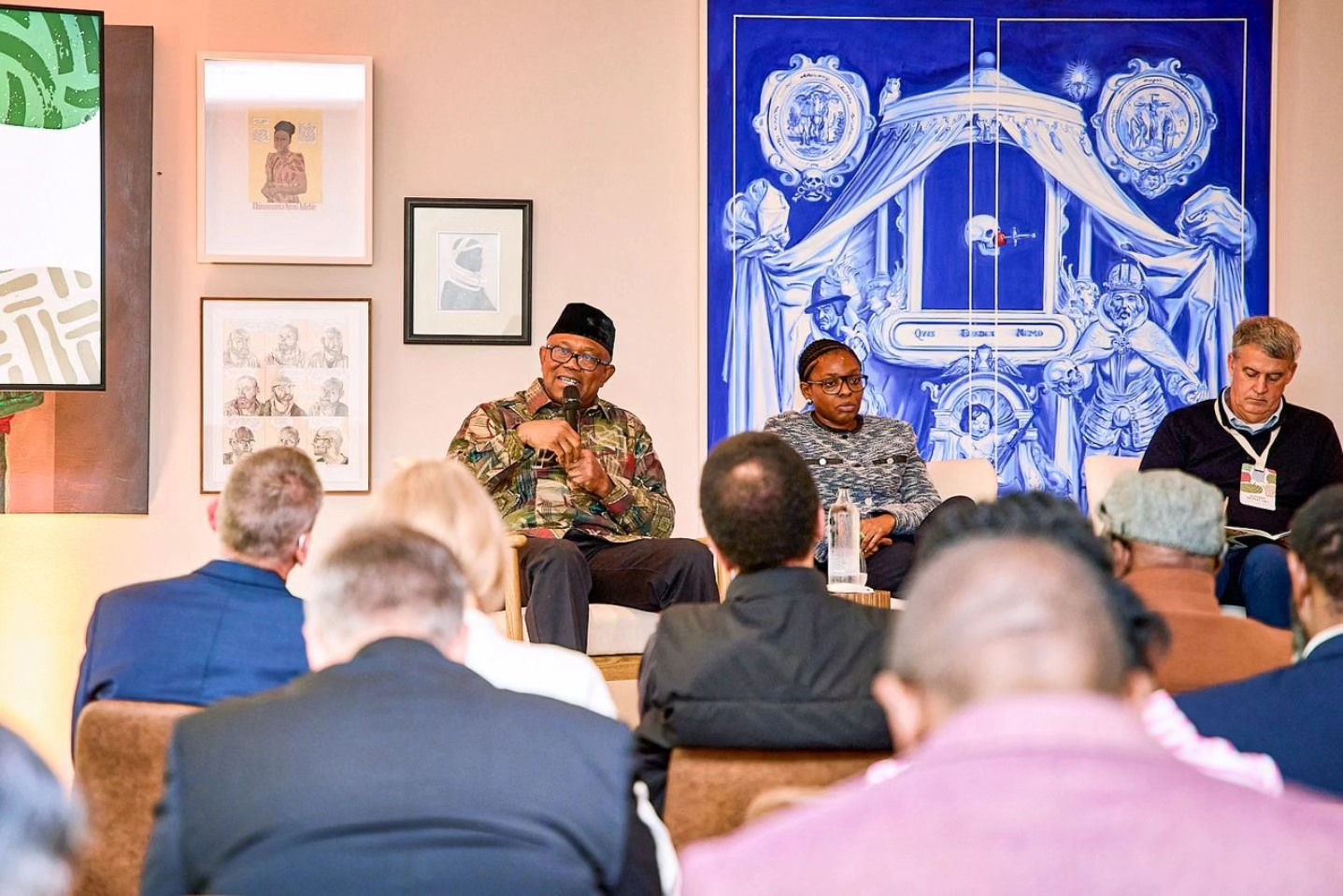
Former Anambra State Governor and Labour Party presidential candidate, Peter Obi, has called on African leaders to prioritise economic productivity, human capital development and institutional reforms as pathways to unlocking the continent’s vast potential and ending widespread poverty.
Obi made the remarks during a visit to South Africa, where he delivered a guest lecture at the Spier Dialogue Event held in Cape Town on the theme, “Policies for Growth in Africa.”
The former presidential candidate disclosed that before the event, he held meetings with ministers in South Africa, during which discussions focused on governance, development and economic transformation across the African continent.
Addressing participants at the dialogue, Obi stressed that Africa possesses all the resources required to become one of the world’s most prosperous regions but continues to struggle because of poor leadership, corruption, weak institutions and governance failures.
According to him, the continent’s enormous human and natural resources should ordinarily place Africa among the leading global economic powers.
“Africa has no reason to remain poor,” Obi stated during the event.
He noted that Africa is richly endowed with mineral deposits, vast agricultural opportunities and a youthful population capable of driving innovation, industrialisation and economic growth if properly harnessed.
According to Obi, Africa controls more than 60 per cent of the world’s uncultivated arable land and also possesses some of the largest reserves of strategic minerals needed for modern industries and technological development.
He described the continent’s youthful population as a major strategic advantage rather than a burden, insisting that with proper investment in education, healthcare and skills development, African countries could transform their economies and reduce dependency on foreign aid and imports.
Despite these advantages, Obi lamented that many African nations continue to experience worsening poverty, unemployment and insecurity.
He attributed the situation largely to poor governance, excessive focus on politics instead of development, and failure by leaders to implement policies that promote production and sustainable growth.
The former governor said African leaders must urgently redirect their attention away from endless political battles and election cycles toward nation-building and economic productivity.
According to him, the future of the continent lies in making deliberate investments in key Human Development Index indicators such as education, healthcare and poverty reduction.
He expressed concern that several African countries still rank poorly in global development indices, with millions of citizens lacking access to quality healthcare, education and economic opportunities.
Obi also highlighted the growing challenges facing small and medium-scale enterprises across Africa, noting that businesses that should ordinarily drive economic expansion are struggling under harsh operating conditions.
He blamed policy inconsistency, weak infrastructure, unstable power supply, corruption and poor economic planning for the collapse of many businesses across the continent.
According to him, sustainable growth cannot occur in an environment where entrepreneurs face constant uncertainty and rising operational costs.
The former Anambra governor maintained that African governments must create enabling environments that encourage local production, industrialisation and private sector growth.
He said development-oriented leadership remains the most critical factor required to reposition the continent.
“What Africa needs is competent leadership with the capacity, compassion and commitment to prioritise production over consumption, and development over politics,” Obi stated.
He further urged African leaders to reduce the cost of governance, strengthen public institutions and tackle corruption decisively.
According to him, resources that should be channelled into critical sectors are often wasted on unnecessary government expenditure and political patronage.
Obi argued that reducing wastage and investing more in citizens would significantly improve economic productivity and social stability across the continent.
He also stressed the importance of building strong democratic institutions capable of guaranteeing accountability, transparency and long-term policy continuity.
The former presidential candidate said countries that have achieved rapid economic growth globally did so by investing heavily in their people and maintaining disciplined governance systems.
He noted that Africa’s development challenges are not insurmountable if leaders demonstrate sincerity, competence and political will.
Obi further called for stronger collaboration among African countries to promote regional trade, economic integration and industrial development.
According to him, African nations must move beyond dependence on raw material exports and focus on value addition, manufacturing and technology-driven economies.
He warned that failure to invest in young people could worsen unemployment, social unrest and migration crises across the continent.
Obi added that the continent’s future prosperity depends largely on how governments manage education, innovation and entrepreneurship.
He expressed optimism that Africa can still achieve meaningful transformation if the right leadership and policies are put in place.
“If we invest in our people, strengthen institutions, reduce the cost of governance, combat corruption and create an environment where businesses can thrive, we can build a more productive, secure, democratic and prosperous Africa that works for all its people,” he said.
Obi concluded his address with a message of hope, insisting that despite current challenges, Africa possesses the capacity to rise and achieve sustainable development.
“A New Africa is Possible,” he declared.