United States President Donald Trump has ordered an immediate suspension of all trade relations with Spain, escalating tensions with one of Washington’s long-standing NATO allies over what he described as Madrid’s persistent failure to meet its defence spending obligations.
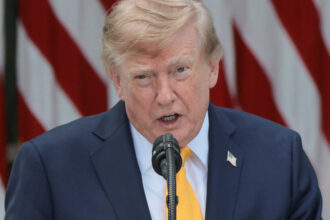
The directive was announced on Wednesday during the NATO summit in Ankara, Turkey, where Trump appeared alongside NATO Secretary-General Mark Rutte. The U.S. president accused Spain of failing to contribute adequately to the alliance’s collective security while continuing to benefit from the protection provided by other member states.
Addressing reporters at the summit, Trump launched a scathing criticism of the Spanish government, insisting that the country had not carried its fair share of the burden within the military alliance.
“Spain is a wasted cause. We don’t want to do any trade business with Spain anymore by the way,” Trump declared.
The president went further, describing Spain as one of NATO’s weakest contributors and accusing the country of taking advantage of the alliance’s collective defence commitments without making corresponding investments.
“Spain is a terrible partner in NATO. They don’t participate. They don’t pay,” Trump said.
He added that he had no interest in maintaining commercial ties with Madrid, calling for a complete cessation of economic relations between the two countries.
“I don’t want anything to do with Spain. Cut off all trade with Spain, please, including visits,” he stated.
Expressing confidence that the move would pressure Spain into changing its position, Trump predicted that the Spanish government would eventually reverse course.
“Watch them come running back. Oh, they’ll come running back,” he said.
Trump also criticised Spain’s relationship with NATO Secretary-General Mark Rutte, claiming that the Spanish government had failed to show adequate respect for the alliance’s leadership.
Turning to Rutte during the joint appearance, Trump suggested that NATO had effectively been carrying Spain’s security responsibilities for years.
“I mean, you sort of automatically carry Spain because you’re protecting an area,” the U.S. president said.
He argued that Spain had become complacent because it believed NATO members, particularly the United States, would always guarantee its security regardless of its own defence contributions.
“So they probably figured, ‘They have to protect us, right?’” Trump remarked.
Despite the sharp rhetoric from Washington, Spain appeared unfazed by the latest comments.
According to Reuters, the office of Spanish Prime Minister Pedro Sánchez dismissed Trump’s remarks as routine political rhetoric and indicated that Madrid had no plans to alter its relationship with the United States.
Spanish officials reportedly described the comments as “business as usual” and reaffirmed that Spain intended to maintain what they characterised as an “excellent” trade relationship with Washington.
The latest confrontation is part of Trump’s long-running campaign to compel NATO member states to significantly increase military spending.
Throughout his political career, Trump has consistently argued that many European allies rely excessively on American military resources while failing to invest adequately in their own national defence.
He has repeatedly insisted that every NATO member should allocate at least five per cent of its Gross Domestic Product (GDP) to defence spending, a figure substantially higher than the alliance’s existing commitments.
Although NATO members have recently agreed to work towards spending 3.5 per cent of GDP on defence by 2035, Trump has continued to argue that even this revised target falls short of what is required in the current global security environment.
Current projections indicate that only five of NATO’s 32 member states are expected to meet that defence spending benchmark this year, leaving the majority of the alliance below the desired threshold.
Spain has remained one of the countries most frequently criticised by Trump over its military expenditure, with the U.S. president arguing that Madrid benefits disproportionately from NATO’s collective defence while making comparatively modest financial contributions.
Beyond defence spending, Trump has also expressed dissatisfaction with what he considers Europe’s limited support for recent U.S. military operations involving Iran.
The president has argued that several NATO allies, including Spain, failed to provide sufficient political and strategic backing for Washington’s actions during the conflict.
His latest remarks are therefore seen as reflecting broader frustrations with European allies over both defence commitments and foreign policy cooperation.
Trump has previously used his Truth Social platform to criticise Spain’s economic performance and defence policies.
In one post published in April, he questioned the country’s economic health while accusing its government of neglecting military investment.
“Has anybody looked at how badly the country of Spain is doing?” Trump wrote.
“Their financial numbers, despite contributing almost nothing to NATO and their military defence, are absolutely horrendous. Sad to watch!!!”
His renewed criticism at the Ankara summit has once again highlighted growing disagreements within NATO over burden-sharing and alliance responsibilities.
Trump has consistently maintained that countries benefiting from the alliance’s security umbrella must contribute more financially rather than relying heavily on American taxpayers.
The president’s directive to halt trade with Spain represents one of the strongest actions yet taken against a NATO ally over defence spending, although it remains unclear how or when such measures would be implemented or whether they would face legal or diplomatic challenges.
The latest development is expected to intensify debate over the future of transatlantic relations, NATO funding, and the balance of responsibilities among alliance members as global security concerns continue to evolve.