The White House on Saturday renewed attention on President Donald Trump’s executive order targeting what the administration describes as “birth tourism,” highlighting comments by Deputy Chief of Staff for Policy and Homeland Security Adviser Stephen Miller that the practice had been effectively prohibited.
In a graphic shared on its official X account, the White House quoted Miller as saying that the signing of the executive order marked the end of the practice.
“That practice of birth tourism is, as of the signing of this order, hereby banned,” Miller said.
“What that means is that no one in the world is anymore allowed to obtain a visa for this fraudulent purpose.”
Miller described the directive as one of the most consequential measures undertaken by the Trump administration on immigration policy.
“I would put this in the top three in terms of importance because it ends what has been one of the gravest and most egregious abuses of the American system,” he added.
The administration uses the term “birth tourism” to refer to the practice of foreign nationals travelling to the United States primarily to give birth so that their child acquires U.S. citizenship by birth.
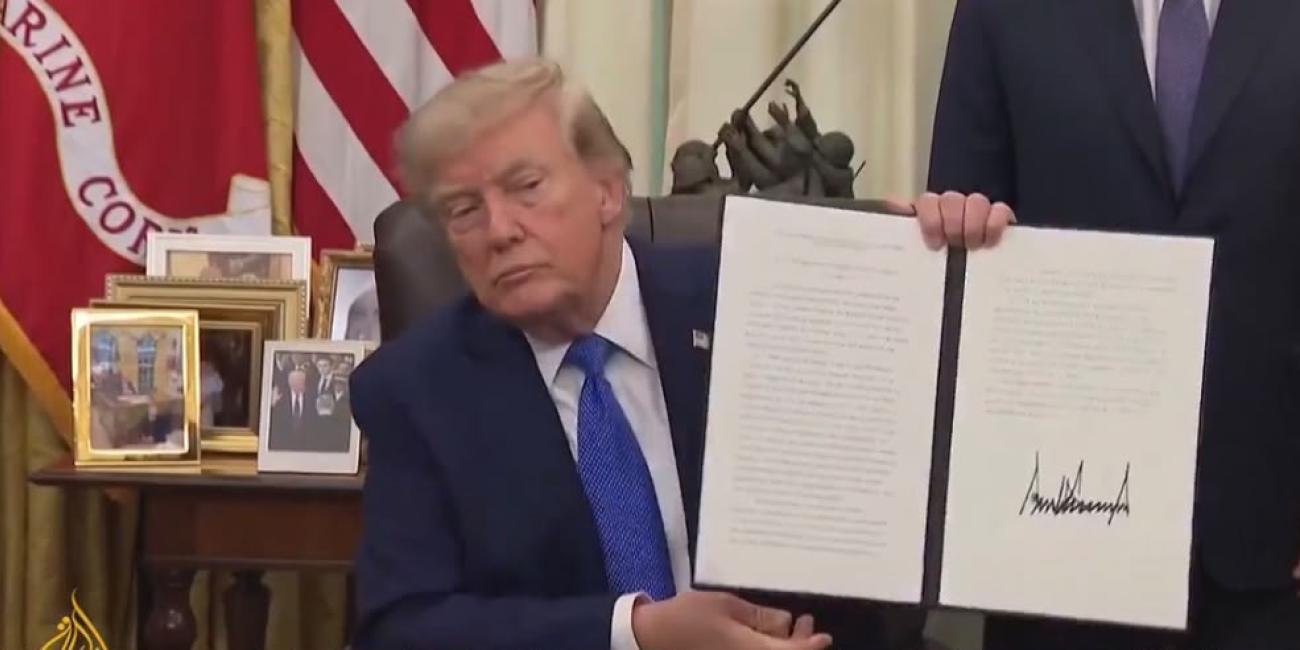
President Trump signed two executive orders on Thursday aimed at restricting birthright citizenship, including one specifically directed at the practice the administration labels birth tourism. The new directives came after the U.S. Supreme Court rejected Trump’s earlier attempt to end birthright citizenship through an executive order signed on the first day of his second term.
According to ABC News, the latest measures represent a narrower approach following the court’s decision, focusing on visa issuance and categories of individuals whose U.S.-born children may be denied automatic citizenship.
Asked how immigration officials would distinguish between an ordinary tourist and someone travelling to the United States to give birth, Miller said the administration would rely on existing provisions of the Immigration and Nationality Act.
“If you’re telling a consular officer you’re here as a tourist, but your true purpose and intent is to go to a baby mill, give birth and try to mint an American citizen while you’re here, then you’re committing a fraud against the American government,” Miller said.
He added that such applicants would no longer be eligible to obtain visas for that purpose.
President Trump has repeatedly argued that birth tourism is being abused on a large scale, claiming that “hundreds of thousands” of people travel to the United States to secure citizenship for their children.
However, during Supreme Court oral arguments in April, Solicitor General John Sauer gave a less definitive assessment when questioned by Chief Justice John Roberts about the prevalence of the practice.
“No one knows for sure,” Sauer said, according to ABC News.
Sauer reportedly referred to media estimates suggesting that more than 1.1 million births may have been linked to birth tourism, including claims involving travellers from China, while also citing congressional material concerning Russian elites allegedly using birth tourism companies to travel to Miami.
In discussing the administration’s broader birthright citizenship policy, Miller said additional categories of people could be deemed ineligible for automatic citizenship, including “alien enemies of the United States, members of foreign terrorist organizations, and large categories of people who lobby and act on behalf of foreign governments.”
Trump also criticised the Supreme Court’s earlier ruling upholding birthright citizenship, describing it as “very unfortunate” and saying his administration was now making adjustments in response to the decision.
“We had a very unfortunate decision in the Supreme Court concerning birthright,” Trump said.
“It was close, but a very, very unfortunate decision. So we’re making adjustments because it’s very unfair.”
He further argued that the constitutional guarantee had been exploited, telling reporters in the Oval Office that “they’ve taken birthright citizenship, and they’ve made a joke out of it.”
The debate has renewed attention on different citizenship systems around the world. Some countries follow jus soli, granting citizenship based on place of birth, while others apply jus sanguinis, granting citizenship through parentage. Several nations operate mixed systems that combine elements of both approaches.
Legal scholars expect Trump’s latest executive orders to face renewed court challenges from opponents who argue that they conflict with the Fourteenth Amendment’s Citizenship Clause, which has long been interpreted as granting citizenship to nearly everyone born on U.S. soil, with limited exceptions such as children of foreign diplomats.
In a separate development on Saturday, Miller again linked immigration to social and educational concerns, commenting on reported reading difficulties among schoolchildren in New York.
Responding to a New York Post report stating that more than half of pupils in grades three to five failed to demonstrate proficiency on a basic reading test, Miller argued that the education debate was obscuring what he called the “real debate.”
“Nearly 40% of children in New York State are foreign-born or the children of migrants,” Miller wrote on X.
“Of that group, about 85% are migrants from the third world. The education debate, like so many others, often disguises the real debate.”
Miller did not provide a source for the figures cited in his post, and his comments did not include evidence establishing a direct connection between the reported reading results and the immigration statistics he referenced.
The remarks nevertheless added another layer to the administration’s broader argument that immigration policy is closely linked to education, social services, and other domestic policy debates, as the White House continues to place immigration enforcement at the centre of its policy agenda.