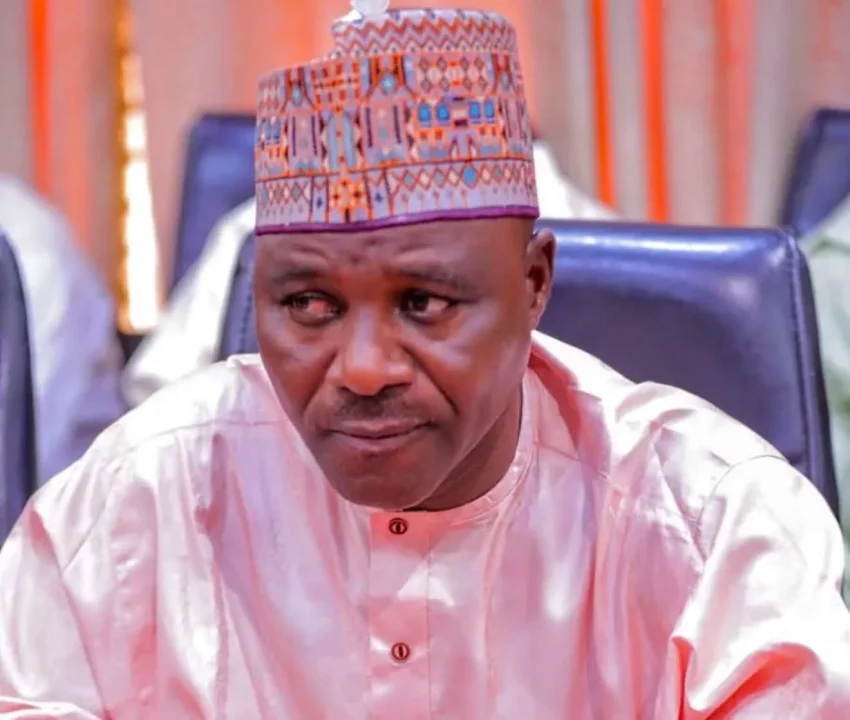
The Borno State Commissioner for Youth and Sports Development, Sainna Buba, has sparked controversy after threatening to “flog” individuals who refuse to support the ruling All Progressives Congress (APC) in the 2027 general elections.
Buba made the remark in a video circulating on social media on Monday. The video captured a campaign inauguration organised by the Tinubu City Boy Movement, a political support group campaigning for the re-election of President Bola Tinubu in 2027.
Speaking at the event, the commissioner said political engagement could involve persuasion and, at times, force, while suggesting that those who support the APC would benefit from the administration.
“As for some people who do not deserve us to call their names. In politics, sometimes things go smoothly, sometimes it goes with persuasion, and sometimes it goes with force. Right now, we are being persuasive, but we’ve noticed they are throwing jabs at us on TikTok,” Buba said.
He went on to warn individuals whom he said were attacking the APC politically, declaring that the government would respond to such actions.
“If they point fingers at us, we will point fingers at them; if they point fingers at us with malicious intent, then we will hold that finger and break it,” he said.
Buba further declared that the APC-controlled government belonged to its supporters and encouraged residents to align themselves with the ruling party.
“This government is our government; follow us and enjoy honey. As for those who refuse to follow us, they will be flogged,” he said.
The commissioner also told supporters that campaign materials would be made available in the state for them to benefit from.
His comments have raised concerns about the tone of political rhetoric ahead of the 2027 elections, particularly the reference to force and physical punishment in relation to political choices.
The development comes amid growing political activity across the country as political parties and support groups begin preparations for the next general elections.
In a separate development, the Chairman of Kuje Area Council in the Federal Capital Territory, Samuel Shekwolo, also came under scrutiny after reportedly warning residents who do not support the APC to leave the council ahead of the 2027 elections.
Shekwolo made the remarks in a video circulating on social media on Tuesday while addressing his followers and constituents.
The council chairman reportedly linked his position to what he described as developmental interventions by President Tinubu and the Minister of the Federal Capital Territory, Nyesom Wike, in Kuje.
According to him, residents who benefited from government programmes and interventions should not subsequently vote against the APC at the 2027 elections.
His comments, like those of the Borno commissioner, have contributed to concerns over the increasingly combative nature of political statements as parties position themselves for the next electoral contest.
The recent developments also recall a controversy involving Senator Francis Fadahunsi, representing Osun East Senatorial District, over comments concerning members of the Accord Party ahead of the August 15, 2026 governorship election in Osun State.
Fadahunsi’s remarks attracted condemnation from political actors and civil society organisations, while Governor Ademola Adeleke called for the senator’s arrest and investigation.
The senator subsequently denied threatening violence against members of the Accord Party. He explained that his comments had been misconstrued and maintained that he was referring to defeating the party through votes rather than physically attacking its members.
Fadahunsi was later invited by the Osun State Police Command, where he was questioned over the controversial remarks.
The latest statements attributed to the Borno commissioner and the Kuje council chairman have once again brought the issue of political language and electoral conduct into focus.
Nigeria’s electoral history has repeatedly shown that inflammatory rhetoric by political actors can contribute to heightened tensions, particularly when supporters interpret such statements as encouragement to intimidate or suppress political opponents.
The Constitution guarantees citizens the right to participate in political activities and to support political parties of their choice. Political competition is therefore expected to be conducted through lawful and democratic means, including campaigns, persuasion and voting.
Against this background, statements suggesting punishment or coercion for citizens who decline to support a particular political party are likely to attract increased scrutiny from political observers, civil society organisations and electoral stakeholders.
The 2027 general elections are expected to generate intense competition as political parties seek to consolidate their support bases and attract undecided voters.
With campaign activities gradually becoming more prominent, stakeholders are likely to face increasing pressure to ensure that political disagreements do not degenerate into threats, intimidation or violence.
The controversy surrounding Buba’s remarks also highlights the responsibility of political office holders to moderate their language and promote peaceful participation, particularly when addressing supporters and prospective voters.
As political parties intensify their mobilisation efforts ahead of 2027, the emphasis is expected to remain on convincing voters through policies, programmes and campaign promises rather than threats or coercion.
The statements attributed to the Borno commissioner and Kuje council chairman have consequently renewed calls for political leaders and their supporters to uphold democratic values and respect citizens’ freedom to choose their preferred candidates and political parties at the ballot box.
Watch video: