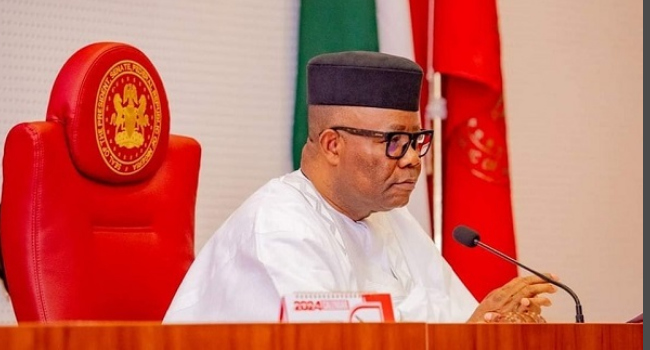
The resolution followed Akpabio’s remarks during plenary, in which he cautioned the public against misinterpreting his comments on a bill seeking to decriminalise attempted suicide.
The Senate President said his contributions to Tuesday’s debate on the proposed legislation had been taken out of context. He also used the opportunity to address concerns surrounding his comments on religion and the ongoing security challenges facing the country.
Akpabio maintained that terrorism should not be associated with any religion, arguing that those responsible for destabilising Nigeria should not be regarded as representatives of the country.
He also stated that suicide was forbidden in Christianity and warned against misrepresenting proceedings of the Senate.
The Senate President further insisted that he had no intention of making disparaging remarks about any religion, noting that his aide-de-camp had been a Muslim for 19 years.
Against the backdrop of the controversy, Akpabio suggested that political interests were targeting his position, arguing that the offices of the President and Vice President had already been settled.
In response, lawmakers expressed support for his continued leadership of the upper legislative chamber.
Senator Fasuyi backed a motion moved by Senator Monguno, affirming that the office of the Senate President was not vacant and would remain occupied by Akpabio.
Another lawmaker, Senator Babangida Hussaini, also commended Akpabio’s contributions to his state and expressed support for his continued leadership. Hussaini additionally raised concerns about drug abuse and substance use, which he said needed to be addressed as part of efforts to tackle banditry, terrorism and other forms of criminality.
Controversy Over Attempted Suicide Bill
The Senate’s resolution came amid public criticism of comments Akpabio reportedly made during Tuesday’s plenary while lawmakers debated a bill seeking to decriminalise attempted suicide and establish a framework for suicide prevention.
During the debate, Senator Asuquo, who presented the proposed legislation, argued that survivors of suicide attempts should receive medical assessment, treatment and rehabilitation rather than face criminal prosecution.
He explained that the bill was designed to replace punitive measures with a system centred on prevention, clinical care, referrals and continued support for people experiencing suicidal crises.
According to Asuquo, the proposed framework would also encourage cooperation among government agencies, healthcare facilities, first responders and communities to prevent suicide and provide timely assistance to people at risk.
He maintained that police stations and correctional facilities should not be the default destinations for people requiring urgent medical and psychological care.
The senator also argued that criminalising attempted suicide could have unintended consequences by discouraging people from seeking help or encouraging those who attempt suicide to ensure that the attempt results in death to avoid prosecution.
Responding to the argument, Akpabio questioned whether the proposed legislation was intended to prevent people from succeeding in suicide attempts.
Asuquo answered in the affirmative, explaining that the concern was the threat of imprisonment for those who survived.
The Senate President, however, reportedly maintained that attempted suicide remained a criminal offence under the existing legal framework.
“But that’s what we are saying now, that as far as we are concerned, we are saying that suicide is a crime for now. And therefore, if you attempt it, you better succeed. If you don’t succeed, we will send you to prison,” Akpabio was quoted as saying.
He reportedly added that a person who survived a suicide attempt could be imprisoned and subsequently rehabilitated.
The remarks generated controversy over whether people who survive suicide attempts should face criminal penalties or receive medical and psychological support.
Bill Seeks Shift From Punishment to Treatment
The proposed legislation seeks to move Nigeria’s approach to attempted suicide away from criminal punishment towards prevention, treatment and rehabilitation.
Its proponents argue that survivors should have access to appropriate clinical care and support services without the additional burden of prosecution.
The bill also proposes a coordinated system for suicide prevention, including crisis helplines, referral arrangements and follow-up services for survivors.
The debate reflects broader concerns about mental health support and the need to ensure that people experiencing suicidal distress can access timely and appropriate care.
Meanwhile, Thursday’s resolution reaffirmed the Senate’s position that Akpabio remains the occupant of the office of Senate President, despite the controversy surrounding his comments on the proposed legislation.