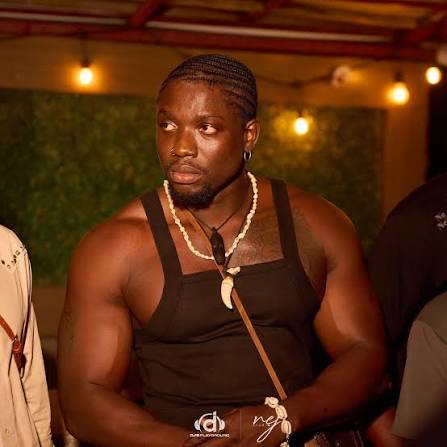
Social media activist Martins Vincent Otse, popularly known as VeryDarkMan (VDM), has apologised to members of the military, police, Nigeria Customs Service and Nigeria Immigration Service over remarks he made during the Nigerian Bar Association’s 66th Annual General Conference in Port Harcourt, Rivers State.
Otse issued the apology in a video shared on Friday, saying he had reflected on his speech and realised that his choice of words had been unfair to many security personnel who were genuinely risking their lives to protect Nigerians.
The activist had generated controversy during his appearance at the NBA conference after describing military, police, immigration and customs personnel as “unknown gunmen” while discussing the country’s worsening insecurity.
His remarks attracted criticism, particularly because many members of the security forces are actively engaged in counter-insurgency operations and other dangerous assignments across the country.
In his latest video, however, Otse acknowledged that his comments could have been interpreted as a blanket condemnation of the security agencies.
He explained that his intention was not to accuse every soldier, police officer, immigration officer or customs official of involvement in criminal activities. Rather, he said he was attempting to draw attention to alleged corruption, sabotage and misconduct by some individuals within the security system.
“I don’t think I was fair to a lot of people, particularly the speech where I said that the military are the unknown gunmen, the police are the unknown gunmen, you know, the immigration, the customs,” he said.
According to him, although he believed he had evidence to support some of the concerns raised during his presentation, he accepted that the manner in which he communicated his argument was inappropriate.
“I know exactly what I was trying to say because, I mean, I have evidence to back up my claim, but I wasn’t fair to a lot of people in that speech,” he added.
Otse said he was particularly concerned about the impact his comments might have on soldiers deployed in remote locations and other dangerous areas to fight Boko Haram and other terrorist groups.
He acknowledged that describing such personnel as “unknown gunmen” failed to recognise the sacrifices made by members of the armed forces who had lost their lives in the line of duty.
“That speech was not fair, especially to the soldiers that are in the bushes fighting Boko Haram to protect our lands, to protect our lives, and to protect our families,” he said.
“I don’t think it’s fair to say they are also the unknown gunmen, to be very honest, because these people have laid down their lives.”
The activist explained that his criticism was directed at what he described as “bad eggs” within the security agencies rather than the institutions or personnel as a whole.
“My speech was not to discourage you,” he said. “My speech was entirely to talk about the bad eggs in our security operative, our security forces, is to put attention on the bad eggs, so that the leaders in these security settings will look inward and to see that sometimes information are being leaked and their own people are sabotaging them.”
Otse nevertheless admitted that his delivery made his argument appear to be a generalisation.
“But by passing that speech, like I said, it seems like I was generalising and it’s not fair to the fallen soldiers,” he said.
He subsequently directed an apology to the Chief of Defence Staff and other leaders of the nation’s security agencies.
“So I will go further to say to the Chief of Defence Staff, Sir, I really want to apologise for that speech, and I don’t want to discourage your boys,” he said.
“Please extend my apologies to your boys, to the ones that are in the bush protecting our lands.”
He also extended his apology to serving personnel in the police, customs and immigration services, as well as families who have lost loved ones in the service of the country.
“To the families of these heroes that might have also felt offended by this speech, knowing fully well that their brother, their sister, their son, their husband fought and died for this country, I am really, really sorry,” Otse said.
While apologising, however, the activist did not withdraw his broader concerns about alleged corruption and misconduct within the security architecture.
He maintained that there were individuals within the various agencies whose actions could undermine national security, insisting that such allegations should be investigated rather than ignored.
“Yes, a lot of bad eggs there, like I said, a lot of bad eggs, a lot of them are there,” he said.
“A lot of corrupt generals, a lot of high-ranking police officers are corrupt, a lot of junior officers are corrupt, a lot of them are there. But there’s still a lot of more good people, a lot of more good people, and I know a lot of them.”
Otse also said he feared that his comments could demoralise soldiers who are currently engaged in combat operations.
He asked Nigerians to consider the psychological effect of public criticism on personnel who are risking their lives in difficult circumstances.
“Imagine a soldier fighting in the bush and he watches VDM’s video, and he’s like, ‘Ah, VDM is one of us now, unknown gunman.’ That would discourage him, to be honest,” he said.
The activist said his interactions with members of the police had also given him an understanding of the challenges faced by security personnel.
He explained that he had previously shared information with police officers concerning suspected criminal activities and had worked with some personnel to draw attention to security threats.
“Me and police, we work steady. I give, sometimes I share police information, tell them, ‘Oh, this is what is happening here, please, can you intercept,’” he said.
He therefore urged security personnel who were genuinely committed to protecting Nigerians not to interpret his remarks as an attack on them.
“And please don’t be discouraged, please, please, don’t be discouraged,” he said.
“We’re there behind you now, and we’ll always support you. You know, and we are part of this thing, security is for all of us.”
Despite his apology, Otse maintained his warning against personnel whom he alleged were involved in acts of sabotage, arms supply and the leaking of information to terrorists.
“But then again, to the bad eggs, your days are numbered,” he said.
“To all of you in the military that are sabotaging and causing deaths to your officers, your days are numbered.”
The controversy surrounding his NBA appearance has generated considerable public debate about the role of social media personalities in professional and specialised forums.
Senior Advocate of Nigeria Femi Falana had criticised the defence of Otse’s participation at the conference and argued that specialised discussions at such events should be handled by experienced professionals.
Otse subsequently defended his invitation to the conference and explained his understanding of why he had been asked to speak. He later appeared in a lawyer’s wig and gown in a video that appeared to mock some of the criticism directed at him.
The latest controversy also follows previous allegations made by Otse concerning the conduct of some police officers at checkpoints. He had alleged that certain officers could pass information about wealthy travellers to kidnappers.
The police challenged him to provide evidence supporting the allegations, while Otse dared the authorities to charge him to court, insisting that he would present his evidence if given the opportunity.
In his latest statement, however, Otse appeared to draw a clearer distinction between his allegations against specific individuals and his assessment of security personnel generally.
“I actually know more than the people I was trying to communicate with, so it was not really communicated properly,” he said.
He concluded his apology by acknowledging the sacrifices of security personnel and calling on Nigerians to support those genuinely fighting to protect the country.
“And to the patriots, to the heroes, to our fallen heroes that have died to protect this country… I am really, really sorry,” he said.
“Keep on fighting for our beloved country, God bless all of you. We Nigerians are with you.”
The apology represents an attempt by the activist to clarify the intent behind his controversial remarks while maintaining his broader call for accountability within Nigeria’s security agencies. It also underscores the delicate balance between criticising alleged institutional failures and recognising the sacrifices of personnel who continue to serve under difficult and often dangerous conditions.