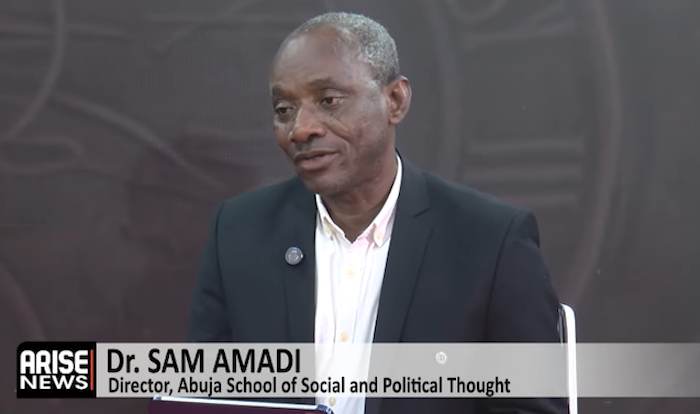
The Director of the Abuja School of Social and Political Thought, Dr Sam Amadi, has called for greater professionalism and constructive engagement between public officials and journalists, following the recent heated exchange between Arise TV presenter Rufai Oseni and Lere Olayinka, media aide to the Minister of the Federal Capital Territory, Nyesom Wike.
Amadi, while reacting to the incident, said both sides have important responsibilities in ensuring that media interviews contribute meaningfully to public understanding rather than degenerating into confrontations and personal exchanges.
The controversy arose during an appearance by Olayinka on the Morning Show programme of Arise News on Friday morning. During the interview, a question from Oseni triggered a sharp reaction from Olayinka, who indicated that he was unwilling to respond to questions from the presenter. The disagreement escalated to the point where the interview was abruptly terminated.
The incident subsequently generated considerable debate on social media, with Nigerians expressing divergent views over the conduct of the journalist and the decision of the government official to decline further engagement.
Commenting on the development, Amadi said public officials who accept invitations to appear on television programmes should be prepared to respond to questions, even where they have disagreements with the interviewer.
According to him, refusing to answer questions creates an undesirable precedent because public officials who voluntarily participate in interviews have a responsibility to engage with issues raised by journalists.
“Hosts should serve as conduits for public understanding, helping to expose weaknesses or false claims tactfully rather than joining the fight directly,” Amadi said.
He acknowledged, however, that the relationship between Oseni and Olayinka appeared to have a history of tension, which could make their interactions particularly combative.
“If Lere was invited, he is still expected to address the questions. Refusing to do so sets a poor precedent,” he said. “However, their relationship has a history that tends to get personalized and combative. While one can argue that you cannot pick who interviews you, an official who attends an interview should engage constructively.”
Amadi also challenged journalists and media organisations to examine their own conduct during interviews, stressing that the media’s constitutional responsibility requires professionalism, fairness and respect for the dignity of individuals appearing on their platforms.
He argued that journalists should not approach interviews with the mindset of defeating, embarrassing or exposing their guests, but should instead use the opportunity to obtain information, test claims and educate the public.
“The press has a social responsibility anchored in the constitution under freedom of the press and expression. That responsibility requires professionalism,” he said.
According to Amadi, aggressive interviewing can undermine the broader purpose of journalism by shifting attention away from substantive issues and turning public discourse into a contest of personalities.
“Media anchors and show hosts should respect the dignity of the person being interviewed. Walking in with an attitude of ‘I’m going to get him’ leads to lost opportunities to engage a public official on substantive principles,” he said.
He maintained that the media should prioritise informing citizens and facilitating meaningful conversations rather than allowing interviews to deteriorate into shouting matches.
“The media’s role is to inform and communicate with the audience, not to engage in shouting matches,” he added.
Turning to the 2027 general elections, Amadi said the quality of political discourse would depend largely on the ability of the media, civil society organisations, think tanks and other influential actors to shift public attention from personality-driven politics to issues that directly affect citizens.
He acknowledged that competition is an inherent feature of politics and that politicians are often motivated by the desire to outsmart their opponents. Such competition, he noted, frequently produces name-calling, accusations and mudslinging.
“Realism dictates that the main aim of politicians is to outsmart one another, which can include name-calling and mutual mudslinging,” Amadi said.
He nevertheless argued that Nigerians should demand a higher standard of political conversation, particularly as the country approaches another major electoral cycle.
According to him, political parties and candidates respond to what voters and the wider political environment reward. If citizens demonstrate greater interest in policies and measurable solutions, politicians will have stronger incentives to focus on substantive issues.
“If political constituencies mobilize attention around policy issues, politicians will have an incentive to focus on them. They look at what works,” he explained.
Amadi identified the economy, hunger, insecurity, health insurance and the rule of law as some of the critical issues that should dominate political debates ahead of 2027.
He observed that the current political environment is heavily dominated by personality, conspiracy theories and political drama, warning that such an approach could distract Nigerians from the issues that determine their welfare.
“If the media, political centers, and intellectual class shape the agenda to address real issues, politicians will adjust their approach,” he said.
Amadi further argued that assessing political candidates should go beyond their manifestos and policy proposals. In his view, the character, integrity, credibility and past conduct of candidates are equally important considerations in determining whether they can be trusted with public office.
He noted that good policies can fail when entrusted to individuals who lack integrity, accountability or the capacity to honour their commitments.
“Effective governance is about policy and personality,” Amadi said.
He therefore encouraged Nigerians to scrutinise the records and conduct of political aspirants, including allegations of corruption, dishonesty and other forms of misconduct, while ensuring that such scrutiny is based on credible evidence rather than malicious propaganda.
“We want to hear more about people and their misdeeds and their non-candor and corruption because it helps us make the right choice,” he said.
According to him, electoral choices should not be reduced to simplistic debates over individual policies such as subsidies. Rather, voters should consider whether candidates possess the credibility and character required to implement whatever policies they promise.
“The right choice is not just a choice of policy—subsidy, no subsidy—it’s also about personality. Can we trust you to deliver what you promise?” he asked.
Amadi stressed that political accountability requires a balance between issue-based scrutiny and responsible journalism. While he opposed smear campaigns and personal attacks, he maintained that the media must not shy away from investigating and reporting information that could help voters make informed decisions.
As Nigeria prepares for the 2027 elections, his comments highlight the need for a more mature relationship between the media, political actors and the electorate—one in which interviews test public officials rigorously, politicians defend their records and policies, and citizens receive credible information with which to make informed electoral choices.