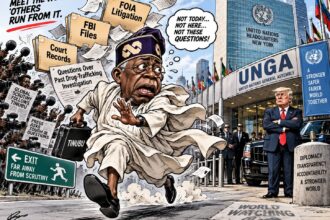
The United States Drug Enforcement Administration has defended its decision to withhold portions of investigative records connected to a criminal investigation involving Nigerian President Bola Ahmed Tinubu, citing the need to protect confidential sources, investigative methods and other sensitive law-enforcement information.
The position was contained in a September 23, 2026 filing by the United States government before the United States District Court for the District of Columbia in a Freedom of Information Act lawsuit filed by American transparency activist Aaron Greenspan.
The case, Aaron Greenspan v. Executive Office for U.S. Attorneys et al., concerns requests for records relating to Tinubu and other individuals in connection with a US investigation into an alleged international drug-trafficking and money-laundering operation dating to the early 1990s. A 2025 ruling in the case confirms that Greenspan had submitted multiple FOIA requests to the FBI, DEA and other US government agencies seeking investigative records concerning Tinubu and Abiodun Agbele, among others.
In its latest filing, the government defended the DEA’s reliance on exemptions under the US Freedom of Information Act to withhold portions of the records.
The filing refers to a declaration by DEA official Angela C. Davis, known as the Davis Declaration, as well as a Vaughn Index setting out the basis for particular withholdings.
Greenspan had challenged the DEA’s Vaughn Index, apparently arguing that some of the explanations provided for withholding information were repetitive or substantially similar.
The government rejected the criticism, explaining that the records consisted of similar categories of investigative documents.
Among the records identified are DEA-6 Reports, DEA-292 Reports and DEA-210 Reports, which are formal law-enforcement documents generated in the course of investigations.
According to the government’s argument, because the records belong to similar categories of investigative material, it is reasonable for the explanations supporting the withholding of information to contain similar reasoning.
The government’s position therefore does not amount to a disclosure of the contents of the investigative reports. Rather, it explains why similar categories of documents may receive similar treatment under FOIA.
One of the principal grounds cited by the DEA concerns information that could identify confidential sources.
The government said the agency had explained in the Davis Declaration why releasing such information could expose individuals who provided information to law enforcement.
The DEA maintained that information concerning confidential sources receives particularly strong protection under FOIA because disclosure could reveal the identity of people who assisted law-enforcement authorities.
The agency’s position is that releasing such information could expose confidential sources to unwanted attention or other consequences and potentially undermine the ability of investigators to obtain information from sources in future cases.
The government therefore argued that the public interest in disclosure does not outweigh the interests protected by the applicable FOIA exemptions in relation to confidential-source information.
The government also defended the DEA’s reliance on FOIA Exemption 7(E), which protects information that could disclose law-enforcement techniques and procedures not generally known to the public.
The filing indicates that some of the withheld material could reveal non-public details concerning investigative methods.
The government said Greenspan had challenged the withholding and sought access to additional material, including a redacted declaration submitted under seal.
The government maintained that the sealed material did not undermine the DEA’s reliance on the exemption, particularly because the underlying records arose from a criminal investigation involving an alleged drug operation.
The significance of the exemption is that disclosure of certain investigative methods could potentially reveal how law-enforcement agencies conduct surveillance, gather information or pursue particular investigative leads.
The latest filing must also be considered alongside an April 8, 2025 ruling by US District Judge Beryl Howell in the same case.
In that decision, Judge Howell addressed Greenspan’s FOIA requests for criminal investigative records concerning Tinubu and Agbele. The requests related to a federal investigation into an international drug-trafficking and money-laundering operation involving a Chicago heroin ring that operated in the early 1990s.
The court record states that Greenspan submitted requests to several federal agencies, including the FBI, DEA, CIA, Internal Revenue Service and Executive Office for US Attorneys.
The 2025 proceedings were significant because the FBI and DEA had initially used what is known as a “Glomar response” to certain requests. Under FOIA practice, a Glomar response allows an agency to refuse to confirm or deny whether responsive records exist when doing so could itself reveal protected information.
Judge Howell concluded that the agencies could not maintain their Glomar responses concerning Tinubu in the circumstances before the court because the existence of the relevant investigation had already been officially acknowledged.
The court specifically found that the FBI and DEA had previously acknowledged their involvement in investigations concerning Tinubu. It therefore ordered the agencies to lift their Glomar responses in relation to the relevant requests.
That ruling, however, did not order the wholesale release of every investigative document or establish that Tinubu committed a criminal offence.
The September 23, 2026 filing does not disclose the substantive contents of the DEA’s investigative records concerning Tinubu.
It does not state how many documents refer to Tinubu, what confidential sources told investigators, whether any source made allegations against him or whether investigators concluded that he had committed a crime.
Nor does the filing, by itself, establish that Tinubu was charged, convicted or found criminally liable in connection with the investigation.
The existence of investigative records and the government’s decision to withhold portions of them under FOIA exemptions are separate from any determination of criminal culpability.
The 2025 court ruling likewise dealt primarily with whether the agencies could refuse to confirm or deny the existence of records, rather than making a finding that Tinubu committed the conduct alleged in the underlying investigation.
The case remains part of a broader legal dispute over access to US government records concerning the investigation.
In August 2026, reports indicated that Tinubu had sought to prevent the release of records relating to the allegations, with his lawyers arguing that disclosure could infringe on his privacy rights.
Greenspan has continued to challenge government withholding and has sought access to records through the FOIA litigation.
The latest government filing represents the DEA’s legal defence of its redactions and withholding decisions. It argues that some information must remain protected because it could identify confidential sources or disclose non-public investigative techniques.
The central issue before the court is therefore not simply whether records concerning Tinubu exist, a matter already addressed in earlier proceedings, but how much of those records can lawfully be disclosed under the exemptions contained in US FOIA law.
As the litigation continues, any eventual release of additional documents could provide further information about the scope and nature of the investigation. Until such records are made public or the court makes further findings, the September 23 filing does not establish the substantive contents of the withheld material or criminal wrongdoing by Tinubu.
The case consequently remains focused on transparency, privacy and law-enforcement exemptions under US federal information-access law, with the court ultimately determining what portions of the records, if any, can be released.