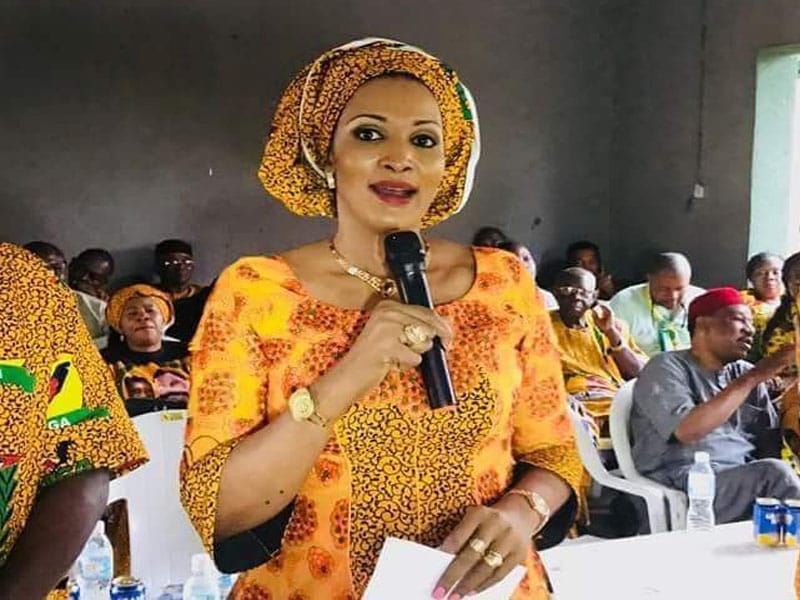
President Bola Ahmed Tinubu has approved the appointment of Bianca Odumegwu-Ojukwu as Nigeria’s new Minister of Foreign Affairs, elevating her from her previous role as Minister of State in the same ministry.
The development follows the resignation of Yusuf Tuggar, who stepped down from the position to pursue his governorship ambition in Bauchi State ahead of the 2027 general elections.
The announcement was made in a statement issued on Wednesday by the Special Adviser to the President on Information and Strategy, Bayo Onanuga, who outlined the rationale behind the reshuffle and the administration’s broader foreign policy objectives.
According to the statement, the President also nominated Sola Enikanolaiye as the new Minister of State for Foreign Affairs. The nomination is subject to confirmation by the National Assembly, in line with constitutional requirements.
Until his nomination, Enikanolaiye served as Senior Special Assistant to the President on Foreign Affairs and International Relations, a role in which he was closely involved in shaping aspects of Nigeria’s diplomatic engagements and international partnerships.
Odumegwu-Ojukwu’s elevation marks a significant step in her public service career, which spans diplomacy, politics, and international representation. She previously served as Nigeria’s Ambassador to Spain and later to Italy, where she played key roles in strengthening bilateral relations and advancing Nigeria’s interests in Europe.
Her initial appointment as Minister of State for Foreign Affairs in 2023 positioned her within the country’s diplomatic leadership structure, and her promotion to the substantive ministerial role is widely seen as a continuation of her contributions to Nigeria’s foreign policy framework.
She is also widely known as the widow of the late Chukwuemeka Odumegwu Ojukwu, a prominent historical figure in Nigeria’s political landscape. However, her career trajectory in diplomacy and governance has largely been defined by her own professional engagements and public service record.
The outgoing minister, Tuggar, had been in office since August 2023. His resignation aligns with a directive issued earlier by the Presidency through the Secretary to the Government of the Federation, which required ministers with political ambitions to vacate their positions before March 31. The policy was intended to ensure a clear separation between governance responsibilities and political campaigns ahead of the 2027 elections.
Tuggar is expected to focus on his gubernatorial bid in Bauchi State, where he aims to contest in the upcoming electoral cycle. His departure created the vacancy that led to Odumegwu-Ojukwu’s elevation.
Meanwhile, Enikanolaiye brings over three decades of diplomatic experience to his new role, pending Senate confirmation. His career in the Nigerian foreign service has included senior administrative and diplomatic assignments, positioning him as a seasoned technocrat within the ministry.
He has served as Permanent Secretary in the Ministry of Foreign Affairs and held diplomatic postings in several strategic global capitals, including Addis Ababa, Belgrade, Ottawa, London, and New Delhi. These assignments have exposed him to multilateral diplomacy, bilateral negotiations, and international policy coordination.
Analysts note that his extensive experience could provide institutional continuity and technical depth to the ministry, particularly as Nigeria seeks to recalibrate its foreign policy in response to evolving global dynamics.
In his remarks, President Tinubu stated that the appointments are part of a broader effort to reposition Nigeria’s foreign policy architecture. He emphasised the need for greater efficiency, strategic engagement, and stronger global partnerships in advancing the country’s national interests.
The President tasked both Odumegwu-Ojukwu and Enikanolaiye with prioritising economic diplomacy, a key pillar of his administration’s foreign policy agenda. This approach focuses on leveraging diplomatic channels to attract foreign investment, expand trade opportunities, and promote Nigeria’s economic growth.
He also urged them to work towards fostering regional stability, particularly within West Africa, where Nigeria plays a leading role in peacekeeping, conflict resolution, and regional integration initiatives.
In addition, the President highlighted the importance of safeguarding the welfare of Nigerians both at home and in the diaspora. This includes strengthening consular services, addressing issues affecting Nigerian citizens abroad, and enhancing the country’s global image.
Observers say the leadership changes at the Ministry of Foreign Affairs come at a critical time, as Nigeria navigates complex international challenges, including shifting geopolitical alliances, economic pressures, and security concerns.
The ministry is expected to play a central role in advancing Nigeria’s strategic interests, particularly in areas such as trade negotiations, climate diplomacy, regional security, and engagement with international organisations.
Odumegwu-Ojukwu’s appointment is also likely to attract attention in diplomatic circles, given her experience and visibility. Her tenure will be closely watched for how it shapes Nigeria’s engagement with key global partners and addresses emerging foreign policy priorities.
Similarly, Enikanolaiye’s potential confirmation is expected to reinforce the ministry’s operational capacity, combining political leadership with career diplomatic expertise.
As the administration moves to consolidate its foreign policy direction, the new appointments signal a blend of continuity and recalibration, aimed at strengthening Nigeria’s position on the global stage while aligning diplomatic efforts with domestic development goals.
With the 2027 elections on the horizon, the evolving composition of the federal cabinet also reflects broader political dynamics, as individuals with electoral ambitions reposition themselves and new actors assume strategic roles within government.
For now, attention will be focused on how the newly appointed leadership steers Nigeria’s foreign relations in an increasingly complex and interconnected world.