A deeply troubling case of alleged medical negligence has surfaced in Lagos, sparking outrage and renewed calls for accountability within Nigeria’s healthcare system. At the centre of the controversy is the death of Blessing Okolie, whose family claims she died as a result of a series of preventable medical errors following a surgical procedure.
The incident, which reportedly occurred at OAR Medical Centre in Ilepo, Abule Egba, has raised serious concerns about patient safety, professional standards, and emergency preparedness in private healthcare facilities. The family of the deceased is now demanding a full investigation and justice for what they describe as a tragic and avoidable loss.
According to a detailed account provided by a family member, Blessing Okolie underwent surgery on March 28, 2026, under the care of Dr. Abiodun Ojifinn. What was expected to be a routine medical procedure soon turned into a prolonged and painful ordeal.
Following the operation, Blessing reportedly experienced persistent and severe abdominal pain. Her condition was said to be accompanied by continuous swelling, raising concerns among her relatives. Despite these alarming symptoms, the family alleges that repeated requests for further diagnostic evaluation—particularly a scan—were either dismissed or ignored by the medical team.
The situation reportedly deteriorated over the next several days, with no significant improvement in her condition.
After nearly two weeks of worsening symptoms and mounting frustration, the family sought medical intervention outside the facility. It was during this external consultation that a scan was finally conducted.
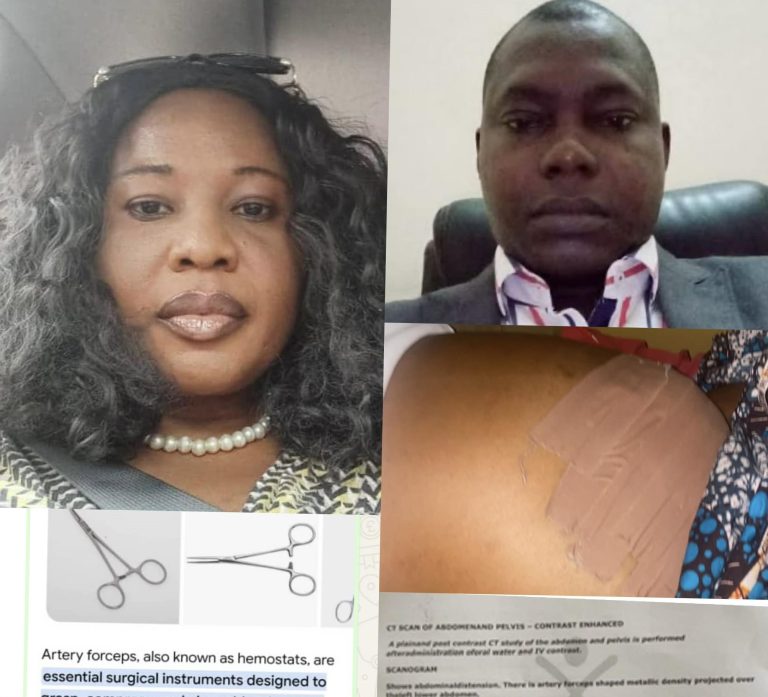
The results, according to the family, revealed a shocking discovery: a surgical instrument—identified as a pair of scissors—had been left inside Blessing’s body during the initial operation.
The revelation prompted immediate concern and anger from the family, who questioned how such a critical oversight could have occurred and remained undetected for over a week.
Rather than referring Blessing to a better-equipped facility, the hospital allegedly proceeded with a second surgery on April 7, 2026, to remove the object. The family claims this decision was made despite her visibly weakened condition and their insistence on seeking care elsewhere.
Following the second procedure, Blessing’s health reportedly worsened further. The family described ongoing complications, including severe swelling and general deterioration, coupled with what they perceived as poor communication and lack of transparency from the medical staff.
They also alleged that the attending doctor was absent for several days during a critical phase of her treatment, further compounding their concerns.
The situation reached a critical point on April 11, 2026. According to the family, the hospital experienced a power-related emergency while Blessing was on oxygen support. They claim the facility ran out of fuel, leaving her in a vulnerable state.
In what the family describes as a delayed and reluctant response, a referral was eventually issued—reportedly after intense pressure from relatives. However, they allege that no medical personnel accompanied Blessing during her transfer.
She was transported in the early hours of the morning, around 3 a.m., by a family member to Lagos State University Teaching Hospital (LASUTH), where she was admitted into intensive care.
Tragically, within 24 hours of her admission, Blessing Okolie was pronounced dead.
The case has raised a number of serious allegations that demand scrutiny. These include claims of gross medical negligence, failure to conduct timely diagnostic tests, and a critical surgical error involving a retained instrument.
There are also concerns about the hospital’s refusal to refer the patient to a more advanced facility when her condition deteriorated, as well as allegations of inadequate emergency preparedness, particularly regarding power supply and oxygen support.
Additionally, the family has questioned the continuity of care provided, citing the alleged absence of the attending physician during crucial moments.
In the wake of the incident, the family and concerned members of the public are calling on key regulatory and oversight bodies to intervene. These include the Medical and Dental Council of Nigeria, the Federal Ministry of Health, the Lagos State Ministry of Health, and the National Human Rights Commission.
They are also urging professional bodies such as the Nigerian Medical Association, alongside civil society organisations and healthcare advocacy groups, to demand accountability and ensure a transparent investigation into the circumstances surrounding the case.
Beyond the personal tragedy, this incident has reignited public discourse on the state of healthcare delivery in Nigeria. Experts note that cases involving retained surgical instruments, though rare, are globally recognised as serious medical errors that are largely preventable through strict adherence to surgical protocols.
If the allegations in this case are substantiated, it would point to systemic lapses not only at the facility level but potentially within broader regulatory oversight mechanisms.
Healthcare professionals are expected to uphold the highest standards of care, including proper surgical counts, timely diagnosis, and appropriate referral when necessary. Any deviation from these standards can have devastating consequences.
For the family of Blessing Okolie, the priority now is justice and accountability. They are demanding a full, independent investigation into the incident, with the aim of identifying all responsible parties and ensuring that appropriate sanctions are applied where necessary.
They also seek broader reforms to prevent similar occurrences in the future, emphasising that no family should have to endure such a loss under avoidable circumstances.
As the case continues to draw attention, it stands as a stark reminder of the importance of vigilance, transparency, and accountability in healthcare delivery.
Ultimately, the pursuit of justice for Blessing Okolie is not only about addressing one tragic incident—it is about safeguarding the lives of countless others who rely on the healthcare system with trust and hope.