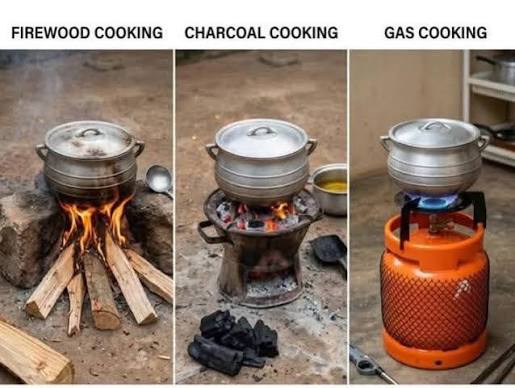
The sharp increase in the price of cooking gas across the Federal Capital Territory (FCT) is pushing many households and small businesses to abandon Liquefied Petroleum Gas (LPG) and return to traditional cooking fuels such as charcoal and firewood.
Over the past few months, the cost of cooking gas has risen dramatically, creating serious financial pressure on families, food vendors, and other small-scale entrepreneurs who rely on LPG for their daily activities. What was once considered a cleaner, more efficient, and affordable cooking option is increasingly becoming out of reach for many residents.
According to findings by the News Agency of Nigeria (NAN), the price of cooking gas in Abuja has climbed from around N1,200 per kilogram earlier in the year to approximately N2,000 per kilogram in many retail outlets. Industry stakeholders attribute the increase to a combination of supply shortages, rising depot prices, foreign exchange challenges, transportation costs, and broader economic pressures affecting the energy sector.
As prices continue to soar, consumers say they are being forced to seek cheaper alternatives in order to survive.
One of those affected is Mrs. Mayo Akinpelu, a food vendor operating in the Gwarimpa area of Abuja. She explained that repeated increases in gas prices made it impossible for her to continue relying on LPG for her business.
According to her, refilling a gas cylinder has become increasingly expensive, significantly reducing her profit margin and threatening the sustainability of her business.
“Refilling my gas cylinder became difficult because the price kept rising. I could no longer afford it and still make reasonable profit,” she said.
Akinpelu disclosed that she has now switched largely to charcoal and firewood, which she purchases in smaller quantities whenever needed.
“Right now, 12.5 kilograms of cooking gas costs about N25,000. Firewood and charcoal are not as convenient as gas, but they help me reduce operating costs and keep my business running,” she explained.
Although the alternative fuels sometimes slow down food preparation and attract complaints from customers, she believes they remain the most practical option under current economic conditions.
Another food vendor, Ms. Victory Samson, who operates in Dutse within the Bwari Area Council, expressed similar concerns. She said the rising cost of cooking gas has had a direct impact on her earnings.
“The increase has affected me greatly. My profit margin has reduced considerably because a significant portion of my income now goes into purchasing gas,” she said.
Samson called on government authorities to intervene and help stabilize prices, arguing that many small businesses are struggling to survive.
In Kubwa, Mrs. Grace Oluwatimilehin described her frustration after discovering that gas prices had increased again shortly after her previous purchase.
“The last time I bought gas, it was selling at N1,600 per kilogram. When I returned to refill my cylinder recently, the price had jumped to N2,000 per kilogram,” she said.
Unable to cope with the rising costs, she has adopted alternative cooking methods, including the use of electric hot plates and charcoal.
“I now combine different methods depending on what is available and affordable. Sometimes I use electricity, and other times I rely on charcoal and firewood,” she explained.
For many households, the increase in gas prices has become a major burden on already stretched family budgets.
Mrs. Abike Ojo, a mother of one, said the constant rise in cooking gas prices is making household management increasingly difficult.
“The last time I bought gas, it was N1,500 per kilogram, but now it has risen to N2,000. If this trend continues, I may stop using gas completely because it is becoming too expensive,” she said.
Ojo appealed to government authorities to take urgent steps to address the situation, warning that continued increases could worsen the cost-of-living crisis facing many Nigerians.
Gas vendors across Abuja also confirmed the significant rise in prices and acknowledged its impact on customer patronage.
Mr. Bamishile Bolanle, a gas retailer in Kubwa, said many customers now buy smaller quantities than they previously did because of reduced purchasing power.
“Gas currently sells for N2,000 per kilogram. The increase has affected our business because people simply cannot afford to buy as much as they used to,” he said.
According to him, product scarcity appears to be one of the major factors driving the price increase, although operators are not fully aware of the underlying causes.
Another gas vendor in Dei-Dei, Mr. Alfred Orshio, said the market has witnessed a gradual but consistent increase in prices throughout the year.
“Earlier this year, gas sold for around N1,200 per kilogram. It later rose to N1,400, then N1,800, and now N2,000. Filling a standard 12-kilogram cylinder now costs about N25,000,” he explained.
Orshio noted that many customers now purchase only a few kilograms at a time rather than filling their cylinders completely.
As consumers abandon cooking gas, sellers of alternative fuels are experiencing increased demand.
Mrs. Amina Yakubu, a charcoal distributor in Kubwa, said business has improved significantly in recent months.
“Patronage has increased because many people can no longer afford cooking gas,” she said.
Yakubu disclosed that she buys a bag of charcoal for N6,500 and sells it for around N8,000, adding that demand continues to rise daily.
Another charcoal seller, Mrs. Saratu Ibrahim, confirmed that sales have increased dramatically.
“What used to take more than a week to sell now finishes within two days,” she said.
However, she noted that the booming demand has attracted many new entrants into the charcoal business.
“I used to be the only charcoal seller on this street. Today, there are more than five of us because people see the growing demand,” she explained.
Firewood vendors are also recording increased patronage.
Mr. Taninu Ibrahim, a firewood seller, said many households and food vendors have turned to firewood because it remains one of the cheapest available cooking options.
“More people now buy firewood because cooking gas has become too expensive for many families and small businesses,” he said.
The increased demand has also driven up firewood prices.
“Before now, customers could buy six pieces of firewood for N1,000. Today, the same amount of money buys only four pieces,” he said.
According to Ibrahim, rising transportation costs and increased demand are responsible for the price increase.
As more Abuja residents return to traditional cooking fuels, concerns are growing about the environmental and health implications of increased charcoal and firewood consumption. Environmental experts have long warned that excessive dependence on firewood contributes to deforestation, while smoke from charcoal and wood fires can expose users to respiratory illnesses.
Despite these concerns, many residents insist that economic realities leave them with few alternatives.
Stakeholders have therefore called on the government to address supply challenges within the LPG sector and implement measures that will stabilize prices. They warn that if the current trend continues, more households and businesses may abandon cooking gas altogether, reversing years of progress toward cleaner energy adoption.
For many residents of the Federal Capital Territory, the rising cost of cooking gas has become yet another symbol of the growing economic pressures confronting ordinary Nigerians.