Fresh records from GovSpend, a civic technology platform that monitors and tracks Federal Government expenditure, have revealed that the Presidential Air Fleet (PAF) received no less than N4.24bn in disbursements between June and December 2025.
The latest figures, obtained from the GovSpend database and reviewed by The PUNCH, showed that the funds were paid into the Presidential Air Fleet naira transit account operated by the State House through eight separate transactions carried out across June, July and December 2025.
Analysis of the transactions indicated that most of the payments were concentrated in July 2025, when four separate disbursements amounting to about N2.43bn were made within one week.
The breakdown of the payments showed that the first transfer of N1.285bn was made on June 12, 2025. This was followed by another N430m payment on July 24. A day later, on July 25, another N1.28bn was disbursed into the same account.
Further payments included N92m transferred on July 29 and another N626m on July 31, making July the month with the highest volume of transactions during the period under review.
In December 2025, three additional disbursements were recorded. GovSpend data showed that N9m was transferred on December 18 and described as “Presidential Air Fleet forex transit funds.” Two more transfers followed at the end of the month — N343.9m on December 30 and N90.9m on December 31.
Interestingly, four out of the eight transactions contained no detailed description on the GovSpend portal and were simply marked “None,” a trend that observers say has become common in some government disbursement records linked to the Presidential Air Fleet.
Most of the payments captured on the platform were classified as “Forex Transit Funds,” a category commonly associated with foreign exchange obligations for overseas operations. Such expenses typically cover international aircraft maintenance, spare parts procurement, aviation fuel purchases abroad, crew training, insurance obligations and other operational services denominated in foreign currencies.
The latest figures have further increased concerns over the growing expenditure on the Presidential Air Fleet since President Bola Tinubu assumed office in May 2023.
Available records indicate that between July 2023 and December 2024 alone, no fewer than N26.38bn were spent on the operations and maintenance of the fleet. Of that amount, N14.15bn was reportedly disbursed in 2024 alone.
Budgetary allocations to the fleet have also remained significant in recent years. In the 2025 budget, the Presidential Air Fleet received a total allocation of N17.32bn. However, the allocation dropped slightly to N14.70bn in the 2026 fiscal year, largely because of reductions in projected capital expenditure.
A major component of the fleet’s expenditure profile has been aircraft engine overhauls and maintenance projects. Official figures showed that engine overhaul contracts gulped N4.58bn in 2024, while N8.65bn was allocated for similar purposes in 2025. Another N6.05bn was budgeted for engine-related projects in 2026, bringing the total three-year spending on engine maintenance to approximately N19.27bn.
The rising operational costs of the Presidential Air Fleet have mirrored a broader upward trend in federal spending on presidential aviation since the administration of former President Muhammadu Buhari.
Records dating back to 2017 showed that allocations to the fleet increased steadily over the years, except for a slight decline in 2020. From N4.37bn in 2017, the operational cost of the fleet reportedly rose to N20.52bn by 2024 — representing an increase of over 370 per cent within seven years.
Industry experts have linked the increase in expenditure to several factors, including the depreciation of the naira, the ageing nature of some aircraft in the fleet and rising security-related operational demands.
Speaking in an earlier interview, the General Secretary of the Aviation Round Table, Olumide Ohunayo, explained that maintenance and operational costs would naturally rise because most aviation services and aircraft components are priced in dollars.
According to him, the persistent depreciation of the naira against major foreign currencies has significantly affected aviation expenses.
“The cost will definitely increase over the years because of the exchange rate situation. Most of the expenses associated with aircraft maintenance, crew training and spare parts are paid in foreign currencies,” he said.
Ohunayo also noted that many of the aircraft in the fleet were no longer new and that ageing aircraft generally require more frequent maintenance and expensive technical checks.
“The older the aircraft, the higher the maintenance cost,” he added.
He further linked rising operational expenses to worsening insecurity across the country, noting that increased terrorism threats and security risks had also pushed up aviation insurance costs.
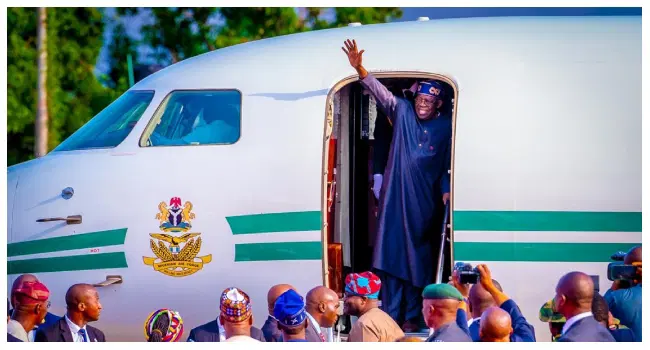
The debate over the state of the Presidential Air Fleet intensified in April 2024 after President Tinubu was forced to abandon one of the presidential aircraft during an official trip.
Tinubu had travelled aboard a state-owned Gulfstream G550 but reportedly encountered technical difficulties while in the Netherlands en route to Saudi Arabia. The incident compelled the President to complete his journey using a chartered private aircraft.
The development sparked renewed concerns about the condition and safety of the fleet and prompted the House of Representatives Committee on National Security and Intelligence to recommend the acquisition of new presidential aircraft.
Subsequently, in August 2024, the Federal Government replaced the presidential Boeing 737 Business Jet with an Airbus A330 acquired for about $100m through service-wide votes.
The aircraft, an ACJ330-200 with registration number VP-CAC, was described by presidential spokesman Bayo Onanuga as a more modern and cost-effective option capable of reducing maintenance and fuel expenses.
According to Onanuga, the aircraft featured advanced avionics, customised interiors and improved communication systems designed for presidential operations.
Between February and July 2025, President Tinubu reportedly relied on a San Marino-registered Boeing Business Jet with registration number T7-NAS while the newly acquired Airbus underwent modifications in South Africa.
Sources familiar with the development disclosed that the aircraft was temporarily flown abroad for repainting and redesign to reflect official presidential colours before returning to Nigeria in July 2025.
The Presidential Air Fleet currently comprises several fixed-wing aircraft, including the Airbus ACJ330-200, Gulfstream G550, Gulfstream G500, two Falcon 7Xs, a Hawker 4000 and a Challenger 605. Reports indicate that at least three of the aircraft are currently unserviceable.
The fleet also includes rotor-wing aircraft such as two Agusta 139 helicopters and two Agusta 101 helicopters operated by the Nigerian Air Force under the supervision of the Office of the National Security Adviser.
Reacting to concerns over the level of expenditure, the Chief Executive Officer of Centurion Security Limited, Group Captain John Ojikutu (retd.), defended the spending, saying aviation maintenance projects, especially major aircraft checks, are globally expensive.
According to him, costs associated with aircraft operations go beyond repairs alone.
“That figure is not unusual if you consider major maintenance checks. There are costs for ferrying the aircraft abroad, fuel, crew accommodation, insurance, catering and other logistics,” he explained.
Ojikutu added that international aviation standards require regular maintenance and safety compliance, particularly for presidential aircraft.
Despite the growing public scrutiny surrounding the air fleet’s expenses, the Presidency has yet to provide detailed explanations regarding the specific disbursements captured in the recent GovSpend records.
Efforts to obtain comments from the Special Adviser to the President on Information and Strategy, Bayo Onanuga, were unsuccessful as calls and inquiries were not answered as of the time this report was filed.
However, in an earlier interview, Onanuga defended the maintenance of the Presidential Air Fleet, insisting that the aircraft belong to the Nigerian state and not to President Tinubu personally.
“It is not President Tinubu’s plane; it belongs to Nigeria and Nigerians. The President did not buy a brand-new aircraft but a refurbished and newer model,” he said.
He stressed that ensuring the safety of the President remained a matter of national interest.
“Nigerians should prioritise the safety of the President. Nobody wants the President involved in an air accident. We want him safe to complete his tenure and hand over properly to whoever succeeds him,” Onanuga added.