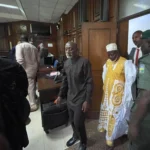
Two brothers from Ohio who constructed an elaborate false identity as wealthy Middle Eastern elites have been handed lengthy prison sentences for orchestrating a series of sophisticated fraud schemes that defrauded victims of approximately $21 million.
The brothers, Zubair Al Zubair and Muzzammil Al Zubair, aged 42 and 31 respectively, were sentenced on Tuesday, May 5, by Donald Nugent. Zubair received a 24-year prison term, while his younger brother, Muzzammil, was sentenced to 23 years behind bars. Their sentencing followed a detailed investigation and subsequent conviction that exposed years of calculated deception, financial manipulation, and abuse of public office connections.
Delivering judgment, Judge Nugent did not mince words in condemning the brothers’ conduct. He noted that their actions not only caused substantial financial harm to victims but also tarnished the image of their community. According to him, the brothers openly flaunted their ill-gotten wealth, parading luxury assets such as high-end vehicles and private jets in a manner that underscored the scale of their fraudulent enterprise.
Federal prosecutors revealed that the brothers built a carefully curated façade of immense wealth and global influence. Central to their scheme was the false portrayal of elite status. Zubair allegedly claimed he was married to a princess from the United Arab Emirates, while Muzzammil presented himself as a sophisticated hedge fund manager—despite having no formal financial training and relying largely on knowledge acquired from online videos.
Their deception extended beyond mere claims. The brothers lived extravagantly, acquiring luxury watches, maintaining a fleet of exotic cars, and traveling via chartered private jets to high-profile destinations including Aspen, Miami, London, Bucharest, and Madrid. Among their possessions were dozens of firearms and even a custom gold-plated rifle modeled after an AK-47, symbolizing the extent to which they indulged in their fabricated image of power and affluence.
Investigators established that between 2020 and 2023, the brothers executed multiple fraudulent schemes targeting individuals and investors. One of the victims was Zubair’s former girlfriend, reportedly from the United Arab Emirates, who lost approximately $737,000. Prosecutors said she was misled into believing in the brothers’ wealth and business credibility.
In a more significant scheme, the duo allegedly defrauded a Chinese investor of nearly $18 million. They reportedly convinced the investor that they owned an industrial complex and planned to develop a cryptocurrency enterprise on the site. This claim, prosecutors said, was entirely fabricated and formed part of a broader strategy to extract large-scale investments under false pretences.
A critical component of their operation involved the complicity of a public official. Michael Smedley, a 56-year-old former chief of staff to the mayor of East Cleveland, was found to have facilitated the brothers’ activities. In exchange for bribes and lavish gifts, Smedley allegedly used his official position to provide legitimacy and institutional backing to their schemes.
Smedley, who was also sentenced to over eight years in prison, reportedly received a range of benefits including cash payments, expensive meals, premium sports tickets, luxury cigars, and high-value food items such as Japanese wagyu beef. Prosecutors also noted that he was promised future employment opportunities as part of the arrangement.
In return, Smedley allegedly abused his office by attempting to secure state funding for the brothers’ ventures, issuing official city documents on their behalf, and even granting them police credentials. He also formally appointed Zubair as an “International Economic Advisor” for East Cleveland—a move that prosecutors argued was intended to lend credibility to their fraudulent claims.
The case culminated in a two-week federal trial, during which a jury found all three men guilty on multiple counts. These included conspiracy to commit bribery involving federally funded programs, conspiracy to commit honest services wire fraud, and conspiracy under the Hobbs Act.
In addition to these charges, the Al Zubair brothers were convicted of several counts of wire fraud, money laundering, and theft of government funds. Zubair faced an additional conviction for willfully failing to file tax returns, further compounding his legal troubles.
Legal analysts say the case highlights the increasing sophistication of fraud schemes that exploit perceptions of wealth, influence, and global connections. By presenting themselves as individuals of high social and financial standing, the brothers were able to gain the trust of victims and manipulate them into making substantial financial commitments.
Authorities also emphasized the role of corruption in enabling such schemes. The involvement of a public official not only facilitated the fraud but also undermined institutional integrity, raising concerns about oversight and accountability within local government structures.
The sentencing marks the conclusion of a high-profile case that underscores the severe consequences of financial crimes and public corruption. It also serves as a cautionary tale about the dangers of unchecked ambition, deception, and the misuse of public trust.
With all three individuals now convicted and sentenced, federal authorities say the case reinforces their commitment to prosecuting complex fraud operations and holding both private individuals and public officials accountable for their roles in criminal enterprises.