A diplomatic and sporting controversy is unfolding after a senior envoy to former U.S. President Donald Trump suggested that Italy national football team should replace Iran national football team at the upcoming FIFA World Cup.
The proposal, attributed to U.S. special envoy Paolo Zampolli, has drawn global attention, not only for its implications on international football governance but also for its intersection with geopolitics. According to reports, Zampolli described the idea as a “dream,” citing Italy’s storied football history and pedigree as justification for their inclusion despite their failure to qualify.
Italy, a four-time World Cup champion, recently suffered another setback after losing a tense qualification playoff, marking their third consecutive absence from football’s biggest stage. Their elimination, this time at the hands of Bosnia and Herzegovina via a penalty shootout, extended a disappointing run for a nation once regarded as a dominant force in global football.
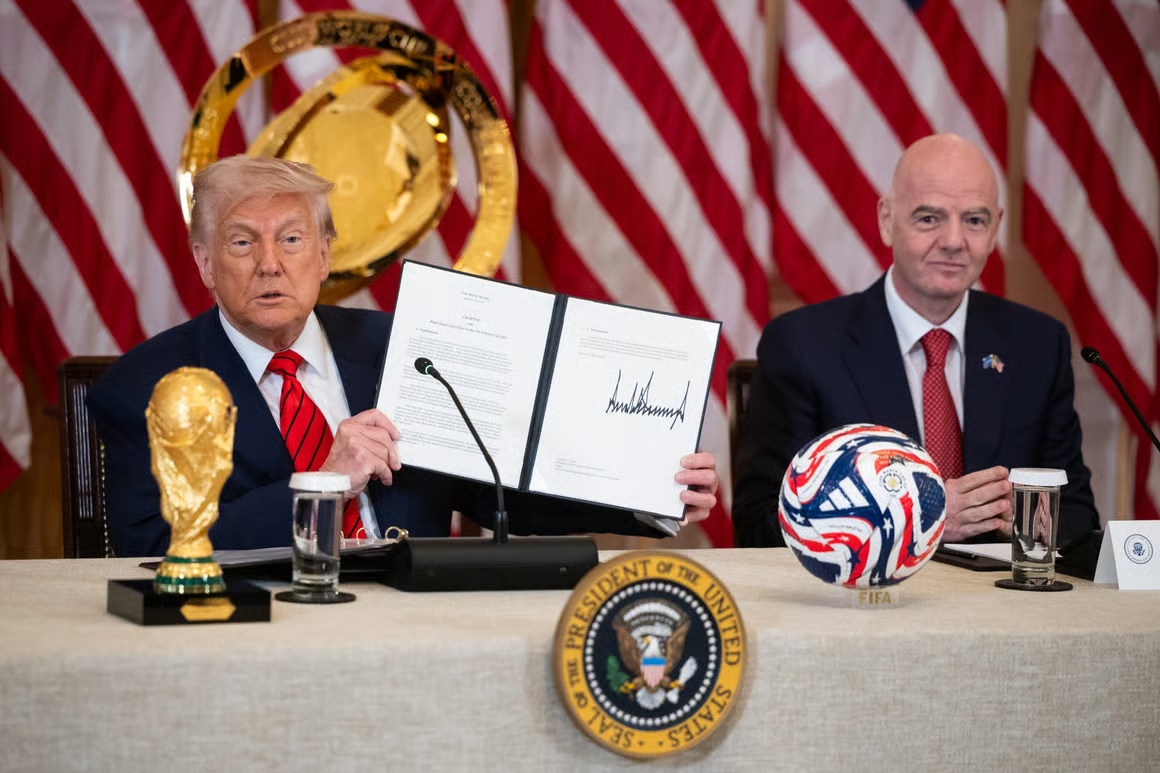
Zampolli reportedly conveyed his suggestion directly to Trump and Gianni Infantino, arguing that Italy’s legacy in the sport makes them a worthy substitute. “With four titles, they have the pedigree to justify inclusion,” he was quoted as saying, emphasizing both national pride and the symbolic value of having Italy compete in a World Cup hosted partly on U.S. soil.
However, the suggestion has raised significant questions about the integrity of international football competitions. The World Cup qualification process, overseen by FIFA, is built on merit-based performance across regional tournaments. Any deviation from this system—particularly one influenced by political considerations—would represent a fundamental shift in how teams earn their place in the competition.
Iran’s participation in the tournament has come under scrutiny due to escalating geopolitical tensions involving the United States and Israel. The conflict, which intensified earlier in the year, has created uncertainty around logistics, security, and diplomatic relations ahead of the tournament, which is scheduled to be jointly hosted by the United States, Mexico, and Canada.
In response to the tensions, the Football Federation Islamic Republic of Iran had earlier indicated it was in discussions with FIFA regarding the possibility of relocating Iran’s matches to Mexico. This proposal was aimed at mitigating potential complications arising from strained U.S.-Iran relations, particularly concerning travel restrictions and security concerns.
Despite these developments, Infantino has maintained that Iran remains part of the tournament lineup. Speaking during a recent international fixture, he reaffirmed FIFA’s position that all qualified teams would participate according to the official draw. “Iran will be at the World Cup and will play where they are supposed to be,” he stated, signaling the organization’s commitment to its established rules and processes.
The controversy surrounding Zampolli’s proposal also appears to have broader diplomatic undertones. Reports suggest the idea may have been partly motivated by efforts to mend relations between Trump and Giorgia Meloni. Tensions reportedly arose after Meloni publicly criticised Trump’s stance during the Iran conflict, including comments related to his criticism of Pope Leo XIV.
Zampolli, an Italian-American businessman and socialite, is known for his close ties to Trump and claims to have introduced the former president to his wife, Melania. His dual identity and connections to both American and Italian political circles have positioned him as an informal bridge between the two countries, though his latest intervention has sparked debate rather than consensus.
Football analysts and governance experts have been quick to dismiss the feasibility of the proposal. They argue that allowing a non-qualified team to replace a qualified one would undermine the credibility of the World Cup and set a dangerous precedent for political interference in sports.
Moreover, critics note that Italy’s recent struggles on the international stage reflect deeper structural issues within their football system, including inconsistent development pipelines and managerial instability. While their historical achievements are undeniable, current performance remains the primary criterion for World Cup qualification.
On the Iranian side, uncertainty persists as geopolitical tensions continue to evolve. The possibility of logistical adjustments, such as relocating matches, remains under consideration, but outright exclusion from the tournament appears unlikely under current FIFA regulations.
The episode underscores the increasingly complex intersection of sports, politics, and global diplomacy. As the 2026 World Cup approaches, stakeholders will be closely watching how FIFA navigates these pressures while maintaining the integrity of the competition.
For now, the governing body appears firm in its stance: qualification must be earned on the pitch, not negotiated off it.