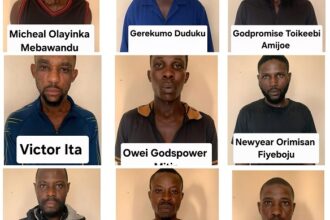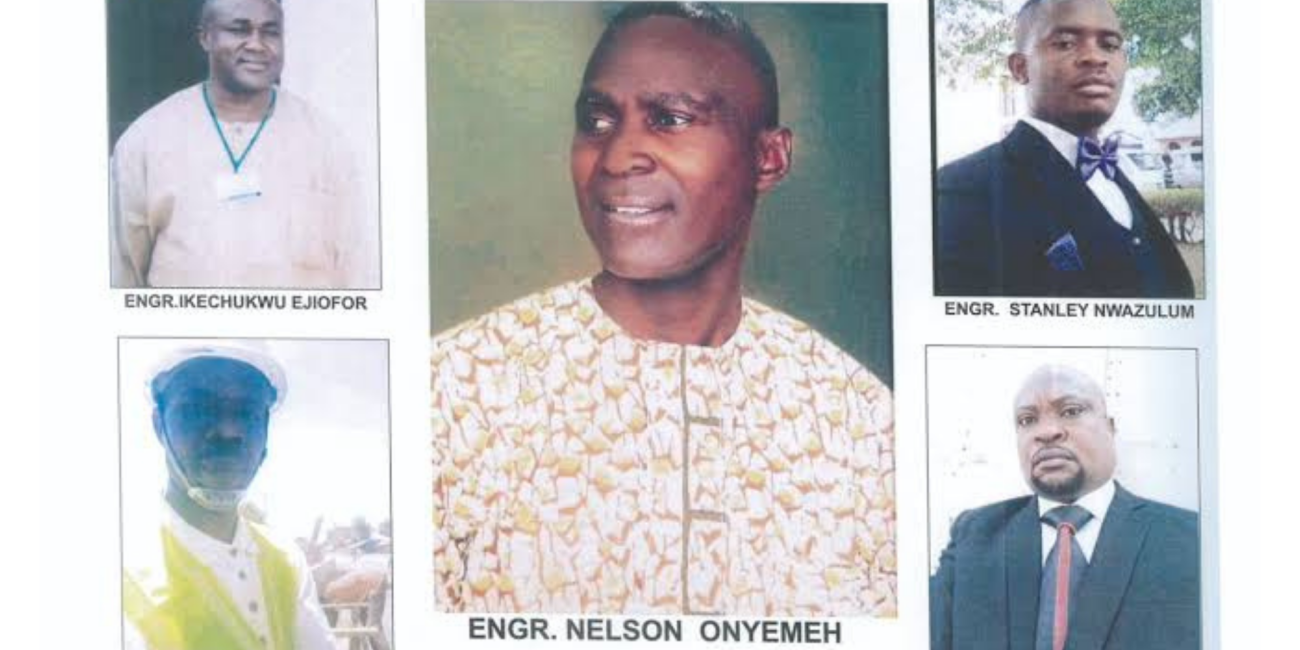
The families of five engineers who disappeared while supervising an African Development Bank (AfDB)-funded road project in Ebonyi State have petitioned the National Judicial Council (NJC), the Nigerian Bar Association (NBA), the National Assembly, the Ebonyi State Judicial Service Commission (JSC), the Ebonyi State House of Assembly and several civil society organisations, alleging serious judicial irregularities in the handling of the criminal case involving suspects accused of kidnapping their loved ones.
The petition follows the release of Certified True Copies (CTCs) of court proceedings, which the families obtained through the legal services of Falana and Falana Chambers. According to the petitioners, the court records reveal a sequence of events they believe raises grave concerns about the administration of justice, including the granting of bail on self-recognisance to suspects, the extension of amnesty by the Ebonyi State Government to some of the accused, and the repeated failure of the defendants to appear before the court, resulting in a stalled prosecution.
The five missing engineers, who were consultants with NELAN Consulting Limited, disappeared in 2022 while supervising the AfDB-funded Ring Road project in Ebonyi State. Their whereabouts remain unknown nearly four years after they were reported missing.
The missing consultants were identified as Engr. Nelson Onyemeh, the Chief Executive Officer of NELAN Consulting Limited from Ihiala, Anambra State; Engr. Ernest Edeani from Nkanu, Enugu State; Engr. Ikechukwu Ejiofor from Umunya in Anambra State; Engr. Samuel Aneke from Nkanu, Enugu State; and Engr. Stanley Nwazulum from Amawbia, Anambra State.
The certified proceedings relate to Charge No. HKW/7C/2022, titled The State v. Nweke Arinze & 5 Others, before the High Court of Ebonyi State, Ohaukwu Judicial Division.
According to the court records, proceedings in the case effectively stalled following the Ebonyi State Government’s decision to grant amnesty to some of the defendants.
During proceedings held on May 7, 2025, the Acting Deputy Director of Public Prosecutions, J.U. Chukwu, informed the court that the prosecution was unable to proceed because witnesses had become reluctant to testify following the government’s amnesty programme.
The court record quoted the prosecutor as saying: “Case is for hearing but we are not ready as our witnesses are trying their best to come owing to the amnesty granted the defendants.”
Despite the prosecution’s inability to proceed with the trial, Justice John Igboji admitted three of the defendants to bail on self-recognisance, noting that they were beneficiaries of the state’s amnesty initiative.
According to the ruling contained in the certified proceedings, “The three applicants who are said to be enjoying the amnesty of the Ebonyi State Government are admitted to bail on self-recognizances.”
The families expressed concern that after securing bail, the defendants repeatedly failed to attend subsequent court sittings.
The court records indicate that the accused persons were absent during proceedings conducted on May 8, May 22 and June 3, 2026, despite hearing notices having been issued to them.
Frustrated by the repeated absences, Justice Igboji ordered Senior State Counsel M. Ezike to personally appear before the court and explain the circumstances surrounding the defendants’ continued absence.
The court held: “For the third time, the Defendants are absent and I hereby order that M. Ezike Esq. – Senior State Counsel who informed this Court about the State granting amnesty to the Defendants only to keep away till date, to appear in Court on 24/06/2026 to explain himself.”
The records further reveal that the defence had earlier sought to have the names of the fifth and sixth defendants struck out of the charge on the grounds that there was no evidence linking them to the alleged offence.
However, the prosecution opposed the application, arguing that one of the defendants allegedly operated the Point of Sale (POS) terminal through which ransom payments connected to the alleged kidnapping were processed.
According to the prosecution, “The 5th Defendant is the POS Dealer through whom money exchanged hands for ransom.”
Delivering his ruling on March 8, 2023, Justice Igboji dismissed the application, relying on the Supreme Court’s decision in Agbo v. State.
The judge held that sufficient allegations existed to warrant a full trial, stating: “Having been fingered on the payment of the ransom for the kidnapping, I am of the firm view that the case ought to proceed for the duo to state their own sides of the story.”
All six defendants subsequently pleaded not guilty to the charges.
According to the families, their decision to obtain the court records followed comments made by the Minister of Works, David Umahi, during a protest staged by relatives of the missing engineers.
The minister had reportedly maintained that the consultants were killed during a communal clash in Ebonyi State and that those responsible had already been arrested and were standing trial.
Dissatisfied with that explanation, the families said they instructed their lawyers to obtain the official court records in order to independently verify the status of the prosecution.
The petitioners alleged that the process of obtaining the Certified True Copies exposed several disturbing developments.
According to them, court officials initially informed their legal representatives that the matter had only been mentioned once in 2022 when six suspects were arraigned and granted bail, with no further proceedings taking place thereafter.
They further claimed they were later informed that the case file could not immediately be located because it was allegedly in the possession of the trial judge.
The families stated that only after persistent follow-up by their lawyers were the records eventually produced, revealing what they described as inconsistencies in the handling of the matter.
They also expressed concern that two of the six suspects were discharged after arraignment on the grounds that no prima facie case had been established against them, while three others were admitted to bail on self-recognisance before later benefiting from government amnesty.
The petitioners argued that the court records appeared inconsistent with earlier public statements made by the Minister of Works regarding the fate of the missing engineers.
According to them, while the minister publicly stated that the engineers had been killed, the charges before the court continued to relate to alleged kidnapping rather than murder.
The families further noted that despite repeated public assertions that the engineers had died, neither their bodies nor any physical evidence confirming their deaths had ever been recovered.
They questioned whether the granting of bail and subsequent amnesty to suspects before the commencement of trial was consistent with established legal principles and due process.
In their petition, the families called on the National Judicial Council, the Ebonyi State Judicial Service Commission, the Nigerian Bar Association, the National Assembly, the Ebonyi State House of Assembly and relevant civil society organisations to investigate the circumstances surrounding the case.
They urged the relevant institutions to examine the judicial proceedings, the grant of amnesty, the administration of the prosecution and any institutional actions that may have contributed to the prolonged delay in the trial.
The families maintained that a thorough and transparent investigation was necessary not only to determine the fate of their missing relatives but also to preserve public confidence in Nigeria’s judicial system and the administration of criminal justice.