United States President Donald Trump has rejected a proposal from Iran to reopen the strategically important Strait of Hormuz within seven days, adding fresh uncertainty to diplomatic efforts aimed at ending the prolonged conflict between Washington and Tehran.
The proposal was announced by Iranian Foreign Minister Abbas Araghchi on the sidelines of the 81st United Nations General Assembly in New York. Under the plan, Tehran said it was prepared to restore normal maritime traffic through the waterway if Washington met a series of conditions, including ending its naval blockade and lifting sanctions on Iranian oil.
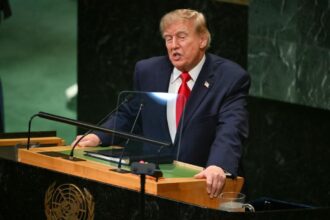
Trump confirmed on Saturday that he had rejected the proposal, according to reports from the White House and international media.
The Iranian proposal was communicated to the United States through Qatar, which has been involved in mediating contacts between the two sides.
Araghchi said the plan provided a seven-day timetable for de-escalation, reopening the Strait of Hormuz and resuming negotiations over Iran’s nuclear programme.
“Iran has conveyed to the United States, through Qatar, a concrete seven-day plan,” Araghchi said. He added that the waterway could be reopened and normal maritime passage restored within seven days if the required conditions were met.
The Iranian foreign minister said Tehran’s demands were based on commitments contained in a memorandum of understanding reached between Iran and the United States in June.
Among the conditions was an end to hostilities across the region during the seven-day period, including fighting in Lebanon. Iran also demanded the lifting of US sanctions on its oil exports, the release of more than $12 billion in frozen Iranian assets and an end to the US naval blockade of Iranian ports.
Araghchi said the measures expected from Washington were not new demands but commitments already contained in the earlier memorandum.
He explained that once the United States accepted the proposal, Washington would have several days to implement the required measures, after which the Strait of Hormuz could be reopened and negotiations on a broader agreement could resume.
The proposal came after renewed diplomatic contacts between Washington and Tehran during the UN General Assembly. Qatar has served as an intermediary, transmitting messages between the two governments as they explore possible avenues for ending the conflict.
The United States had acknowledged that diplomatic contacts were continuing, with an American official describing discussions through mediators as positive and constructive. However, Washington also indicated that it was not under pressure to accept Tehran’s proposed timetable.
Iranian President Masoud Pezeshkian, who attended the UN General Assembly, has also maintained that Tehran remains open to negotiations.
Pezeshkian said Iran had not abandoned diplomacy but had become distrustful of Washington because of previous experiences.
“Iran has not walked away from the negotiating table, but given past experiences, it no longer trusts the United States,” he said, according to Iranian state media.
The disagreement over the Strait of Hormuz has become one of the most important elements of the confrontation between the two countries.
The waterway, located between Iran and Oman, is a major route for international energy shipments. A significant proportion of the world’s oil and liquefied natural gas transported by sea passes through the strait, making any disruption potentially significant for global energy markets and shipping.
Iran has asserted its authority over maritime movement through the waterway during the conflict, while the United States has sought to maintain freedom of navigation and challenge restrictions on international shipping.
The standoff has also affected commercial shipping, with vessels facing increased risks and uncertainty over passage through the waterway. Reuters reported earlier that Iran had expressed willingness to reopen the strait if Washington reduced military pressure and lifted its blockade.
Trump’s rejection of the seven-day proposal represents another setback for efforts to establish a negotiated framework between Washington and Tehran.
According to reports, Trump has expressed scepticism about whether Iran would fulfil commitments demanded by the United States. Washington has continued to insist on conditions concerning the Strait of Hormuz and Iran’s nuclear programme.
Trump also posted an image on his Truth Social platform depicting a map of the Strait of Hormuz with the words “Trump Strait,” a move that drew further attention to the dispute over control and access to the waterway.
Iranian officials have meanwhile maintained that they will not accept what they regard as coercion or threats.
A spokesman for Iran’s Revolutionary Guard, Hossein Mohebi, said Tehran would continue its response to Washington until Iran’s conditions were met, according to Iran’s Tasnim news agency.
Despite the rejection, diplomatic contacts have not completely broken down. Iranian officials have continued to signal willingness to negotiate, while US officials have acknowledged ongoing discussions through intermediaries.
The immediate issue remains whether Washington and Tehran can agree on conditions for de-escalation, particularly over sanctions, military activity, the Strait of Hormuz and Iran’s nuclear programme.
For now, Trump’s rejection of the seven-day roadmap leaves the proposed timetable inoperative and raises further questions about the next stage of the conflict.
With the Strait of Hormuz remaining a major flashpoint and diplomatic channels still open, attention is likely to remain focused on whether the two sides can narrow their differences sufficiently to return to formal negotiations.