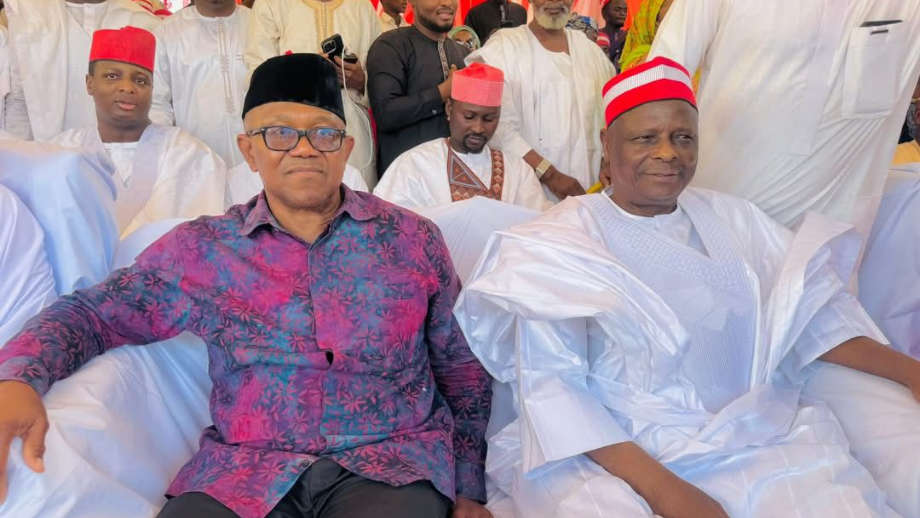
Strong indications have emerged that former presidential candidate Peter Obi and former Kano State governor Rabiu Kwankwaso are on the verge of exiting the African Democratic Congress for the Nigeria Democratic Congress NDC, in what could mark a significant shift in Nigeria’s opposition landscape ahead of the 2027 general elections.
The development was confirmed by the Kwankwasiyya movement, a political bloc loyal to Kwankwaso, which disclosed that the decision had already been finalised and that formal defection is expected to take place next week.
Speaking to TheCable, the spokesperson of the movement, Habibu Mohammed, revealed that the move followed extensive consultations among stakeholders within the Kwankwasiyya political structure. According to him, the decision to leave the ADC and align with the NDC was reached through a unanimous endorsement by key leaders and supporters.
Mohammed noted that the planned defection reflects broader strategic considerations within opposition circles, particularly as political actors continue to realign ahead of the next election cycle. He described the decision as both deliberate and necessary, aimed at strengthening political positioning and creating a more viable platform for future electoral contests.
Although details of Peter Obi’s exact role in the planned transition remain less explicit, sources within the emerging coalition suggest that discussions involving the former Anambra State governor have been ongoing for weeks. Obi, who has remained a central figure in opposition politics since the 2023 presidential election, has consistently emphasised the need for unity, reform, and a shift toward issue-based governance.
Political analysts say the potential joint movement of Obi and Kwankwaso into the NDC could significantly alter the configuration of opposition forces. Both men command substantial followings across different regions—Obi in the South-East and parts of the South-South, and Kwankwaso in the North-West—making any coordinated political move between them a development of considerable national importance.
The ADC, which had recently positioned itself as a coalition platform for opposition figures, may face renewed internal challenges if the defection materialises. The party has been grappling with leadership disputes and factional tensions, issues that have complicated efforts to build a unified front against the ruling party.
Observers note that the departure of high-profile figures such as Kwankwaso—and potentially Obi—could weaken the ADC’s standing as a credible coalition vehicle. At the same time, it may provide an opportunity for the NDC to emerge as a new focal point for opposition mobilisation.
The NDC, though relatively less prominent in previous electoral cycles, appears to be positioning itself as an alternative platform capable of accommodating diverse political interests. The anticipated influx of influential political actors could boost its visibility and organisational strength, particularly if accompanied by broader coalition-building efforts.
Within the Kwankwasiyya movement, the decision to move to the NDC is being framed as a strategic recalibration rather than a retreat. Supporters argue that the new platform offers better prospects for cohesion, discipline, and electoral competitiveness.
“This is not just about leaving a party; it is about moving to a structure that aligns with our long-term political vision,” a source within the movement indicated, echoing sentiments expressed by Mohammed.
For Obi, the move—if confirmed—would represent another phase in his evolving political journey, characterised by coalition-building and efforts to reshape Nigeria’s opposition politics. Since 2023, he has engaged in a series of consultations with political stakeholders across the country, consistently advocating for a more united and purpose-driven opposition.
Kwankwaso, on the other hand, brings with him a well-established political machinery, particularly in Kano and neighbouring states. His Kwankwasiyya movement remains one of the most organised grassroots political networks in Northern Nigeria, capable of mobilising significant electoral support.
The convergence of these two political forces within a single platform could create new dynamics, especially in a political environment where fragmentation has often weakened opposition effectiveness.
However, the proposed defection also raises questions about ideological alignment, party structure, and leadership within the NDC. Analysts caution that while mergers and defections can generate momentum, sustaining unity requires clear agreements on policy direction, internal democracy, and power-sharing arrangements.
As of the time of this report, neither Obi nor Kwankwaso has issued a formal public statement confirming the move. Nonetheless, the confirmation from the Kwankwasiyya movement adds weight to the speculation and suggests that an official announcement may be imminent.
The coming days are expected to provide greater clarity on the situation, including the terms of the defection, the roles to be played by key actors, and the broader implications for Nigeria’s political landscape.
If finalised, the move could mark one of the most consequential opposition realignments in recent times, potentially reshaping alliances and strategies ahead of the 2027 elections.