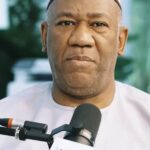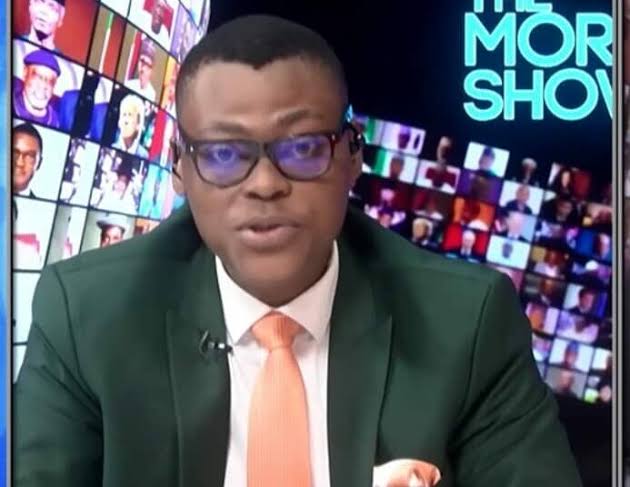
Arise Television anchor Oseni Rufai has vowed to remain committed to holding public officials and those in positions of authority accountable, despite criticism, opposition and attempts to discourage him from expressing his views on issues affecting Nigeria.
Rufai made the declaration while reacting to the controversy that followed a heated exchange between him and Lere Olayinka, media aide to Federal Capital Territory Minister Nyesom Wike, during a live edition of Arise Television’s The Morning Show on Friday.
The confrontation attracted considerable attention after the discussion between the journalist and the guest became tense, eventually forcing the programme to be brought to an abrupt end.
Following the incident, Rufai took to his verified X account to thank Nigerians who contacted him with messages of support and encouragement.
The controversy reportedly began when Rufai asked Olayinka to respond to the inclusion of former Minister of Humanitarian Affairs, Betta Edu, in a presidential campaign council despite allegations of corruption previously levelled against her.
Rather than address the question directly, Olayinka shifted the discussion to Rufai’s previous use of the Yoruba expression “Gbewudani”, taking issue with the journalist over the comment.
Olayinka subsequently told Rufai that he was unwilling to answer questions directed at him by the anchor.
“I don’t want to answer any question from you, Oseni Rufai. I want this conversation to be among reasonable human beings,” Olayinka said during the programme.
The exchange created tension on the set and prompted another anchor, Ayo Mairo-Ese, to intervene.
Mairo-Ese reminded the guest that The Morning Show has three anchors and that guests appearing on the programme should expect to respond to questions from any of the presenters.
Despite the intervention, Olayinka maintained his position and declined to engage Rufai.
The disagreement eventually disrupted the interview, leading to the programme being cut short and the discussion brought to an end.
Reflecting on the incident afterwards, Rufai indicated that the criticism would not make him abandon his approach to journalism or his willingness to challenge those in positions of power.
He argued that speaking against perceived injustice is not always a popular position and that journalists and citizens who seek accountability should be prepared to face resistance from people who disagree with them.
Rufai drew an analogy with the experience of the late labour leader, Pa Michael Imoudu, during the 1945 general strike, using the historical episode to illustrate how individuals who challenge an established system can encounter opposition from both those in authority and people who benefit from that system.
According to Rufai, Imoudu’s experience demonstrated that resistance to oppression does not always come exclusively from those exercising power. He suggested that people who benefit from an existing system may also defend it because they fear losing the advantages associated with the status quo.
“It takes a trained mind to see oppression,” Rufai said, stressing his determination to continue speaking out on issues he believes deserve public scrutiny.
He added that he would continue to “speak truth to power” despite opposition from individuals he believes benefit from what he described as the deterioration of Nigeria.
“For those benefiting from the ruination of Nigeria, we will never agree, and we ought not to,” he said.
Rufai’s comments have placed the broader issue of the role of journalists in a democratic society back in the spotlight. Journalists are expected to question public officials, scrutinise government policies and provide platforms where those in authority can be held accountable.
At the same time, political figures and their representatives often face difficult questions concerning their decisions, affiliations and public records. Such exchanges can sometimes become contentious, particularly when questions touch on allegations of misconduct, corruption or political accountability.
The incident involving Rufai and Olayinka therefore reflects the increasingly heated nature of political discourse in Nigeria as the country approaches the 2027 general elections.
With political parties, public officials and their supporters already positioning themselves for the next electoral contest, media platforms are expected to play an important role in questioning political actors and examining competing claims.
Rufai’s response suggests that he intends to maintain his approach despite the backlash that may accompany it.
His position is that journalists should not allow pressure, criticism or disagreements with guests to prevent them from asking difficult questions or scrutinising those entrusted with public responsibility.
The episode has also generated renewed discussion about the importance of civility and mutual respect during political interviews. While journalists have a responsibility to ask probing questions, public officials and political representatives also face the challenge of responding to difficult issues without allowing disagreements to derail public conversations.
For Rufai, however, the controversy appears unlikely to change his position. He has made it clear that he intends to continue challenging what he considers injustice and holding people in authority to account, regardless of whether such a position attracts applause or opposition.
As Nigeria moves towards another politically significant electoral cycle, such confrontations are likely to remain part of the country’s increasingly intense public discourse, particularly as journalists, politicians and citizens debate the direction of the nation and demand greater accountability from those in power.