Former Labour Party vice-presidential candidate in the 2023 general elections, Senator Datti Baba-Ahmed, has accused President Bola Tinubu’s administration of being more oppressive than the military regimes of former military rulers Ibrahim Babangida, Sani Abacha and Abdulsalami Abubakar.
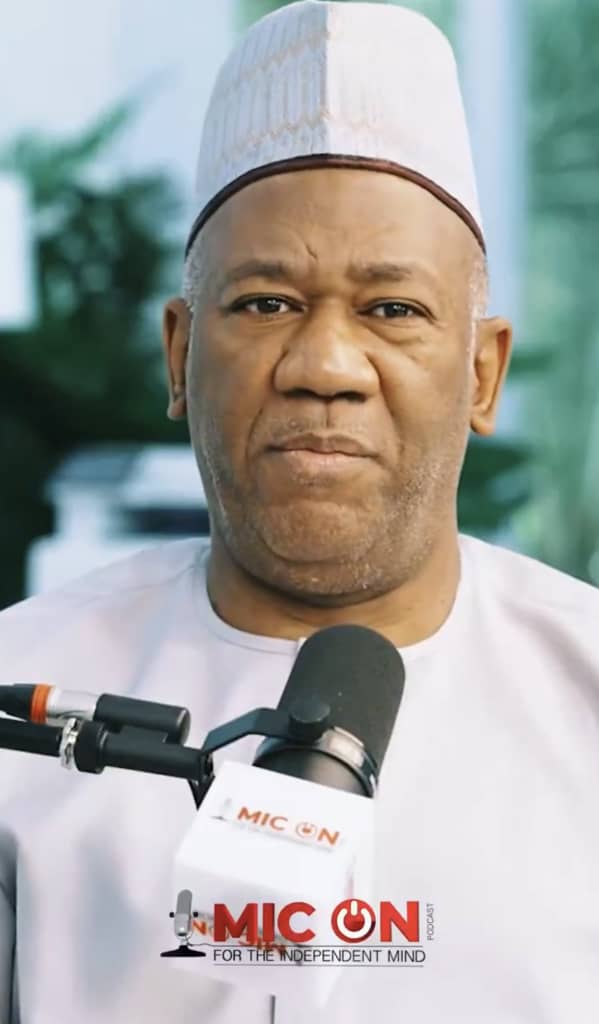
Baba-Ahmed made the claim while speaking on The Mic-On Podcast, hosted by Seun Okinbaloye, where he also urged President Tinubu not to seek re-election in the 2027 presidential election.
According to the former senator, the next presidential election should not simply be viewed as a contest between political parties or individual politicians but as a struggle between the incumbent administration and Nigerians seeking a fundamentally different political system.
He alleged that the Tinubu administration had relied heavily on what he described as “brute civil force,” accusing the government of using state institutions to suppress political opposition, dissent and alternative political voices.
Baba-Ahmed argued that the concentration of political authority under the present administration was unprecedented, insisting that some former military rulers, despite governing Nigeria under authoritarian conditions, demonstrated greater respect for constitutional principles.
“Is it because we have an individual, because we have a civilian, that civilian is more than a maximum ruler? Because the person ruling Nigeria today is doing what even military rulers did not do,” he said.
The former senator specifically compared the Tinubu administration with the regimes of Babangida, Abacha and Abubakar.
He acknowledged that the military rulers were dictators but argued that they operated with a level of discipline and restraint that he believes is lacking under the current civilian administration.
“The military was so disciplined. They respected the Constitution. They had shame. They had principles. They had scruples. But now it is brute civil force. That’s what we’re experiencing in Nigeria,” he said.
Baba-Ahmed consequently advised President Tinubu to prepare to leave office at the end of his current tenure rather than seek another term in 2027.
“I would simply advise ‘Uncle’ to please prepare to hand over and move away,” he said, adding that his position was not necessarily an endorsement of any of the politicians currently positioning themselves to contest the presidency.
The former Labour Party vice-presidential candidate was particularly emphatic that he did not believe the existing political class represented the fundamental change Nigeria needs.
When asked whether his criticism also applied to Peter Obi, his running mate on the Labour Party presidential ticket in 2023, Baba-Ahmed answered in the affirmative.
“None of that pack. Tinubu should leave the stage. All those people contesting against him, too, they were all in bed together at some point or another,” he said.
“Including Peter Obi,” he added when specifically asked about the former Labour Party presidential candidate.
Baba-Ahmed explained that his position should not be interpreted as support for any particular politician. Rather, he said Nigeria needs what he described as “a whole new Nigeria” and a political leadership that breaks away from the established political order.
He challenged Nigerians to identify a prominent politician who had never been associated with one of the country’s major ruling parties.
“Tell me one politician who has never been in a ruling party. Tell me,” he said.
The former senator also criticised the National Assembly, alleging that the legislature has become excessively close to the executive and has failed to maintain the independence expected of a democratic parliament.
He particularly objected to lawmakers publicly singing political songs in support of President Tinubu, arguing that such conduct compromises the independence and dignity of the legislature.
“A legislature must never be that compromised to the level of singing for those who are members of their party. Singing ‘On your mandate we shall stand,’” Baba-Ahmed said.
He added that if he were still a member of the House of Representatives, he would have taken steps to prevent such conduct.
According to him, the legislature has a constitutional responsibility to provide effective checks and balances on the executive rather than simply supporting the government because of partisan affiliation.
Baba-Ahmed also revisited the controversial 2023 presidential election, reiterating his long-standing position that the Labour Party ticket of Peter Obi and himself won the election.
He alleged that the electronic transmission and reporting of results through the Independent National Electoral Commission’s IReV platform was interrupted during the election and argued that constitutional provisions were breached.
“From outside government, you had switched off IReV. From outside government, it was switched off. The Constitution was breached,” he alleged.
He further questioned the circumstances surrounding the declaration of the presidential election result and raised concerns about the presence of the National Security Adviser in court during proceedings related to the election.
The former senator also questioned aspects of the judicial proceedings, including the circumstances surrounding the reading of a judgment, asking where the document originated and when it was received.
Baba-Ahmed has consistently maintained that the 2023 Labour Party presidential ticket secured victory and that there were constitutional grounds for challenging the process that eventually led to Tinubu’s inauguration.
Despite his strong criticism of the current political system, Baba-Ahmed rejected military intervention as a solution to Nigeria’s democratic challenges.
He argued that Nigerians should not respond to failures in democracy by abandoning democratic governance.
“The only option to bad democracy is good democracy,” he said.
Instead, he called for what he described as “legitimate, active civil engagement,” urging Nigerians to become more involved in political processes and demand accountability from their leaders.
He said citizens who desire change must be willing to sacrifice their comfort and participate actively in efforts to reform the country’s political system.
Baba-Ahmed also linked Nigeria’s persistent insecurity to corruption, arguing that addressing corruption would significantly improve the country’s security situation.
“How do you… Once you remove corruption, you have fought more than 50% of insecurity in Nigeria,” he said.
He called for increased investment in the armed forces, particularly in military equipment, personnel welfare and modern surveillance technology.
According to him, technology could enable Nigeria to monitor extensive sections of its borders from central command facilities.
“One individual sitting from a control command centre in Abuja can control a border of 1,000 kilometres with technology,” he said.
He also criticised the government over recurring attacks and abductions, particularly the kidnapping of students, arguing that Nigeria possesses sufficient resources and strategic importance to develop stronger systems for protecting its citizens.
On the administration’s economic policies, including the removal of fuel subsidy and foreign-exchange reforms, Baba-Ahmed argued that economic policies cannot succeed without a credible foundation of leadership, integrity and accountability.
He likened governance to the construction of infrastructure, saying the success of policies depends largely on the quality of the foundation upon which they are built.
“Those policies are supposed to rest on something. What is that thing? That is the character, content, principles, and philosophy of the leadership,” he said.
Baba-Ahmed maintained that even well-designed economic policies would fail if corruption remained deeply embedded in government.
“Whatever policy—however beautiful it is you bring—that is laced with corruption, it will never work,” he said.
Although he acknowledged that some Nigerians may have benefited from policies introduced by the Tinubu administration, he attributed such benefits largely to what he described as the president’s friends and political associates.
His comments come amid increasing political activity ahead of the 2027 general elections, as political parties and opposition groups seek to position themselves for a contest that is expected to attract intense competition.
Baba-Ahmed ultimately urged Nigerians to look beyond individual politicians and focus on building stronger democratic institutions capable of producing accountable and competent leadership.
For him, the central challenge facing Nigeria is not simply replacing one politician with another, but creating a political system in which institutions function independently, citizens participate actively and leaders are held accountable for their decisions and actions.