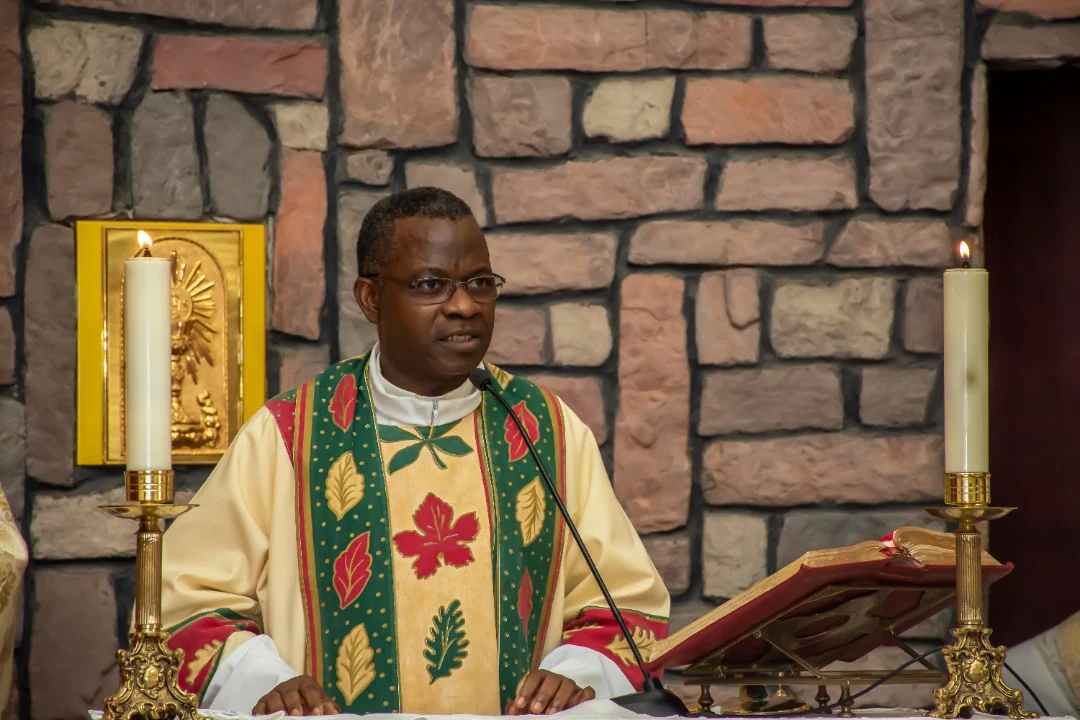
Fresh criticism has emerged against the administration of President Bola Tinubu following comments by prominent Catholic priest, preacher, and social commentator, Fr. George Ehusani, who condemned what he described as attacks on Archbishop Emeritus of Abuja, Cardinal John Onaiyekan.
Speaking during a church gathering in a video that has circulated widely on social media, Fr. Ehusani expressed displeasure over reactions from government officials and supporters following recent remarks made by Cardinal Onaiyekan concerning the state of the nation and the meeting between President Tinubu and members of the Catholic Bishops’ Conference of Nigeria (CBCN).
The cleric said he was “not happy” with the manner in which the respected Catholic leader had been criticised, insisting that public officials ought to show greater respect for senior national figures, especially religious leaders who have devoted decades to the service of the country.
Ehusani lamented what he considered a growing decline in respect for elders and moral authorities in public discourse. According to him, Cardinal Onaiyekan has spent many years contributing to national unity, interfaith dialogue, peacebuilding, and moral leadership, and should not be subjected to personal attacks for expressing his views on national issues.
In the widely shared video, the priest stressed that disagreement with a religious leader’s opinion should not degenerate into insults or attempts to discredit his character. He argued that the role of religious leaders includes speaking truth to power, offering moral guidance, and drawing attention to the suffering of ordinary citizens.
The controversy followed comments by Cardinal Onaiyekan after a recent meeting between President Tinubu and the Catholic bishops, during which the bishops raised concerns about insecurity, economic hardship, poverty, and governance challenges in Nigeria. Some government officials subsequently criticised the cardinal for discussing aspects of the meeting publicly, while others accused him of political bias.
Fr. Ehusani rejected such criticism, maintaining that the bishops were speaking on behalf of Nigerians experiencing hardship rather than acting as partisan political actors. He said the concerns raised by the bishops reflected the realities faced daily by millions of citizens across the country.
The priest also questioned why honest criticism of government policies should provoke hostility instead of reflection and corrective action. He urged leaders to listen to voices of conscience rather than surround themselves with people who tell them only what they want to hear.
Ehusani noted that religious leaders remain close to the people and are often among the first to hear complaints about hunger, unemployment, insecurity, and rising living costs. For that reason, he said their interventions should be regarded as valuable feedback rather than opposition.
The outspoken cleric further warned against creating an atmosphere in which citizens become afraid to express concerns about national problems. According to him, democracy thrives when people are free to speak honestly and when leaders are willing to accept constructive criticism.
He called on the Federal Government to focus on addressing insecurity, economic hardship, and social distress rather than engaging in disputes with respected clerics. He added that Nigerians expect practical solutions to their challenges, not attacks on those who highlight them.
Ehusani’s comments have added to the growing debate sparked by the bishops’ recent engagement with President Tinubu. Several political leaders, civil society groups, and religious organisations have since weighed in, with many defending the right of religious leaders to comment on national affairs.
The priest concluded by urging Nigerians to remain committed to truth, justice, and national unity, insisting that honest dialogue between government and citizens remains essential for the country’s progress.