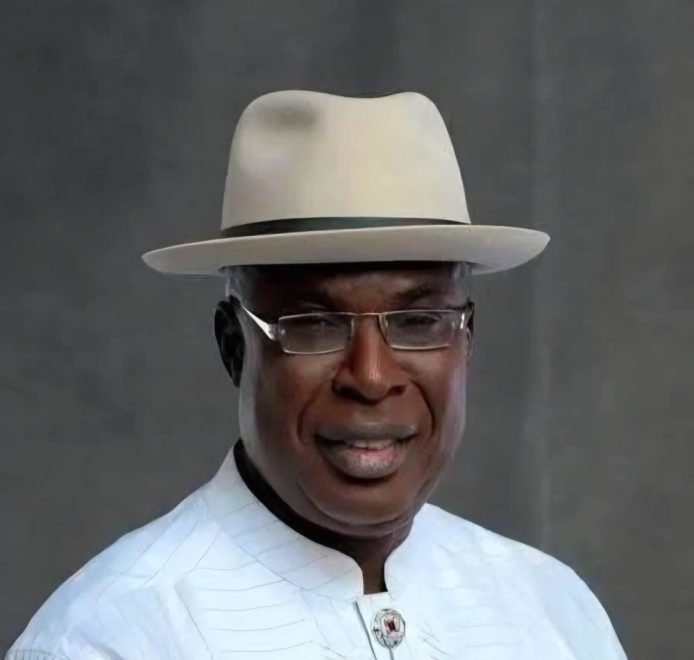
The Economic and Financial Crimes Commission (EFCC) has asked former Bayelsa State Governor and ex-Minister of State for Petroleum Resources, Timipre Sylva, to make himself available for questioning following his declaration as wanted over an alleged $14.86 million fraud.
The commission’s spokesperson, Dele Oyewale, confirmed the position on Monday while responding to allegations by Sylva that the anti-graft agency had become politically partisan and was operating more like an organ of the All Progressives Congress (APC) than an institution of the Nigerian state.
“He has been declared wanted; he should make himself available to the commission,” Oyewale said when asked to respond to the former governor’s allegations.
The development came on the same day Sylva announced his resignation from the APC, accusing the ruling party of abandoning the principles upon which it was founded and criticising the administration of President Bola Tinubu.
Sylva said he had forwarded a copy of his resignation letter to the EFCC, alongside copies sent to relevant officials of the APC.
The former governor’s resignation letter was addressed to the APC chairman of Ward 4 in Brass Local Government Area of Bayelsa State. The letter, dated August 31, 2026, was delivered electronically and copied to the national chairman of the APC, the chairman of the APC in Bayelsa State and the executive chairman of the EFCC.
Explaining his decision to leave the party, Sylva said he had consulted with members of his family, associates, colleagues and sympathisers before reaching the decision.
He described the APC as a “floundering ship” whose future, in his assessment, had been compromised by what he called an “irredeemable load of iniquities.”
Sylva, a founding member of the APC, said he was particularly disappointed by what he described as the erosion of the ideals that informed the creation of the party.
“As a founding member of the APC, and one who joined other well-meaning Nigerians in building the Party with sweat and money, it is deeply saddening to witness how the ideals we espoused have been so thoroughly and unrecognisably thwarted,” he stated.
He also criticised what he described as a political culture in which party leaders appeared to believe that “all is fair in politics.”
According to him, such an approach was inconsistent with basic standards of morality and decency.
“I cannot, in all good conscience, continue to belong to a Party whose leaders believe that ‘all is fair in politics;’ and have consistently demonstrated that belief in practice,” he said.
“All cannot be fair in any endeavour of life. The demands of basic decency and morality forbid it. Unfortunately, this mentality appears to underpin virtually every action, and even inaction, of this administration.”
Sylva also expressed dissatisfaction with the performance of the APC-led Federal Government, arguing that the administration had failed to meet the expectations of the majority of Nigerians.
“The present Government, formed under the banner of the APC we once loved, has disappointed the vast majority of Nigerians. And I can see neither a credible attempt nor any possibility of a revamp,” he said.
He said his decision to leave the party was influenced by his belief that Nigerians would use the next general election to seek a change in the country’s political direction.
“I am therefore left with no other choice than to jettison a floundering ship whose fate appears to have been sealed by its irredeemable load of iniquities,” Sylva stated.
He added that he believed Nigerians would “vote for Nigeria” in the forthcoming election and free the country from what he described as the current political “stranglehold.”
Sylva also used the resignation letter to directly accuse the EFCC of political bias.
He explained that he deliberately copied the anti-graft agency in the letter because, in his view, the commission had increasingly conducted itself as an organ of the APC rather than as an independent institution of the state.
“I am deliberately putting the EFCC in copy of this letter because, of late, it has conducted itself more as an organ of the APC than as an institution of State,” he wrote.
The former governor said he was aware that his decision to leave the APC could potentially result in intensified scrutiny or further action against him and his associates.
“I am fully aware that this action of mine may invite a redoubled witch-hunt against me and my associates, but that is a risk I am willing to take,” he stated.
The EFCC, however, has maintained that Sylva should present himself to the commission for questioning.
The agency’s position came against the backdrop of the alleged $14.86 million fraud for which the former governor was declared wanted.
The commission’s directive means that the immediate focus is likely to remain on Sylva’s willingness to respond to the EFCC’s invitation and on the next steps in the investigation.
Sylva’s political resignation and the EFCC’s demand for his appearance have consequently created a significant development involving one of the prominent figures in the APC and the former petroleum minister.
The former governor has framed his resignation primarily as a political and moral decision, citing what he described as the failure of the APC-led administration and the abandonment of the party’s founding principles.
The EFCC, on the other hand, has focused on its investigative mandate, maintaining that the former governor should make himself available to answer questions arising from the allegations against him.
The unfolding situation is likely to attract considerable political attention, particularly as Nigeria moves closer to the 2027 general elections.
Sylva’s decision to leave the APC could have political implications in Bayelsa and beyond, while the corruption allegations against him are expected to remain subject to the EFCC’s investigation and any subsequent legal proceedings.
For now, the former governor has not publicly indicated whether he will appear before the EFCC in response to its demand. The commission, however, has made its position clear: having declared Sylva wanted, it expects him to make himself available for questioning.