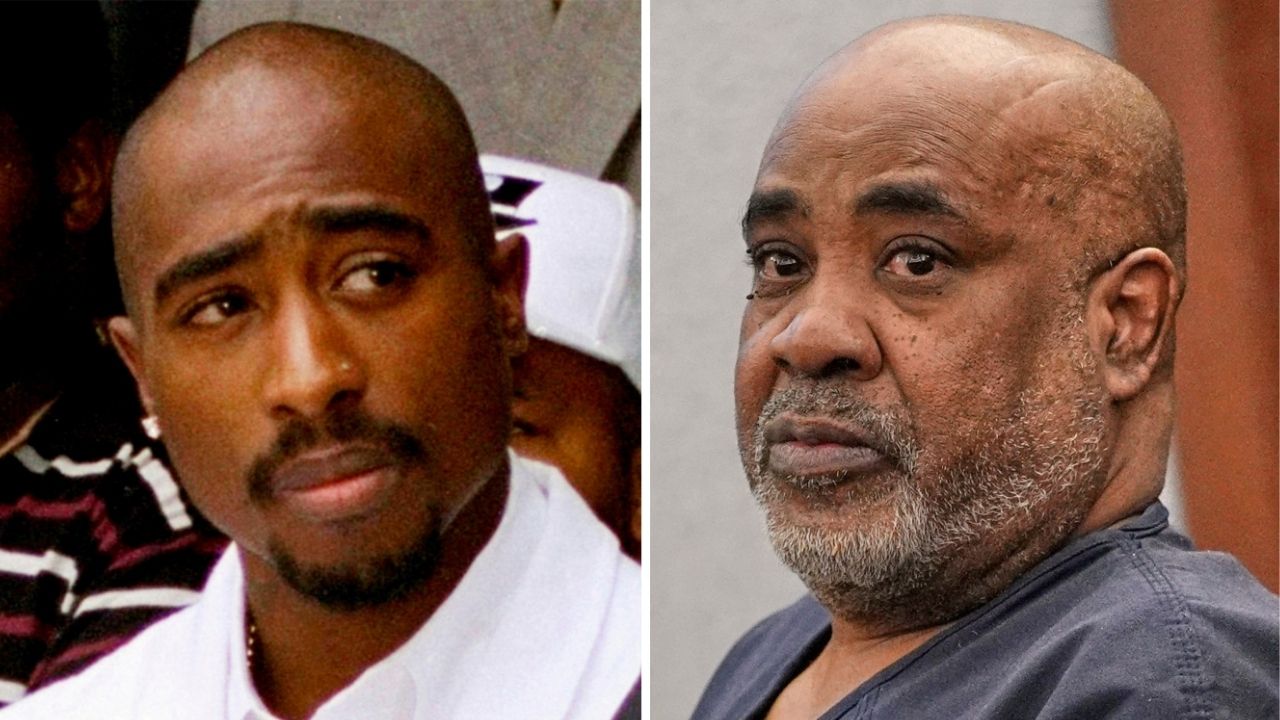
Duane “Keffe D” Davis, the former gang member accused of orchestrating the 1996 killing of hip-hop icon Tupac Shakur, has been found guilty of first-degree murder, bringing a nearly three-decade-old case to a dramatic conclusion.
Jurors returned the verdict on Monday, August 31, following a trial that lasted roughly two weeks and centred heavily on Davis’ own statements about the fatal shooting.
The 63-year-old Davis was the only person ever criminally charged in connection with Shakur’s murder. Prosecutors argued that although he was not the gunman, he played a central role in organising the attack that claimed the life of the celebrated rapper.
Davis now faces the possibility of life imprisonment following his conviction.
The verdict came after a jury comprising 10 women and six men heard testimony from about two dozen prosecution witnesses and three witnesses called by the defence.
During proceedings, prosecutors relied extensively on interviews, recordings and other public statements Davis had made over the years concerning Shakur’s death.
The case remained unsolved for decades before renewed attention was drawn to Davis following a series of public interviews and the publication of his 2019 memoir, in which he discussed aspects of the events surrounding the shooting.
Prosecutors alleged that the killing was carried out as an act of retaliation following a confrontation earlier on the night of September 7, 1996.
Shakur had been in Las Vegas to attend a heavyweight boxing match between Mike Tyson and Bruce Seldon at the MGM Grand. After the fight, he was travelling in a BMW driven by Death Row Records co-founder Marion “Suge” Knight.
According to the prosecution’s case, a white Cadillac carrying Davis and several other men pulled alongside the BMW at a red light near the Las Vegas Strip.
Gunfire was then directed at the BMW, striking Shakur multiple times.
The rapper was critically wounded and died six days later at the age of 25.
Knight survived the attack.
Prosecutors maintained that the shooting was linked to an earlier altercation at the MGM Grand involving Shakur’s entourage and Orlando “Baby Lane” Anderson, Davis’ nephew.
Chief Deputy District Attorney Binu Palal told jurors during closing arguments that the evidence showed the attack had been deliberately planned rather than being an impulsive act.
“It’s a plan, not an impulse,” Palal told the jury.
He argued that Davis had obtained a firearm and helped organise the attack after the confrontation involving his nephew.
Prosecutors also pointed to Davis’ changing accounts over the years, but maintained that one critical element remained consistent: his admission that he was inside the Cadillac during the shooting.
Palal told jurors that the group had initially searched for Shakur before encountering him on the road and making a U-turn near the Strip.
The prosecution also played portions of Davis’ previous interviews, including YouTube appearances in which he discussed the case and promoted his book.
According to prosecutors, Davis’ own public comments provided important evidence linking him to the planning of the attack.
A 2008 police interview played during the trial was particularly significant. In the interview, Davis reportedly said that he provided the gun used in the attack and that Anderson was the person who opened fire.
However, Anderson died in 1998 without ever being charged in connection with Shakur’s killing. Other men who were allegedly in the Cadillac have also died, leaving prosecutors with limited opportunities to obtain direct eyewitness testimony from the people who were present.
The defence challenged the prosecution’s interpretation of Davis’ statements and argued that his words should not be treated as reliable admissions of guilt.
Davis’ attorney, Michael Sanft, told jurors that his client’s public claims were examples of exaggeration and “braggadocio” intended to enhance his image and make money rather than truthful descriptions of what happened.
Sanft also emphasised the absence of physical evidence directly placing Davis inside the Cadillac at the time of the shooting.
The defence argued that the prosecution’s case was largely circumstantial and questioned why Davis had not been charged during the many years following Shakur’s death if investigators had sufficient evidence against him.
At one point during the trial, Sanft argued that authorities had not previously charged Davis because they knew he was unreliable.
The defence also fought unsuccessfully to have several of Davis’ previous statements excluded from the trial.
The jury was ultimately instructed that Davis had been charged under an indictment alleging an open murder charge, meaning jurors could consider whether the evidence supported first- or second-degree murder.
They ultimately convicted him of first-degree murder.
The prosecution’s case was built around the theory that Davis could be held responsible for Shakur’s death even though he did not personally fire the shots.
Palal emphasised this distinction while addressing the jury, making clear that the prosecution’s argument was that Davis organised and facilitated the attack.
“Let’s be clear, Duane Davis did not pull the trigger. But he did plan the shooting in retaliation of the beating of his nephew,” Palal said.
He added that the prosecution’s evidence would ultimately demonstrate Davis’ involvement through Davis’ own words.
“Now, 30 years later, we’re going to ask you to finally hold Duane Davis accountable,” Palal told jurors.
The conviction marks a major development in one of the most closely watched unsolved murders in music history.
Shakur, known professionally as 2Pac, was one of the most influential figures in hip-hop. His career combined commercially successful music with politically and socially charged themes, while his public feuds contributed to the intense rivalry between the East Coast and West Coast hip-hop scenes of the 1990s.
His death at 25 shocked the entertainment industry and generated numerous theories about who was responsible.
For years, investigators struggled to bring charges in the case, while speculation about the identity and motive of the attackers continued.
Davis’ eventual arrest and prosecution represented the first criminal case directly connected to Shakur’s killing.
With the jury’s guilty verdict now delivered, Davis faces a potential life sentence. The case nevertheless leaves a complex legacy, given the passage of nearly 30 years, the deaths of several individuals linked to the shooting and the prosecution’s reliance on Davis’ own historical statements.
The verdict closes a major chapter in the long-running investigation into Shakur’s death, while underscoring how statements made publicly years after a crime can eventually become central evidence in a criminal prosecution.